- Thursday, 28 May 2026

Ending The Sway Of Middlemen

Nepal's political development, including changes of all scales, always culminated in power-sharing among the major political forces and seeking support from the existing political and economic elite. They became so apathetic to the public issues that reports of all the review, reform and probe commissions were buried under massive political interest, and sometimes a collusion among the politicians, businesspersons and criminals didn't allow it to come out.
Public expectations for basic services like obtaining a passport, driving licence and National Identity Card (NID), reaching other locations on time, and having good health and education services were never addressed. Political 'bhagbanda' became a culture, and a few individuals played musical chairs with the lucrative posts. To the great surprise of the public, the same individual could be an expert in energy, industry and even sports. For political leaders, there were no experts beyond their coteries. While most of the top government posts in public bodies were allotted at the discretion of the prime minister or minister, a few competitions made to appoint chiefs of public corporations were 'a farce'. The results used to be fixed, but the entire process would be followed to appoint their henchmen.
A few years ago, the middlemen were ruling the application process for passports, labour permits, and driving licences. People paid up to Rs. 10,000 to get their passport application filled out by an agency. Neither the government nor the anti-graft bodies and activists raised the issue of data protection, although there were concerns about the technical efficiency and exorbitant fees charged by the middlemen.
Missed opportunities
The country missed multiple opportunities to set a basis for good governance with the adoption of Information and Communication Technology (ICT). The first was after the revolution of 1990. But the Nepali Congress' government was more focused on economic liberalisation. The second came with the culmination of the Maoists' armed war. The then Maoist-led 'revolutionary' government failed to meet the public expectations because, rather than implementing sweeping reforms in governance, administration and procedures, it opted for the way of 'consensual governance', which was safer and appeared as a solution to stay in power for a long time. It is equally important that it lacked the clear majority to implement its policy and programmes single-handedly.
The third chance dawned with the almost two-thirds majority government formed in 2018 by the Nepal Communist Party – created with the unification of the CPN (UML) and the CPN (Maoist Centre). The government formed after the country was ushered into federalism created foundations for the new political structure and initiated long-term development projects. But good governance took the back seat. The prime minister and ministers pledged rapid and massive development both in terms of physical and social aspects. However, delivery remained poor against their promises. That was the period when youths were struggling to successfully submit their application for a passport.
The fourth occasion for governance reform is now. The almost two-thirds majority government of the Rastriya Swatantra Party (RSP) is also comparatively less meddled with by the power-brokers and national-scale middlemen. The government’s initial actions against potentially corrupt individuals and middlemen showed early signs of positive progress.
Faceless, paperless service
Good governance in public service, infrastructure development, delivery of health services, and quality of utility services is critical for the overall development of any society. For this, all the agencies dealing with the public, such as police, land, revenue, administration and local bodies, should assure prompt service at a reasonable fee. The first step towards this development is creating a faceless and paperless system for every service delivery. Critical public agencies should be fully equipped with information technology and skilled human resources.
Likewise, for the activities like public procurement of goods and services, anti-graft bodies should enhance their surveillance. However, it is also equally important to have the right people in such bodies like the Commission for the Investigation of Abuse of Authority (CIAA), the National Vigilance Centre (NVC), and the Public Procurement Monitoring Office (PPMO). The government has already expressed commitment that the structure of investigative and regulatory bodies and institutions will be reformed and strengthened.
The RSP has pledged in its election manifesto that by 2031, public services will be shifted to online platforms, while a national database linking to the National ID cards will be created to streamline social security and policy implementation. By then, the compulsion to visit offices and meet employees to receive government services will be brought to an end.
Indicator system
In its national commitment made public on April 13, the government said service-providing agencies will be linked to a good governance indicator system, and a system will be developed for service recipients to evaluate offices. Likewise, while providing impartial, swift, and high-quality services, all types of corruption—including syndicates, irregularities, delays, and malpractice within the public service delivery system—will be controlled, pledged the government.
The government has indicated that it would move ahead in governance by incorporating the election agenda of the major political parties. The government said the assets of individuals holding public office after 1990 will be made transparent and investigated. This agenda has been propping up intermittently in national political discourse, and various political parties have pledged to implement this, but there is no progress so far. The RSP has said in its manifesto that it will begin the move to good governance with an investigation of the assets of the high-ranking officials who held the public posts since 1990. Illegally acquired assets will be confiscated and nationalised.
Alongside the institutional strengthening of constitutional bodies, the definition of policy decisions made by the Council of Ministers will be clarified. Laws concerning the protection and encouragement of whistleblowers, as well as laws regarding conflicts of interest, will be formulated. Judges of all courts will be appointed on the basis of meritocracy through a competitive system.
Common tendencies like rent-seeking, policy capture, cartels and artificial shortages are to be controlled to ensure fair competition, entrepreneurship and a business-friendly environment. The election manifesto of the RSP said the government is set to introduce predictable tax policies (at least 10-year stability) and simplify procedures through paperless digital systems, improving investor confidence.
Similarly, the government is set to implement development projects in a target-oriented work style (mission mode). To ensure projects are completed qualitatively and on time, it will make arrangements not to transfer project heads and staff until the project is finished.
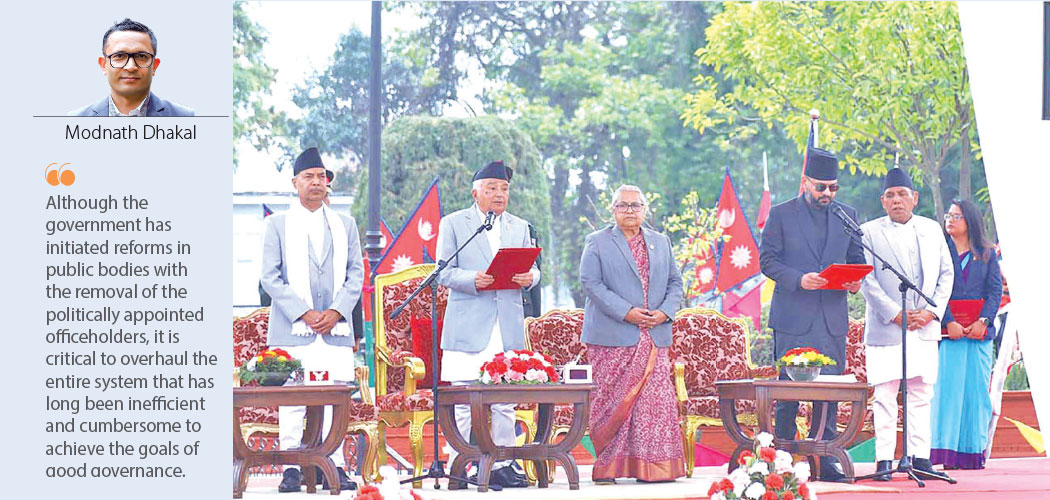
However, the success of the government will rest on its capacity to generate and mobilise meagre resources that are insufficient even to meet the administrative operation cost. Although the government has initiated reforms in public bodies with the removal of the politically appointed officeholders, it is critical to overhaul the entire system that has long been inefficient and cumbersome to achieve the goals of good governance.
(Dhakal is a journalist at The Rising Nepal.)





-original-thumb.jpg)