- Thursday, 28 May 2026

PM's Strategic Communication In Diplomacy

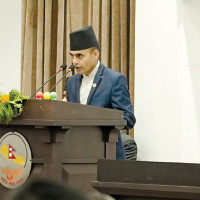
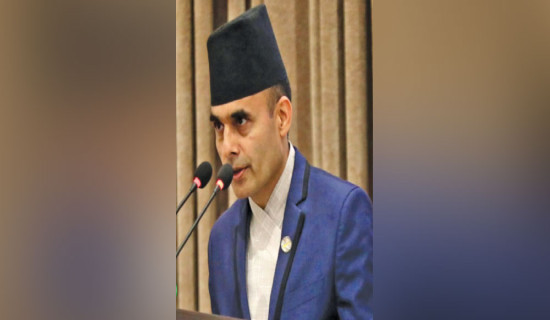
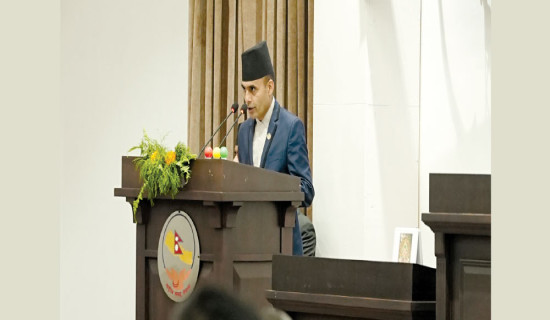
Prime Minister Balendra Shah has increasingly projected a social media communication style that emphasises direct access to the people. Foreign affairs and diplomatic contacts in contemporary time are marked by intense geopolitical competition, information warfare and public spectacle diplomacy. His leadership communication in the field of strategic foreign affairs and diplomacy cannot afford impulsive reactions or theatrical messaging. Nepal, a sovereign middle country situated between two major powers in the neighbourhood and navigating a highly competing major power ecosystem, must maintain balance through carefully measured policies, institutional discipline and strategic clarity.
In this context, communication channels and messaging phrases of the prime minister matter as much as policy itself. Leaders such as Vladimir Putin, Narendra Modi, Xi Jinping and Donald Trump all employ different political styles, yet each recognises that communication with foreign envoys, strategic actors and state institutions must ultimately preserve national interests and state credibility. Nepal’s evolving networked communication outreach under Prime Minister Balendra Shah appears increasingly aligned with a few tested principled words and more systematic and sustained development actions and purposeful engagement rather than sheer reaction. Balendra government is trying to focus on foreign affairs and diplomatic interaction for the best feasible delivery to the country.
Institutional trustworthiness
Strategic communication channels are not merely about public speeches and big talks. They include how messages and messengers are linked with the Prime Minister Balendra, how they are conveyed to the contacts (respondent representatives/organisations, neighbouring states, international organisations, and political stakeholders). Foreign affairs and diplomatic agency often advance quietly through trusted interlocutors, discreet consultations and forward-looking exchanges rather than loud public declarations. The continued preservation of Nepal’s independence, therefore, depends on maintaining basic consistency and institutional trustworthiness in communication.
The equally important issue relates to the legitimate competence of a government head to designate trusted representatives for both Sherpa meetings and high-level strategic dialogues. Under established statecraft traditions across the world, the head of government possesses the authority to appoint competent and acceptable representative/s for these meetings and dialogues. Negotiators or communication intermediaries are sought when national interests require specialized quality engagement. Such individuals may come from political leadership, the foreign ministry, the military establishment, security institutions or even from among respected veteran experts possessing long institutional memory and strategic experience.
Such practice is neither unusual nor improper. Resilient modern diplomacy frequently depends upon special representatives, back-channel interlocutors and trusted communicators. What matters is not political noise surrounding such appointments, but whether the designated individual possesses competence, credibility and the confidence of the state leadership. Before assigning such responsibilities, a prudent government head naturally consults strategic, intelligence, legal and security agencies in order to ensure institutional compatibility and national security safeguards.
Nepal particularly requires this resilient but responsible mechanism because its geopolitical environment is sensitive. Strategic communication with neighbouring countries, international partners and multilateral actors often demands confident and experienced hands capable of understanding protocol, state psychology, historical context and national security implications. Forward-looking engagement cannot be reduced to populist slogans or social media activism. It requires disciplined judgment and critical understanding of both spoken and unspoken state interests. This emphasis on disciplined statecraft is not new; classical Asian strategic traditions also placed high value on prudent counsel and calibrated diplomacy.
Ancient oriental wisdom strongly reinforces this principle. The book on Art of War teaches that wise statecraft depends upon knowledge, preparation and understanding of circumstances before action. The famous book was traditionally written by Sun Tzu (also spelled Sunzi), an ancient military strategist, philosopher, and general. He is believed to have written the book roughly around 500–400 BCE. The modern idea of “publication” did not exist at that time. The work originally circulated as handwritten bamboo-slip manuscripts.
Similarly, Kautily’s Arthashastra repeatedly emphasises that rulers should rely upon tested advisers, experienced envoys and informed counselors in matters concerning foreign affairs, diplomacy and national security. Arthashastra is traditionally attributed to Kautilya, who is also known as Chanakya or Vishnugupta. Most scholars believe the core text was composed between the 4th century BCE and 2nd century BCE. Kautilya himself is generally associated with the reign of Chandragupta Maurya around 321–297 BCE. Like many ancient works, it was circulated in manuscript.
The underlying oriental wisdom remains timeless: sensitive affairs of state should be entrusted not merely to the loudest voices, but to calm, capable, and seasoned hands with integrity.
Credibility
Nepal’s diplomatic credibility in the contemporary world will increasingly depend upon the balance between governance legitimacy and autonomous merit-based competence. A sovereign nation preserves dignity not by emotional reactions, but through mature institutions, strategic patience and trustworthy, networked channels of communication. In this regard, Prime Minister Balendra Shah’s focus on seeking measured engagement and credible communication may gradually contribute toward strengthening Nepal’s image as an independent, balanced and responsible state.
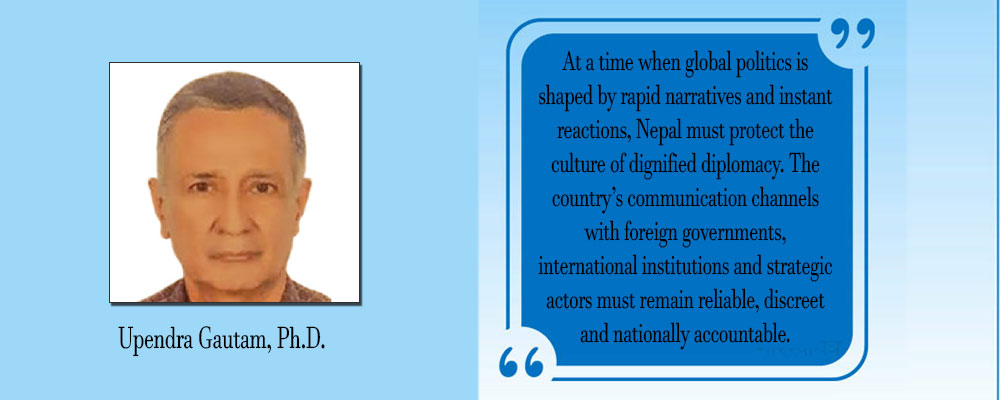
At a time when global politics is shaped by rapid narratives and instant reactions, Nepal must protect the culture of dignified diplomacy. The country’s communication channels with foreign governments, international institutions and strategic actors must remain reliable, discreet and nationally accountable. Merit, experience and institutional trust are therefore not optional luxuries; they are prerequisites for safeguarding Nepal’s sovereignty, stability and international respect.
(Gautam is secretary general of China Study Centre Nepal.)