- Thursday, 28 May 2026

Conflict Over Critical Minerals Intensifying

Today, countries across the world have been locked into multi-layered conflicts. In the past, especially during the Cold War, the rivalry revolved around ideology-driven proxy wars and an arms race between the two superpowers, namely the US and the Soviet Union. As the Soviet Union collapsed following the secession of its socialist republics, the bipolar world has given way to a multi-polar world. Still, the US and China are at the lead of today’s global strategic competition characterised by rivalry in different areas, including trade, technology, critical mineral resources, semiconductors, artificial intelligence, and so on.
US President Donald Trump's visit to China last fortnight focused on critical mineral resources in which the US and China have key stakes in their bid to outplace each other. US President Trump’s assertion during the initial days of his presidency to bring Greenland under US suzerainty, a business deal with Ukraine to leverage access to rare earth minerals, indicate the enduring US interest in exercising dominant control over critical minerals. According to the articles published in the latest issue of East Asia Forum's weekly digest, critical material resources are essential for modern economies, national security, and advanced technologies.
Strategic industries
They include a group of seventeen elements such as neodymium, dysprosium, and cerium used in electric vehicles, wind turbines, smartphones, missiles, and defence systems, chips and semiconductors. Other critical minerals include lithium, cobalt, nickel, graphite, copper, tungsten, and so on. These minerals are critical because they are vital for strategic industries difficult to replace and are concentrated in a few countries. They are essential for energy transition and military power. The US and China are in competition with each other for dominance over critical minerals. China controls around 60–70 per cent of rare earth mining and over 80–90 per cent of rare earth mineral processing.
This dominance gives China strategic leverage over the United States and other competing nations. The US depends heavily on Chinese-controlled supply chains for defence manufacturing, clean energy technology, electronics, AI, and semiconductor industries. This raises concerns about supply disruptions, price manipulation, and national security risks and so on. According to the East Asian Forum weekly digest, the specific minerals that are classed ‘critical’ differ between countries, companies, and industries. One type of supply risk faced by mineral users is short-term and results from a lack of geographic diversity in production. A disruption to supply from a single important source could lead to unexpected material shortages and volatile prices.
A longer-term risk stems from the fear that production capacity will be insufficient to satisfy the material requirements for key technologies. The importance of rare earth materials was felt when there was an explosion of their prices following a temporary cut-off of Chinese exports to Japan during a territorial dispute. This embargo occurred during a period when China restricted rare earth exports through export duties and quotas. Chinese restrictions sought to restructure the industry, giving domestic manufacturers a cost advantage over foreign customers. This saw a shift in the manufacturing of products containing rare earths to China.
Almost two decades ago, rare earth production in China accounted for more than 90 per cent of world output at both the mining and processing stages of production. Chinese production also accounted for most of the global output for many other critical minerals. China has used export controls on certain minerals, while the US has responded with tariff restrictions. The US–China struggle over these resources is about who controls the technologies. With a view to counterbalance China, the European Union (EU) and the US signed an agreement recently to coordinate on the supply of critical minerals needed for key industries, including defence. China's dominance becomes a growing concern for both the US and the EU.
The EU-US agreement marks a rare embrace by President Trump's administration of the role of the EU. Flexing its muscle at times of tension, Beijing has restricted exports of critical minerals needed for products including semiconductors, electric vehicle batteries, and weapon systems. Since 2022, the United States and the EU have shifted rapidly towards a more interventionist industrial policy aimed at building ‘trusted’ critical mineral supply chains free from Chinese inputs. The logic of this strategy is understandable. China has demonstrated its capacity to exploit key supply chain points. Policymakers in both the United States and the EU have promoted strategies such as ‘strategic autonomy,' ‘friend-shoring,' and ‘secure supply' for critical minerals and the industrial capabilities that convert them into batteries, magnets, and advanced weapons components. Yet this turn towards state capitalism, with governments acting as direct economic actors, applies the logic of military supply chains to a climate challenge that can only be met by the mobilisation of market forces across the global economy.
Vulnerability
Minerals are classified as critical not only because of their functional importance, but also because of their supply chain vulnerability. A mineral may be economically vital yet not deemed to be critical if its supply is diversified across markets and resilient. This differs from strategic minerals, which are defined by their specific utility in defence, aerospace, or critical infrastructure and by the absence of viable substitutes. The same minerals, used in both security-related applications and in green technologies, are classified differently across jurisdictions to reflect national security priorities.
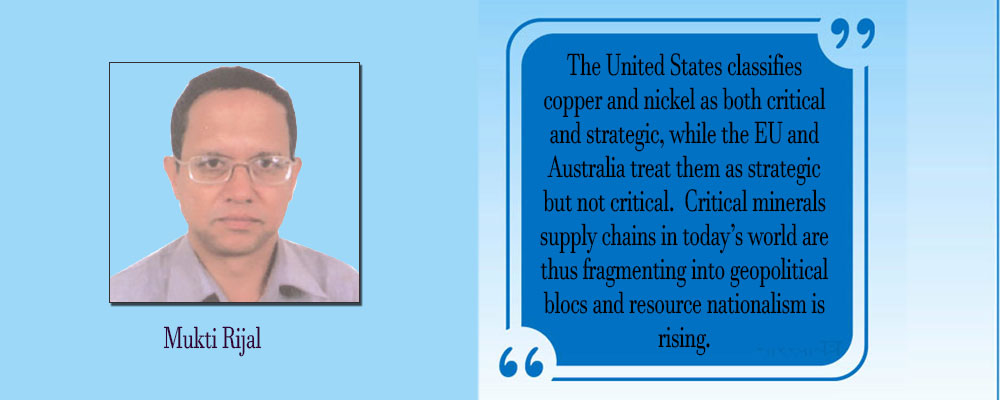
The United States classifies copper and nickel as both critical and strategic, while the EU and Australia treat them as strategic but not critical. Critical minerals supply chains in today’s world are thus fragmenting into geopolitical blocs and resource nationalism is rising. According to new projections, Africa and the Arctic are becoming new strategic battlegrounds during the coming days where China, Russia and the US are going to be mainly involved.
(The author is presently associated with Policy Research Institute (PRI) as a senior research fellow. rijalmukti@gmail.com)