- Wednesday, 27 May 2026

Sagarmatha, Muktinath And Melting Himalayas


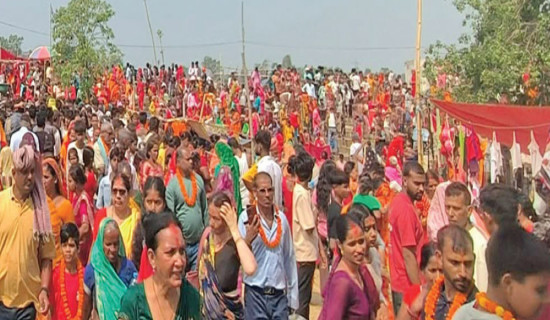
While the media in Nepal and across the world were covering the successful completion of the 2026 Everest climbing season, I was completing my third ascent to Muktinath, which stands tall at an altitude of 3,800 meters, making it one of the highest temples in the world. Muktinath Temple is situated at the foot of the Thorong La mountain pass within the Muktinath Valley section of the Annapurna Circuit. It was encouraging to see a large number of Indian and Nepali pilgrims and trekkers at the temple, indicating a rise in religious tourism and trekking activities, which increases the economy of these areas to some extent.
This month is known as the Purushottam Month, also called Adhik Mas or Mal Mas. It is a significant one-month period in the Hindu calendar that occurs approximately every three years. This month is mainly dedicated to the worship of Lord Vishnu and is understood as a time of spiritual growth; therefore, people engage in several rituals, fasting, and other religious activities. Hinduism believes in achieving moksha, or salvation, at the end of life. Purushottam Month is believed to help Hindus achieve this, and many devotees worship the various avatars of Vishnu, one of the Hindu gods among the trinity. This year, Mal Mas is being observed in Nepal from Jestha 3, falling between May 17 and June 15.
Immense significance
The Himalayan range holds a special place in the lives of Nepali people. These snow-peaked mountains also carry immense significance for Hindus around the world, as they are believed to be the abode of Lord Shiva. The Himalayas are also featured as sacred spaces in several Hindu mythologies. Beyond their spiritual importance, these snow-capped mountains continue to attract trekkers and mountaineers from around the globe. Initially, professional mountaineers were usually the ones climbing the world’s highest peak, Mount Everest, and other Himalayan summits. Today, however, people from different professions and walks of life dream of training for and climbing Everest and other peaks in the Himalayan range.
However, the time has now come to pause and reflect on a question that repeatedly comes to my mind: while humans continue conquering Everest, is climate change slowly conquering the Himalayas? During my third journey to Muktinath, I could clearly feel how different the temperature has become compared to my previous visits. Places including Beni, Jomsom, Lete, Marpha and finally Muktinath definitely felt warmer than before. Climbing the final steep steps remained as difficult as ever, perhaps even more because of my increasing age, but another thing had increased significantly — the heat. Another glaring reality was the reduced snow cover on the mountain peaks surrounding Muktinath.
The impact of global warming can now be clearly seen and felt while travelling along Himalayan trails and scaling mountain peaks. On one hand, Nepal has contributed positively by increasing forest cover and helping maintain environmental balance. On the other hand, carbon emissions from across the world, especially from developed nations, have accelerated the melting of the Himalayan range, threatening the fragile flora and fauna of the region.
According to Nepal government data, Nepal issued 494 Everest climbing permits during the 2026 season, the highest number so far. A record 274 climbers summited Everest in a single day in May, causing overcrowding and increasing safety risks, especially in the so-called “death zone.” Five deaths were reported during this season. Kami Rita Sherpa once again broke his own record by successfully scaling Mount Everest for the 32nd time on May 17, 2026. Similarly, climber Kenton Cool completed his 20th Everest summit, the highest number achieved by a non-Sherpa climber. There were also concerns over delayed climbing schedules due to unstable ice conditions in the Khumbu Icefall.
According to a 2026 report by the International Centre for Integrated Mountain Development (ICIMOD), glaciers in the Hindu Kush Himalayan region are now losing ice at double the rate compared to 2000. Reports further mention that nearly 27 meters of ice thickness has already been lost since 1975. ICIMOD also states that Himalayan glaciers lost ice 65 per cent faster during 2011–2020 compared to the previous decade. Similar studies show that glaciers in the Everest region are retreating at an average rate of 10 to 59 meters per year. Research further warns that if global warming continues at the current pace, the Everest South Col Glacier may disappear by the middle of this century. Nearly two billion people depend directly or indirectly on Himalayan glaciers for water, agriculture and energy.
Climate risks
Nepal has also been directly affected by threats from Glacial Lake Outburst Floods (GLOFs), endangering downstream communities. This has become increasingly visible as floods continue to affect Nepal while erratic rainfall patterns confuse farmers and disrupt traditional crop cycles. Tourism is undoubtedly a major source of income for Nepal. However, as the new youth-led government moves towards development and modernisation, it must seriously reflect on several important questions. Has Everest become more overcrowded and commercialised than it should be? Issues such as climate risks resulting from rising tourism activities and the contribution of developed countries to global warming through excessive carbon emissions must be studied seriously. Nepal must take stronger steps towards protecting its natural wealth and fragile Himalayan ecosystem.
While travelling across the Mustang region for four days on my way to Muktinath, I could genuinely sense changes in weather patterns and agricultural practices through my interactions with local communities. Their experiences reflected a changing Himalayan reality that can no longer be ignored. At a time when the Everest summiting season is ending this year, the Purushottam Month has commenced. Perhaps this coincidence itself carries a message for the Nepali people — that the Gods created the Himalayas not merely for admiration, but for protection and preservation. Among the many expectations people have from the Balendra Shah-led government, safeguarding our Himalayas may be one of the most important responsibilities of all.
(Sharma is a senior journalist and rights advocate. namrata1964@yahoo.com X handle: NamrataSharmaP)