- Thursday, 28 May 2026

Govt investment nears Rs. 800 billion in PEs as dividends gradually decline
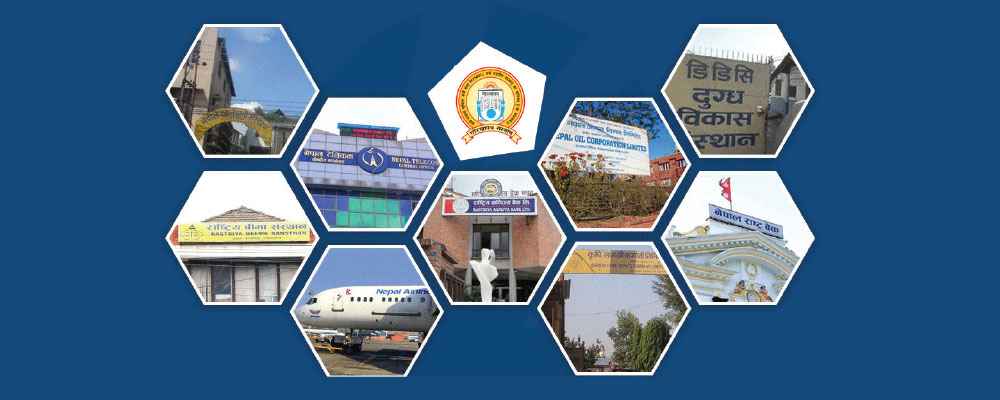

Kathmandu, May 28: The government investment in public enterprises (PEs) has reached nearly Rs. 800 billion in the fiscal year 2024/25, while returns in the form of dividends have continued to decline.
According to the annual report on Public Enterprises for fiscal year 2024/25, presented by Finance Minister Dr. Swarnim Wagle in the House of Representatives on Wednesday, total government investment in public enterprises increased by 13.44 per cent compared to the previous fiscal year, reaching Rs. 798.56 billion.
Of the total investment, share investment accounts for Rs. 370.25 billion, while loans amount to Rs. 428.31 billion.
In the fiscal year 2024/25, the total assets of public enterprises increased by 9.49 per cent from the previous fiscal year to Rs. 3,206.91 billion. This is equivalent to more than 50 per cent of the Gross Domestic Product (GDP). By the end of fiscal year 2023/24, such assets had stood at Rs. 2,928.97 billion.
Net profit up by 12%
There are currently 45 public enterprises operating in Nepal across industrial, commercial, service, social, public utility and financial sectors. Of these, 20 are fully government-owned and 25 are majority government-owned.
Public enterprises fall under the Ministry of Finance, Ministry of Industry, Commerce and Supplies, Ministry of Agriculture and Livestock Development, Ministry of Forests and Environment, Ministry of Physical Infrastructure and Transport, Ministry of Culture, Tourism and Civil Aviation, Ministry of Energy, Water Resources and Irrigation, Ministry of Education, Science and Technology, and Ministry of Communications and Information Technology.
Of the operating enterprises, 27 are profitable, 16 are running at a loss, and two have been closed. However, the net profit of public enterprises increased by 12.03 per cent in fiscal year 2024/25, reaching Rs. 45.08 billion. In the previous fiscal year, net profit had declined by 12.88 per cent to Rs. 42.62 billion.
By the end of fiscal year 2023/24, among the operating public enterprises, 28 were in profit, 15 were in loss, and two were in a closed state. The net profit of profit-making institutions stands at Rs. 48.89 billion, while the net loss of loss-making institutions amounts to Rs. 3.80 billion.
In fiscal year 2023/24, 28 enterprises were profitable while 15 were operating at a loss. Net profit had declined by 12.88 per cent to Rs. 42.62 billion in that fiscal year. The report shows that the net profit of profit-making institutions increased by 10.58 per cent compared to the previous fiscal year, while the net loss of loss-making institutions decreased by 4.14 per cent.
The total income and operating income of public enterprises reached Rs. 721.14 billion and Rs. 672.40 billion, respectively, in fiscal year 2024/25. The shares of total income and operating income in the Gross Domestic Product (GDP) stood at 11.80 per cent and 10.85 per cent, respectively. In fiscal year 2024/25, the cumulative profit of public enterprises increased by 21.51 per cent compared to the previous year, reaching Rs. 105.45 billion.
NAC records highest cumulative loss
According to the report, Nepal Electricity Authority, Nepal Telecom Company Limited and the Civil Aviation Authority of Nepal recorded the highest cumulative profits. Among sectors, the public utility sector posted the highest cumulative profit at Rs. 98.50 billion.
On the other hand, the industrial sector recorded the highest cumulative loss, amounting to Rs. 22.62 billion.According to the report, Nepal Airlines Corporation recorded the highest cumulative loss among public enterprises at Rs. 18.90 billion, remaining the weakest performer in terms of financial position.
Dividend receipts fall to Rs. 8.37 billion
Despite mixed performance, the government received Rs. 8.37 billion in dividends from public enterprises in fiscal year 2024/25, reflecting continuing though fluctuating returns on state investments. The dividend-to-share investment ratio stood at 2.3 per cent in fiscal year 2024/25.
Dividends received from public enterprises have been declining over the years. The government received Rs. 8.83 billion in dividends in fiscal year 2023/24, while it had received Rs. 13.75 billion in fiscal year 2022/23.
In fiscal year 2024/25, the shareholders’ fund (net worth) of public enterprises increased by 3.89 per cent compared to fiscal year 2023/24, reaching Rs. 1,073 billion.
During the review period, the net worth of seven enterprises remained negative. Nepal Airlines Corporation recorded the largest negative net worth at Rs. 7.93 billion.
According to financial statements received from public enterprises, the government expected to receive a total of Rs. 164.96 billion in fiscal year 2024/25 under various headings. Of this amount, income tax accounted for Rs. 11.36 billion, value-added tax (VAT) for Rs. 52.33 billion, while the remaining amount came from other sources such as interest, royalties and customs duties.
As of mid-July 2025, seven public enterprises were listed among the 466 companies on the Nepal Stock Exchange Limited. These enterprises accounted for 15.08 per cent of the total market capitalisation.
Administrative expenses drop
According to the report, public enterprises have a total approved workforce of 38,285 positions, while 30,352 employees — including permanent, contract and daily wage staff — are currently employed.
Sector-wise, the public utility sector employs the highest number of workers, while the social sector employs the fewest. The total administrative and personnel expenditure of public enterprises stood at Rs. 61.05 billion, which is 8.36 per cent lower than in the previous review period.
By the end of fiscal year 2024/25, 27 public enterprises had completed their final audits. Although the number of audited institutions improved compared to the previous review period, the report stated that financial discipline remains weak.
The report noted that these institutions continue to face major problems, including unclear objectives, lack of competitive capacity, operational inefficiency and weak management.
To ensure their relevance and sustainability, and to support the development of a stakeholder economy, the report recommended implementing a Public Enterprises Reform Programme through an integrated approach involving immediate policy, structural and managerial reforms.
The report also said that government investment should be managed based on necessity and returns in order to address operational problems and make public enterprises more efficient and accountable.



-original-thumb.jpg)