- Sunday, 17 May 2026

Confusion grows over non-iodised salt as experts raise health concerns

By Laxman Kafle/Raman Paudel
Kathmandu, May 17: With the opening of salt trade to the private sector, non-iodised salt has become available in the market. Following the entry of less- or non-iodised salt into the market, consumers have become confused about which type of salt they should consume.
Gayatri Banjara of Bhaktapur expressed serious concern about which salt should be chosen for consumption now that both iodised salt sold by Salt Trading Corporation (STC) and non-iodised salts of various brands are available in the market.
“We are confused about which salt to consume. There has been no clear direction from government bodies for consumers regarding the consumption of non-iodised salt. If we consume non-iodised salt, it may create health problems in the future,” she said.
However, she said that her family has continued to use the iodised salt sold by STC to date.
Prakash Khadka, a resident of Barhadashi Rural Municipality in Jhapa, said that his doctor advised him a few weeks ago to reduce his sodium intake because he had high blood pressure.
Accordingly, Khadka stopped consuming salt for a few days. However, he then began feeling physically weak. Recently, after finding low-iodised salt in the market, he considered consuming it. But he remains confused because he does not have enough information about such salt.
“Low-iodised salt is available in the market. I do not know how much I should consume or whether it will have other effects on the body. I am confused,” he said.
Consumer rights activist Madhav Timalsina argued that the sale and distribution of non-iodised salt by various companies in the market has created confusion among consumers about which type of salt they should use.
He said that personal opinions and advice circulating on social media have increased misunderstandings regarding salt consumption, which is a sensitive issue directly related to public health.
Consumption of less-, non-iodised salt may hamper public health
Public health experts and consumer rights activist have emphasised the need for regular monitoring of iodine levels in salt and among the population to maintain optimal iodine intake and prevent both deficiency- and excess-related health problems.
Public health expert Dr. Sharad Onta raised serious concerns over the possible public health effects of the availability of less- or non-iodised salt in the market. Talking to The Rising Nepal, Dr. Onta said that people living in a high-altitude country like Nepal require more iodine rather than less for their bodies.
“However, the supply of low- or non-iodised salt may affect human health, especially among children. We cannot predict when or how consuming low- or non-iodised salt may impact human health,” said Dr. Onta.
He further said that the government should take the issue seriously and ensure the supply of salt containing an adequate amount of iodine.
“It is said that the use of high levels of iodine has had certain effects. As a result, less iodised salt is being sold. However, insufficient iodine also affects human health. Therefore, it is not enough to simply reduce iodine consumption. The government also needs to be serious about the potential impact of selling low-iodine salt,” said Dr. Onta.
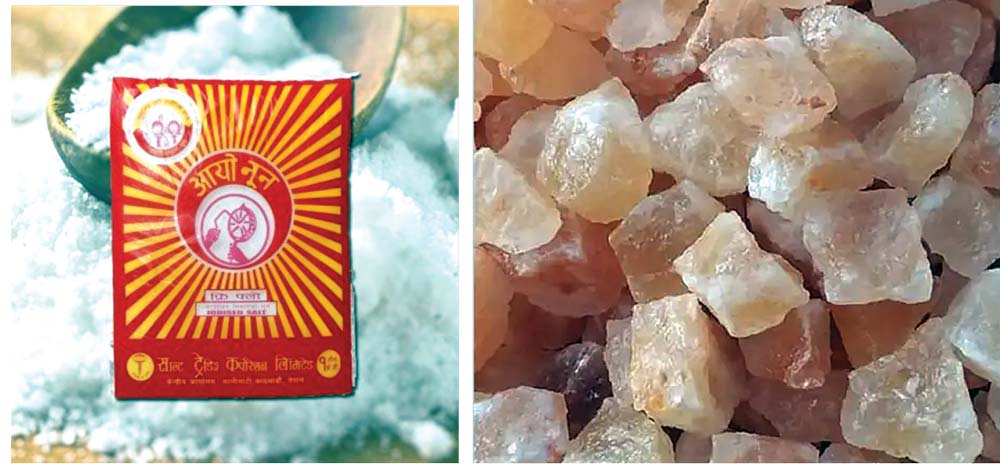
According to Timalsina, the Ministry of Health has so far recommended the use of iodised salt with the logo of two children sold by STC for everyone, and he stressed the need to follow the recommendations of government officials.
He said that if the salt sold by STC is found to contain excessive iodine, it should be adjusted according to the required standards before distribution and sale.
Timalsina emphasised the need for the government to manage the sale and distribution of the sensitive product — salt — through a single-channel system.
He stressed that market monitoring should be proactive and effective, as such conditions could negatively affect consumer health.
Govt to conduct survey
Lila Bikram Thapa, head of the Nutrition Section of the Family Welfare Division, said that the government had instructed the distribution of salt with lower iodine content in accordance with a survey conducted in 2016.
The survey identified high iodine consumption and its adverse effects on children. Following the survey, the government instructed that salt with lower iodine content be sold in the market.
“In the survey conducted in 2016, it was found that high levels of iodine had affected consumers, particularly children. The government-led survey also revealed that people across the country were consuming more than the recommended amount of salt. As a result, the government decided to limit the sale of highly iodised salt in the market,” said Thapa. He said that the government will conduct another survey to assess how lower iodine levels in salt affect human health.
He added that a committee has been formed to monitor the issue and carry out a new survey to determine the impact of iodine deficiency caused by low-iodised salt on public health.
Timalsina said that the government should have consulted experts before deciding to allow the sale of low- or non-iodised salt, rather than conducting surveys afterward.
Policy shift in salt sale opens door for private sector
The government led by then Prime Minister KP Sharma Oli had opened the salt trade to the private sector. Previously, the state-owned STC had been importing and selling iodised salt throughout the country. By publishing a notice in gazette on May 5, 2025, the government allowed the private sector to sell salt effective from July 17, 2025.
Since then, the private sector has been engaged in selling salt in the country. Non-iodised salts of different brands tested by laboratories are now available in the market.
The price of non-iodised salt available in the market is much higher than the salt sold by STC. A kg of such salt costs up to Rs. 200. In contrast, the salt sold by STC is available at only Rs. 26 per kg.
Earlier, through the budget speech for the fiscal year 2021/22, the government had announced provisions to make the supply of iodised salt easily accessible, high-quality, and available at affordable prices. It also stated that salt production and distribution would be made competitive with the participation of the private sector.
However, the then government was unable to implement the decision due to opposition from political parties, including Nepali Congress, Communist Party of Nepal (Maoist Centre), Janata Samajbadi Party Nepal, and Rastriya Janamorcha.
Role of STC in salt supply
The STC, established in 1963 as a public-private partnership in Nepal, is a key government backed organisation responsible for ensuring a consistent nationwide supply of essential commodities, most notably iodised salt.
It helps prevent shortages of essential goods such as salt, sugar, flour, and fuel, particularly in remote Himalayan regions.
So far, STC has been supplying salt throughout the country in line with the government’s plan to make the country free from iodine deficiency disorders.
As per the direction of the then Ministry of Health on July 20, 1995, to increase the iodine content from the existing 30 ppm to 50 ppm, STC has been selling salt containing 50 ppm iodine. The directive was introduced to control iodine deficiency disorders by the year 2000.
Nepal has achieved a notable public health success in controlling iodine deficiency. Visible goitre rates dropped from 55 per cent in 1965 to a negligible 0.4 per cent by 2007, effectively meeting the elimination target.
The Nepal Demographic and Health Survey 2011 indicated that no visible goitre cases were observed among the population.
However, Nepal National Micronutrient Status Survey (NNMSS) 2016 found that Nepalis consume excessive amounts of iodine, which has resulted in high prevalence of hyperthyroidism.
The survey showed that more than two-thirds of the population across the country is consuming iodine far in excess of the recommended levels. The World Health Organisation recommends iodine concentration at 15 to 40 ppm per kg.









-original-thumb.jpg)
-original-thumb.jpg)