- Saturday, 6 June 2026

Leveraging Political Power To Elevate Lives

Political power is the power of the public derived from popular consent, public opinion, electoral preference and constitutional tradition of politics. It is accountable to Nepalis. Actualisation of this public power requires legitimate action of authorities constituted by the people and the state in matters of politics, laws, policies and concrete actions for positive outcomes for their life, liberty and dignity. Political power is actualised by people by the exercise of their rights, needs and aspirations within the scope of system reforms and attuning to actualise the government’s policies and programmes anchored in the ‘100-point agenda for governance reform’ of the ruling Rastriya Swatantra Party (RSP). The imperative of the state is to create order and security and the interest of people is to realise their freedom and self-fulfillment in a reciprocal manner.
Use of public power to enrich personal interest causes rationality deficits and erosion of public order to promote justice at various scales and infringe the boundaries of multi-scale politics. Improvement in human condition requires first the realisation of survival necessities through the enrichment and sustainability of nature, expansion of labor market opportunities for people to live a life of dignity and choices within the nation and exercise freedom and participation in democratic life. A violence that disrupts these areas amounts to the tragedy of politics. It can generate a spiral of silence and dents peaceful activities. Self-referential media and civil society must read politics as a public purpose.
Eternal dilemma
Nepal’s eternal dilemma of shaping political power on the basis of political equation made its use contested, not artful to get things done. It has left those outside the political benefits anguished and stirring, seeking to change this political culture and forging social contract on the basis of enduring national and humanitarian values so that those routed in the election do not lose stake in the system as a process. Stable change can be legislated through reformist politics of the middle ground which can also optimise extremist positions of political actors of Nepali society. The questions are: does the current government of Nepal hold enough political will to institutionalise the power of public for productive use, alter the political culture of negation and patronage and build a future commonly shared by all people? Can it create common ground for all politically significant and left out forces to engage in the participatory process of nation building?
Upland commitment of Prime Minister Balen Shah exists to make Nepal a modern state founded on an edifice of good governance, employment and social justice. These are vital areas for nation building and espouse loftier aspirations of people. But the only question is how laws, institutions, authorities and resources constituted as a system are efficiently arranged or reformed to achieve the vision and keep inputs and outcomes of politics in a perfect balance. One irony of Nepal is that rights of people have swollen but there is no matching opportunity to realize them unless the capacity building of welfare state is built and theft and fraud are purged in public life through a change in the integrity of political leadership.
Government as vacuum cleaner: The government of Prime Minister Shah is calibrating reformist agenda as per the frame of rationality, legitimacy and historicism—with the aplomb to overcome the deficiencies of his predecessors in skill and will to solve national problems from structural factors such as poverty, inequality, landless squatters, loan shark victims, health, education, infrastructures, youth migration to border disputes. These are critical bumps on the road to reforms. It requires using a powerful vacuum cleaner to abolish the toxic elements of the system such as grand corruption, arbitrary use of power, impunity for rights abusers and injustice for the weak. The government has executed a torrent of liquidation of many positions filled by patronage politics aiming to control the institutional atrophy.
Priorities on good governance, policy reforms to ease the supply of public goods and service in a transparent manner, infrastructural development, social progress focusing on innovation, entrepreneurship, competition, digitalisation and economic reforms, sustainable growth and expansion of energy sector are legitimate. They can unleash meritocratic lure but by no means enough unless the fear of resistance, debt trap and dependency are dispelled by a spike on productive sector of the real economy. The nation cannot afford the vacuum of indispensable posts for a long time. The efficiency of public positions is vital to execute the mandate of the state. It has also to reduce the cost of living and salvage the Nepali way of life. Knowledge about the problematic condition of now requires social learning and understanding the root causes — a canon of historicism and unlearn from the tattered and torn leadership working under the illusion and self-gratification and encountering one after another failure.
The new government marks a paradigm shift from the false utopia of universal ideology to pragmatism that not only delivers but also deradicalises the society to prevent linguistic, spiritual and cultural erosion. Its duty is to defend the people and the nation and prevent the decapitation of the Nepali state. It does not mean that the government does not have to be receptive to creative ideas emanating from the spirit of the people and the other side and remain averse to cooperation on common ground of foreign policy, diplomacy, eco-balance and public goods.
Moderating the post-modern spin: Constitutional change in Nepal is vital to make it a document of national unity, glued by the notion of citizenship equality, not a tool of differentiation and division of people on the basis of biology, territory, caste, class, region or religion and instrumentalisation of mini identities aiming to expand political constituency for short-term power play. Post-modernist turmoil shelters the reengineering of the state and society, opening loopholes for atomisation of people and social cohesion. Leaders' decency and maturity can serve as a role model for people to emulate. Yet the great task lies in building national unity, not fomenting the centrifugal forces of society to weaken polity and the state which cannot satisfy the needs and rights of people. The current Nepali leadership is marking a shift of politics from a life of leisure, pleasure and comfort to a life of responsibility to the wellbeing of people and improves the life-affirming possibilities so that youths do not have to emigrate abroad to sustain their livelihood and earn remittance as national economic lifeboat while draining the nation of dynamic force.
The government has lost no time in promulgating eight extraordinary ordinances to legitimise structural change in both institutional leadership and policy. To be sure, meritocratic recruitment of pubic leadership can unhinge the polity, enhance the efficacy of public institutions which can also detrabilise authorities and the public and connect them to national state rather than becoming clients of postmodern deconstructionist impulse of many forces some of them are seeking to asphyxiate the rhythm of polity and desperate to stage a return after being faded into the shadow of power. The mad fury of the forces of reaction and their efforts to foment stirs may strain Nepalis vision of progress.
Breaking the asphyxiating embrace: Suffocating Nepalis are aspiring for freedom and dignity rather than piety and sympathy. Dependency implies a lack of choice for the nation and people to realise self-worth and craft suitable public policies. Democracy, as a system of choice, requires unshackling the people from poverty, inequality, discrimination, abuse of human rights and livelihood crisis. Progress in Nepal can be achieved not only by necessary laws of the market under structural conditions of poverty, inequality and skewed opportunity but by awakening people and leaders from cognitive slumber and promoting overall human progress in the rhythm of nature.
If the vast outpouring of cutting-edge technologies are applied to productive sectors it can break the disgusting embrace of delayed justice, inertia in bureaucracy, unleash productivity of real economy, widen the political economy of scale and spur national cohesion and improve the competitive edge of the nation in the international market and politics. Only the liberation of Nepalis from the desolate conditions of social, economic and political life can enable them to adapt to a great shift from rule-based order to power-based geopolitics. It is generating a hot climate for small states for Nepal. It must find a room for maneuver in a state of global anarchy that is denting global governance like the UN and WTO, multilateralism and nonalignment. Civic nationalism can be a shield against the rise of feudalism, radicalism and authoritarianism and keep improving the human condition.
Forces of change
Driving forces of change: The government is accelerating non-linear change—refining police and bureaucracy, cutting surplus personnel, institutions, privileges and vehicles to save resources for productive use. It is enlivening an acute consciousness of history and culture and contribution of heroes and builders. Propelled by the information revolution it is infusing people to indulge in social learning, self-mastery of destiny and overcoming the web of causes that landed personal and national life in what the government unveils “caught in an unproductive cycle of policy corruption, transaction and peripheral capitalism.”
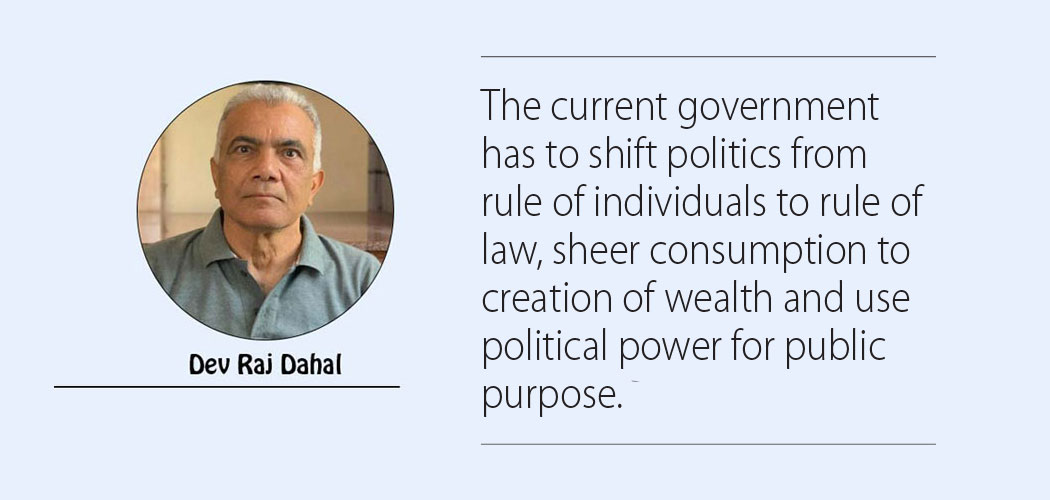
It is in the driver’s seat of systemic change, adapting to technology and strategic adjustments of those requiring bursts of motivation in the condition of living and reshaping imagination, disposition, habits and meritocratic lure. Democracy is built on the bedrock of common bond of people and public authorities and their institutions and leadership. As an apostle of systemic change, the current government has to shift politics from rule of individuals to rule of law, sheer consumption to creation of wealth and use political power for public purpose. Its justification is to make sense of the ideals of the constitution and improve the living condition of people.
(Former Reader at the Department of Political Science, TU, Dahal writes on political and social issues.)