- Friday, 5 June 2026

Responsible Tourism Saves Himalayas
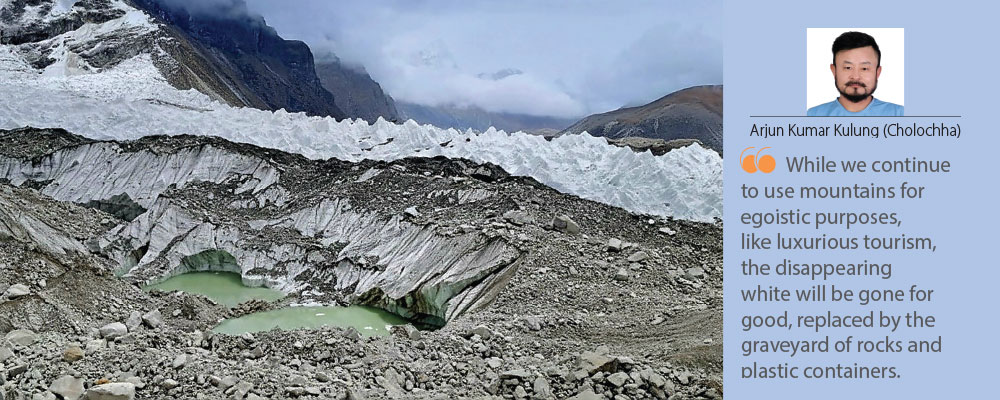

Earlier, the glaciers of Nepal were serene giants whose cathedrals of ice drew reverence from each soul who stepped foot on their slopes. As a guide who has worked in mountains for almost twenty years, I know all too well what the white of our country’s roof looked like back then. Now, that giant bleeds grey. The disappearing white, once Nepal’s source of pride, is being replaced with the dust of debris and the ghost of plastic that has been carelessly thrown away. The problem in our highlands is not only climate change but rather a crisis caused by our very actions when dealing with our holiest ground. The visual manifestation of this problem is evident everywhere across the Himalayas. While scientists measure the consequences of global warming and retreating glaciers, a guide feels it in his blood.
We see it in the cracks growing ever wider between the crevasses, in the weakening of the ice walls, and even in the emergence of waste from the glaciers, where the trash dumped decades ago by the trekkers has begun to emerge due to melting ice. The crowded state of the most popular trails around the world is no secret to anyone today, but the truth about the reason for their popularity is frequently overlooked. It is not simply the sheer number of tourists that makes a problem. Rather, it is who the visitors are that creates the real dilemma.
Today’s urbanised trekker insists on having all the luxuries of the plains even at the heights of five thousand metres. This desire for comfort contributes greatly to environmental degradation. To install wood-fire heaters in the teahouses of high altitudes, we strip bare the vegetation of this mountainous terrain, which takes decades to grow back. To satisfy the demand for western-style menus, we airlift in thousands of tonnes of preserved foodstuffs to our mountain valleys.
Anything luxurious that gets transported to the remote area will leave behind a trail of garbage and a heavy carbon footprint. When a visitor requests a pizza or a hamburger in Gorakshep (5,164 m), which is the last halt before the famous Everest Base Camp (5,364 m), he inadvertently adds to the burden of handling the waste material. At such a height, there is no other place where one can dispose of garbage.
Anything that gets brought up generally stays up and ends up polluting the water resources that millions of people depend on.
What is even more regrettable than the disappearance of ice glaciers is the fading out of mountain cultures. The mountainous regions of Nepal have been places of worship and the abodes of generations gone by. In those days, there was a sacred bond between mountain communities and the peaks they lived among. As tourism grows, there emerges a shift away from the traditional culture of resilience and humility towards one of consumerism. When tourists come first and everything else second, we forget our culture.
Our local economies have become dangerously dependent on foreign goods, discarding the fertile and sustainable crops our forefathers thrived on. Instead of ceasing tourist activities that serve as the lifeline of our mountain people, we need to change the mentality of the tourists themselves. We should cease to be consumers and turn into contributors.
A contributor recognises that being in the mountains is a privilege and approaches the experience with respect. This mindset begins with the philosophy of the "hygiene man", where caring for the mountain environment is treated as a personal responsibility. It means following the principles of Leave No Trace (LNT) by planning ahead, staying on appropriate surfaces, and disposing of waste properly. In essence, a contributor strives to leave behind nothing but footprints. It means the practice of zero-trace tourism, where he reduces litter at the source, carries reusable bottles instead of single-use plastic bottles, etc.
Another point about being a contributor is adopting a local way of living instead of the manufactured comforts of the modern world. Eating local products like Dal-Bhat and choosing traditional high-altitude foods like potatoes, barley, wheat, maize, and buckwheat is particularly impactful. The plants are called "low footprint" since they are produced on mountain soils, which don't necessitate the use of carbon-heavy helicopters and overused plastic packages for delivery. Thus, by eating locally, the trekker is both getting nourishment from nature and protecting a heritage of generations before them.
As Nepal plans its future with tourism, a crucial question arises about what sort of legacy we are willing to give to those who will become our new trekkers and guides. While we continue to use mountains for egoistic purposes, like luxurious tourism, the disappearing white will be gone for good, replaced by the graveyard of rocks and plastic containers. On the other hand, if we manage to educate our young travellers to regard these sights as protectors, showing respect to the principles of LNT, hygiene as a form of worship, and local culture as their own treasure chest, then there may be some hope left. Mountains don't need us – but we definitely need them. Therefore, let us make sure that our way to the peak of the world leaves nothing more than footprints and takes nothing else from nature except for the blessings it gives us.
(The author is a professional of mountain tourism.)