- Friday, 5 June 2026

Journey Into The Land Of Battlefield

I had long harboured an urge to visit Kurukshetra, the legendary land where the epic battle of the Mahabharata was fought. This urge was instilled and shaped since childhood. In the early evenings at home during my childhood days, I used to listen to my father, elder brother and sister doing recital delivery of verses of the Mahabharata epic in Nepali poetic form. We had in our home almost a moth-eaten Nepali version of the Mahabharata, rendered into Nepali poetic form and published by Babu Madhab Prasad Sharma in Varanasi. My late sister Mayadevi – a piety-minded devout lady – used to do very powerful recital deliveries of the Mahabharata in her sonorous and mellifluous tone, which rings in my ear even today. It was almost a decade ago my sister succumbed to a carcinogenic-related illness.
This domestic ambience had etched in my imagination heroic and righteous figures such as Bhisma, Bhima, Arjuna, Karna, and so on. Later, as Mahabharata was reproduced into televised form in Hindi during the nineties, the character role of Bhishma, performed by Mukesh Khanna, comes alive in my mind. His tall stature, powerful voice, and dignified expressions perfectly matched the image of Bhishma as the wise, oath-bound patriarch of the Kuru dynasty. His deep, authoritative voice gave immense weight to Bhishma’s moral vows and emotional moments. He portrayed Bhishma not just as a warrior but as a tragic figure torn between duty, loyalty, and justice.
Kurukshetra to me has never been only a holy place described in the Mahabharata epic; it has been a living civilisational canvas of conflict between good and evil, right and wrong. Accompanied by my family members, including my brothers Mohan and Laxmi Rijal and spouse Pabitra Rijal and sisters, I set out to fulfil this long-cherished wish to visit Kurukshetra. Hiring a vehicle from Gurugram, New Delhi, in the helpful company of Diraj Khanal, who performed the role of driver and a reliable guide, we embarked upon a journey along the historic Grand Trunk Road, which is popularly called the GT Road in local parlance. Our route passed through Sonipat, a rapidly emerging educational hub, home to institutions like O.P. Jindal Global University. The transformation of such towns into centres of education reflects the evolving landscape of modern India. Thereafter, riding around 80 kilometres, we reached Panipat – a city that has decisively influenced and shaped the history of India. As a student of history, I had read about the historic battles fought in Panipat in the Haryana state of India. My interest to explore those battles that had defined the destiny of the Indian subcontinent came to life, and I have plucked bits and pieces of relevant information about the battles from the relevant sources. Known for the three monumental battles fought in 1526, 1556, and 1761 in succession, Panipat, as described by historians, stands as a silent witness to the shifting tides of power. It was here that Babur defeated Ibrahim Lodi, laying the foundation of the Mughal Empire. It is in the battles fought in Panipat that Akbar’s forces restored imperial authority.
Ahmad Shah Durrani halted Maratha expansion in one of the bloodiest conflicts of the 18th century. Panipat’s significance lies not merely in these battles but in its strategic location. Positioned along the invasion route from Central Asia via the Khyber Pass, it became the inevitable battleground for those seeking control over Delhi, the political heart of northern India. The old saying, “The road to Delhi passes through Panipat", resonates with Mackinder’s heartland strategy. Halford John Mackinder was a British geographer who wrote a paper in 1904 called "The Geographical Pivot of History". Mackinder's paper suggested that the control of Eurasia was vital to the control of the world.
I explored how Indian historians view the battles of Panipat. I checked with the website sources about India’s prominent historiographer, such as R.C. Majumdar, who holds nationalist perspectives. According to him, the battles of Panipat, especially the First (1526) and Third (1761), had been the decisive power-shifting battles. Historian Romila Thapar holds a critical and structural approach. She is less focused on battlefield heroics and more on long-term structural change.
According to her, the Panipat battles have been moments of political realignment, not the isolated turning points. The famous Marxist historiographer Irfan Habib holds a Marxist economic perspective and situates Panipat within economic and class structures. According to Irfan Habib, the battles marked the transition to a more centralised agrarian empire under the Mughals.
Another historian, Satish Chandra, focuses on Mughal decline, indirectly enabling the rise of the British East India Company. Bengali historian Jadunath Sarkar, a military historian, highlights leadership, discipline, and battlefield planning as vital to war strategy. The Third Battle is seen as a classic case of strategic overreach by the Marathas and superior Afghan tactics under Ahmad Shah Abdali, with a strong focus on logistics, morale, and command failures.
Panipat is called one of India’s major textile and handloom hubs because of a unique mix of history, geography, entrepreneurship, and industrial specialisation. After partition in 1947, many skilled weavers and traders from Punjab migrated to Panipat. They brought expertise in weaving, carpets, durries, blankets, and home furnishings. This laid the foundation for a large textile ecosystem. Panipat is often referred to as the “City of Weavers” and "Textile City". Panipat is one of the world’s largest centres for shoddy yarn (recycled textile fibre). Old clothes and discarded fabrics are recycled into yarn and reused for blankets, mats, and low-cost furnishings. This has earned it the title 'cast-off capital of the world’.
After historic Panipat we continued onwards and arrived at Karnal, the birthplace of Kalpana Chawla, whose legacy lives on through the memorial planetarium, inspiring countless young minds to look beyond earthly boundaries towards the cosmos.
Kalpana Chawla was an engineer who studied in the US and joined NASA. Chawla worked on the development of the Robotic Situational Awareness Display, a tool to help astronauts operate robotic arms. Chawla specialised in operating the robotic arm. Chawla made history as the first Indian woman and the first South Asian American woman to fly in space.
The erstwhile late Indian Prime Minister Inder Kumar Gujral called Chawla in space to congratulate her on her journey and express pride in her representing India in space. Chawla and the other six crewmembers were tragically killed when the Space Shuttle Columbia broke apart during re-entry on February 1, 2000.
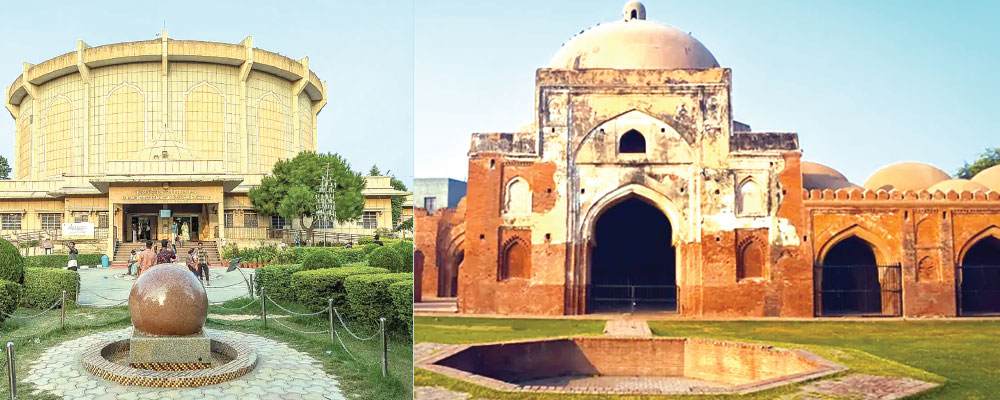
A brief halt at Pipli offered us an opportunity to glimpse into the Kurukshetra Panorama and Science Centre, where statues of Nobel laureates and scientific exhibits symbolically bridge ancient wisdom with modern knowledge. We took a group photograph together with the busts of Nobel laureates placed on the premises of the museum.
As we finally reached Kurukshetra, the atmosphere seemed to shift from the movement of roads to the stillness of reflection. Kurukshetra is revered as the site where Lord Krishna delivered the eternal teachings of the Bhagavad Gita to Arjuna.
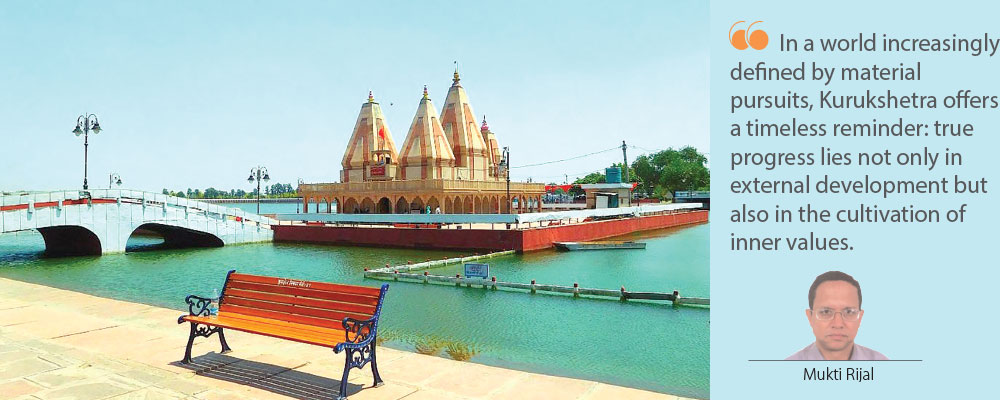
Kurukshetra’s significance extends beyond mythology. It has been a centre of Vedic learning, ritual practice, and cultural continuity for millennia. Our first visit was to Brahma Sarovar, a vast and serene water tank believed to be associated with the act of creation itself.
Pilgrims gathered along its banks, offering prayers and performing rituals. The stillness of the water seemed to mirror the depth of contemplation the place inspires.
Festivals such as Gita Jayanti and solar eclipse fairs continue to draw thousands of pilgrims, ensuring that ancient traditions remain vibrant. The recitation of the Gita, the performance of rituals, and the gathering of scholars and devotees transform Kurukshetra into a dynamic space. We visited the premises of Kurukshetra University, which is known as a centre of learning, particularly in fields like Sanskrit, philosophy, and Indology. The name of the gate to enter the university’s premises is Dronacharya Dwar – the great teacher who taught the skills for using arms and artillery to the Pandavas and Kauravas.
The modern transformation of Kurukshetra owes much to the vision and dedication of leaders like Gulzarilal Nanda and Himmat Singh Sinha. Gulzarilal Nanda, a freedom fighter and twice acting prime minister of India, envisioned Kurukshetra as more than a pilgrimage site. For him, it was to be a “living centre of Dharma”—a place where ethical values could be cultivated in a newly independent nation seeking moral direction.
As Union Minister for Planning and Irrigation, he initiated the Kurukshetra Development Plan, which aimed to integrate spiritual heritage with modern infrastructure. Under his guidance, significant efforts were made to restore sacred sites such as Brahma Sarovar and Jyotisar, improve connectivity, and develop facilities for pilgrims. He also played a key role in promoting educational institutions, recognising that the teachings of the Gita must be complemented by scholarly engagement.
Working closely with Nanda was Dr. Himmat Singh Sinha, a scholar-administrator whose contributions were instrumental in translating vision into reality. Dr. Sinha, who passed away almost two years ago, was deeply committed to the idea that Kurukshetra should serve as a bridge between tradition and modernity.
His efforts in planning and implementing development projects ensured that the region evolved as both a spiritual and academic hub. Travelling to Kurukshetra with my family members transformed the journey into a shared pilgrimage—one that combined personal memory with collective experience. From the battlefields of Panipat to the sacred waters of Brahma Sarovar, each place carried a lesson—about power, impermanence, duty, and the enduring quest for meaning.
As we returned to Delhi, the journey lingered in my thoughts not as a series of destinations visited, but as an ongoing dialogue between past and present, action and reflection. In a world increasingly defined by material pursuits, Kurukshetra offers a timeless reminder: true progress lies not only in external development but also in the cultivation of inner values.
(The author is presently associated with Policy Research Institute (PRI) as a senior research fellow. rijalmukti@gmail.com)