- Tuesday, 9 June 2026

Nepali workers outflow to GCC drops by 47 per cent


Kathmandu, May 20: Migrant worker outflows from Nepal to the Gulf Cooperation Council (GCC) countries has dropped by 45 per cent in February-March this year compared to the same period in 2025, according to a report of the International Labour Organisation (ILO) published on Tuesday.
This drop further widened to 47 per cent in March-April this as compared to last year. While the Philippines witnessed a massive decrease of 78 per cent in March on year-on-year basis Bangladesh's drop sit on 15 per cent.
According to the report 'Employment and Social Trends May 2026 Update: Growing labour market risks of the Middle East crisis', the West Asia crisis is increasingly affecting jobs, working conditions and incomes far beyond the region, as higher energy costs, disrupted transport routes, supply chain pressure, weaker tourism and migration constraints weigh on economies and labour markets.
After the war broke out between Israel-USA and Iran earlier this year, the security situation in the West Asian nation has significantly deteriorated. This has not only impacted the businesses and workers there but also the national and household economy in many developing countries in South Asia and Northern Africa.
The Arab States are the most directly exposed, through conflict-related disruption, damage to economic activity, displacement, energy and trade shocks, and pressure on migrant workers and refugees, read the report.
The ILO predicted that total working hours could fall by 1.3 per cent under rapid de-escalation. This could reach 3.7 per cent under a prolonged crisis and 10.2 per cent under a severe escalation. Such a decline is more than twice the scale recorded during the COVID-19 pandemic in 2020. "Around 40 per cent of employment in the region is concentrated in high-exposure sectors such as construction, manufacturing, transport, trade and hospitality. Migrant workers are expected to bear a disproportionate share of labour market adjustment," read the report.
According to the recent news reports, jobs of about 80,000 Nepalis is at risk in Saudi Arabia following the suspension of the ambitious 'Future City' project.
“If the crisis disrupts both deployments and remittance flows, the effects could spread to consumption, poverty and local employment in countries of origin,” the report said.
Effectively operate rapid response mechanism
Meanwhile, a tripartite meeting among the government, Nepali missions abroad and the Non-Resident Nepali Association (NRNA) held on Tuesday, suggested to create a rapid response mechanism and operate it effectively to conduct timely rescue and repatriation of Nepalis in the conflict-affected countries.
The meeting discussed the safety and management of Nepali migrant workers in the conflict-affected countries in West Asia, and said that digital assistance system must be made effective and accessible.
The meeting, attended by the representatives of Labour Migration and Nepali Diaspora Coordination Division and concerned government and non-government agencies, suggested to immediately implement emergency rescue plans and safe transfer systems.
Stating that the coordination among the NRNA, Nepali missions and the government must be further strengthened and made more effective, the meeting recommended to make the crisis management and risk awareness mandatory components of pre-departure orientation training.
Other suggestions include updated data system for Nepali workers, access to psychological counselling, awareness campaign on foreign-employment-related fraud, and strengthened labour-related bilateral agreements.
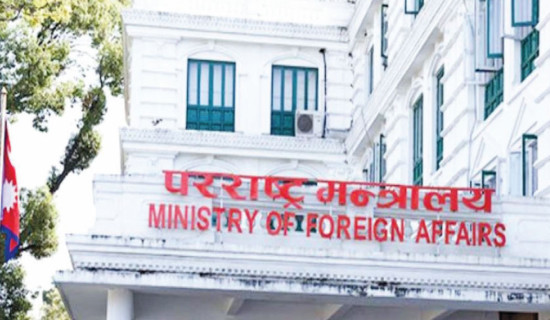
Speaking at the meeting, Ramkaji Khadka, Head of the West Asia Division at the Ministry of Foreign Affairs (MoFA), updated the status of Nepalis in West Asia and said that Nepali missions in the respective GCC countries are vigilant on the situation and are regular communication with the Ministry.
NRNA for a high-level coordination mechanism
Recalling the rescue, relief and rehabilitation of Nepalis from countries including the West Asia during the COVID-19 pandemic, President of the NRNA Dr. Hem Raj Sharma emphasised the need for effective cooperation among the government and non-government stakeholders.
“The case related to transitional justice is pending before the court. I may have to decide on this matter myself in the future, and I will need to form an opinion at that time. Therefore, it would not be appropriate for me to comment here,” he said.
"A high-level coordination mechanism should be established immediately between the MoFA, Ministry of Labour, Foreign Employment Department, Foreign Employment Board, Welfare Fund, and the NRNA, and an emergency response mechanism should be set up without delay," Sharma said.
He stated that the NRNA is ready to work alongside the government or through its own mechanisms to take immediate action in rescue, safe transfer, and relief management.
Following the conflict escalation, the government had formed a task force to study the situation of Nepalis in labour destination countries, including West Asia, and Emergency Response Team to assist in rescue and relief operations.
The ILO report also noted Nepal's efforts in crisis monitoring and coordination, implementing helplines, emergency response and other support systems activated in countries of destination, including consular assistance, crisis monitoring and coordination, and repatriation assistance.
Nepal also suspended the labour permit to West Asian nation for about six weeks, effective from March this year. More than 30,000 Nepali nationals have returned from the conflict-affected countries, of whom, 21,000 are from Qatar alone.
According to the government statistics, there are 1.72 million Nepali migrant workers in 13 countries in the region whose safety has troubled the government here.
Nepalis in Iran, Israel, Egypt, Oman, Qatar, Kuwait, Jordan, Bahrain, Saudi Arabia, the United Arab Emirates (UAE), Lebanon, Iraq and Cyprus were or likely to be affected by the Israel-Iran war, MoFA had said.
The largest number of Nepalis are in the UAE with a presence of 478,144, followed by Saudi Arabia at 383,865, Qatar at 357,000, Kuwait at 175,000, and Iraq at 30,000. There are 11 Nepali citizens in Iran and 500 in Egypt.







-original-thumb.jpg)