- Saturday, 6 June 2026

SC issues order to treat people respectfully at customs points
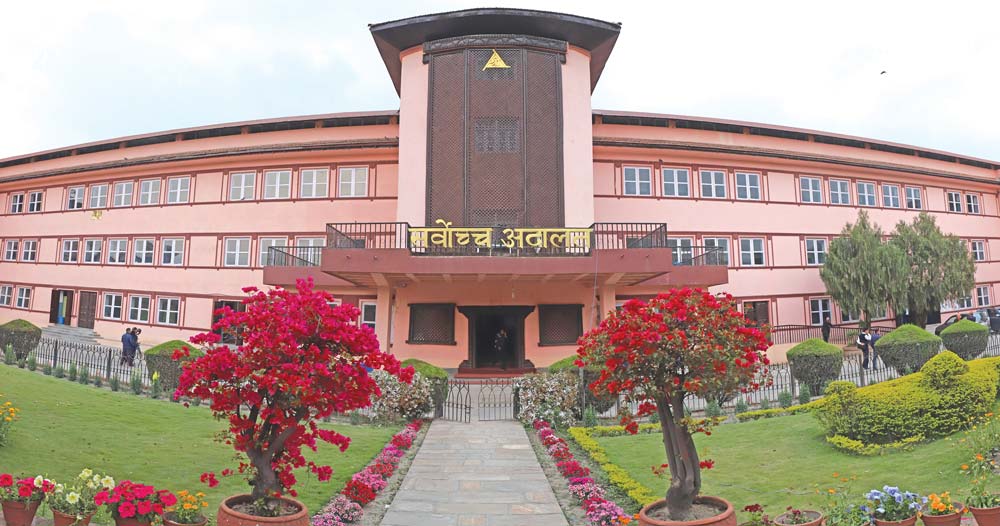

Kathmandu, May 17: The Supreme Court (SC) has issued an interim order against the government that the law enforcement officials must behave and cause others to behave respectfully towards every individual while implementing the customs-related rules at the Nepal-India border points.
Issuing the order on Friday, joint bench of justice duo Hari Prasad Phuyal and Tek Prasad Dhungana directed the Prime Minister's Office, Ministry of Home Affairs, Ministry of Finance and Department of Customs to ensure that the law enforcement official's behaviour is not against the right to live with dignity as mentioned in the Constitution.
The Ministry of Finance had issued a notice a year ago to implement the provision to impose customs duty on goods worth above Rs. 100. The Customs Department had begun strictly enforcing the rule from April this year.
The petitioners, advocates Amitesh Pandit, Suyogya Singh, Prashant Bikram Shah and Akash Mahato from DJ Law Associates, had demanded an interim order directing not to immediately implement or cause the implementation of the provision.
However, the SC did not clearly say anything for or against the government's decision to impose customs duties on goods worth above Rs. 100 brought to Nepal from India via land routes.
According to the order, except for controlling the transportation of goods for commercial purposes or the criminal offence of smuggling, lawful import of medicinal items related to an individual's health, items of minimal necessity used in social relations, and minimal commodities purchased for the personal use of local residents of the border area should be respected.
But the SC said clearly that imposing customs duty is a sovereign right of the government (State).
It stated that the validity, relevance, and appropriateness of the limit of Rs. 100 specified by the MoF by publishing a notice in the Nepal Gazette exercising the power conferred by the law, will be considered during the full hearing of the petition.
In their petition, the advocates had demanded appropriate orders including mandamus and prohibition not to create any hindrance or obstruction in bringing daily and monthly food supplies through the border checkpoints, to grant full exemption on any obstruction or duty on goods carried while travelling for marriage or visiting relatives, and to implement strict monitoring for smugglers.
Similarly, the petitioners argued that while individuals travelling by air are granted exemptions to bring one mobile phone handset, 25 grams of gold, and even a 32-inch television, and while at the Chinese Tibetan border points, exemptions are granted to bring goods through the checkpoints simply by verifying citizenship, it is evident that the government has discriminated people residing at the southern border.
Stating that the century old relations between Nepal and India has transformed the specific border regions into a distinct kind of Semi-Integrated Socio-Economic Zone, the petition maintained that for the people, the market across the border is of their own village, the hospital across the border is the health post of their own neighbourhood, and the relatives across the border are members of their own household.





-original-thumb.jpg)