- Saturday, 6 June 2026

Satbanjh revives amid climate change challenges

By Gokarna Dayal, Baitadi, June 6: The historic Satbanjh orchard in Baitadi, once renowned for its abundant apple harvests, is gradually changing its identity and character as climate change continues to affect the region.
Snowfall, once common in the area, has become increasingly rare, and the lack of sufficient winter chill has caused many apple trees to stop bearing fruit and begin drying up.
In response, the centre has adopted a new strategy and started transforming itself into a hub for winter fruit cultivation.
The orchard was established in 1962 on 29 hectares of land after 6,000 Red Delicious apple saplings were brought from Kashmir, India. However, as the ageing apple trees have ceased to produce fruit in recent years, the orchard has been renamed the Satbanjh Dry Fruit Development Centre. The centre's nursery now produces more than 50,000 winter fruit saplings every year.
According to technician Arjun Khadka, the saplings produced at the centre are sold not only within Sudurpashchim Province but also across Karnali Province. He said that despite the challenges posed by climate change, the nursery currently produces between 50,000 and 55,000 grafted saplings of various winter fruits. These include walnut, pear, kiwi, olive, almond, chestnut, peach and apricot.
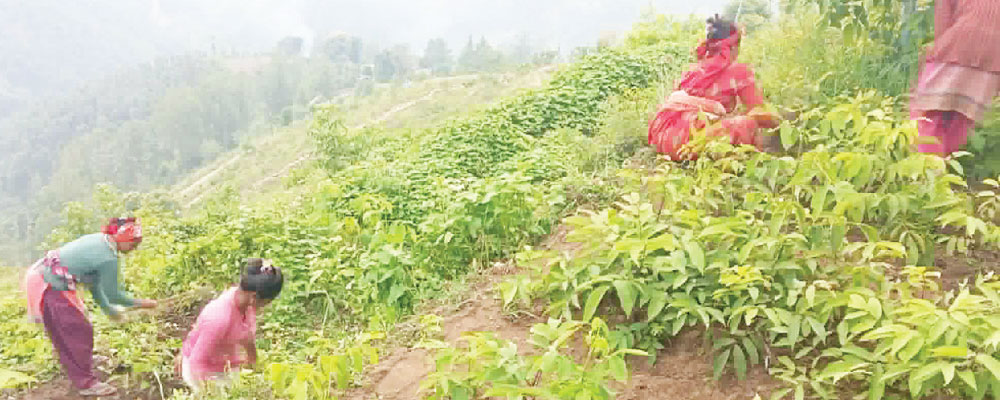
The improved fruit saplings produced at the centre are supplied to various districts of Sudurpashchim and Karnali provinces, in addition to Baitadi. At present, around 10,000 grafted walnut saplings are being raised in the nursery. Maintenance and care work has been intensified, with 10 workers assigned to fertilisation and nursery management.
Khadka said locally available farmyard manure is used as much as possible to nourish the saplings. Soybean is also planted between the nursery rows to improve soil fertility. According to him, soybean plants help absorb nitrogen from the atmosphere and store it in the soil, thereby enhancing soil productivity.
In an effort to preserve the orchard's long-standing reputation and history, several climate-resilient dwarf apple varieties, including Fuji and Gala, have recently been planted on a trial basis.
According to Sashishekhar Bista, head of the office, preparations are under way to develop the centre not only as a fruit production facility but also as a recognised study and research institution.
“We have already formally proposed to the provincial government that the centre be developed into a research and study facility, alongside our goal of producing quality saplings and helping farmers become commercial growers,” Bista said. “We are planning to adopt a new approach by establishing a dedicated research centre.”
Bista, who was recently transferred to Satbanjh, is an agricultural science specialist and a senior government official at the under-secretary level. Staff members said that, under his leadership, preparations are already under way to transform the Satbanjh Dry Fruit Development Centre into a centre for research and innovation.
Photo: Gokarna Dayal\TRN
Workers tending a walnut orchard at the Satbanjh Dry Fruit Development Centre in Baitadi.