- Saturday, 6 June 2026

Politics Demands Return To Ethical Roots

The term 'ethics' is derived from the Greek word 'ethos', denoting moral fibre or character of a person or group. Practical ethics is related to the good life of citizens at empirical levels. It embraces the concept of rightness that underlies moral obligations and the system of fundamental values such as honesty, integrity, and fairness in the conduct of authorities and people. Stretching beyond the canons of law, rule, privilege, comfort and pleasures of elites, it includes the application of justice, equality and morality as its intrinsic ideals whereby people can realise their self-worth. If the normative frame of ethics is linked to the practice inclusive of science, economics and politics, the life of society becomes orderly and peaceful. Modern consciousness has expunged the boundary of politics in the binary code of the right and the left and shifted to just and unjust spheres.
Instrumental rationality of politics rooted in material efficiency through technical, administrative, political and economic domination of people is shifting to a politics with heart and soul, social inclusion and unity, not differentiation to weaken their vibes and vigour for collective action and capacity for moral judgment about powerful actors of society. It shifts cut-throat competition to gainful cooperation beyond the power of profit. At a time of great strait of turbulence, people appeal not to reason and science only but to faith, emotion, sentiment and feeling. The power which justifies the reason for the government's existence is the promotion of public interests including public order, freedom, justice and peace. Many of these ethical ideals are inscribed in the Nepali constitution.
Constitutional ideals
Ideally, the Nepali government’s duty is to build institutions, laws and policies to realise these constitutional ideals. The search for the common good enhances the integrity and dignity of each Nepali and elevates contextual relativism to a general concern of society, reflecting the conscience of its civilisation. Acting with scruples is a moral imperative to keep society in a rational order where everyone puts a stake on it and bears responsibility for the consequences of their actions. The ethical life of Nepalis builds their social trust and cooperation with leadership and harnesses appropriate, decent conduct and sociability. This means social responsibility is critical in every aspect of life to infuse the duties and obligations of individuals, authorities, and institutions to the people, social order, and nature.
The native consideration to see individuals in the cosmic web of life refutes the Greek theory that human beings are the measure of all things. The utilitarian belief in the greatest happiness of the greatest number and Kantian suggestion that human beings cannot be reduced to the means of other human beings, they are ends in themselves, find eloquent ethical resonance in Hindu-Buddhist philosophy. This means one can agree with Aristotle, whose ethical tightrope, like Buddha’s, supposes virtuous behaviour of individuals to one another without resorting to extremism, but to the virtue of the golden mean, where each one is responsible for action.
Nepal’s classical life was duty-based, governed by the notion of dharma (virtuous conduct). The adoption of legal and constitutional tradition has inverted this culture and made life rights-based. The espousal of human rights and a free market economy has disproportionately disfigured this culture by individualising people. Modern Nepali civil society has a great appetite to rear institutions, demands, and rights of the people against the state without performing corresponding duties to build the responsive capacity of the state. The dependency on the state has increased at a time when the ruling classes have forced the state to structurally adjust to the conditionality of global institutions and private sectors. The subordination of the Nepali state to the market has eroded the writ of Nepali democracy, forfeited the power of parliament to formulate public policies, and cut the choice of the people.
The crushing burden of adjustment fell upon the shoulders of ordinary Nepalis while political elites reaped its benefits. As adjustment skewed state institutions and democracy and spread patronage networks of political parties in every sphere of public life, the ethical glue and political trust between political leaders and the people putrefied. The abdication of the government from its duties drifted its rule to an authoritarian route, not a participatory one envisaged by the Nepali constitution.
The increasing monetisation of life has cut the notion of giving something back to society. It has also made Nepali family, job and civic and political life contractual, self-chosen. Nepali constitution has related the ethical behaviour of people, the state, business and civil society and defined their boundaries of action bound by both rights and duties. Nepal’s classical business practice is rooted in the ethics of shuva lav (justice price mechanism), not alienation, while civil society is founded on niskam karma (selfless service to the needy) in society, not reckless activism. The virtues of both are harnessed to Nepal’s social development in a sustainable way without excluding the poor and weak members of society. Power and wealth entail giving to the needy under the ethical spell of Hindu-Buddhist philosophy.
As a high-leverage actor, corporate social responsibility allows businesspersons not only to become responsible to shareholders, employees, consumers and partners but also to contribute to people’s rights to work, social justice, social protection and social security. A legal framework exists in the nation. Nepali Constitution treats people as sovereign entities, not commodities to be bought and sold in the market or only workers entitled to earn remittance. The only question is its compliance and due diligence by unions, human rights bodies, media and the government. It is important to find common ground for Nepalis of enormous diversity in cognition, culture, income and temperament to organise collective action for social development beyond the consumerist haven for elites veiled in laws and structures which the current government is struggling to tear down.
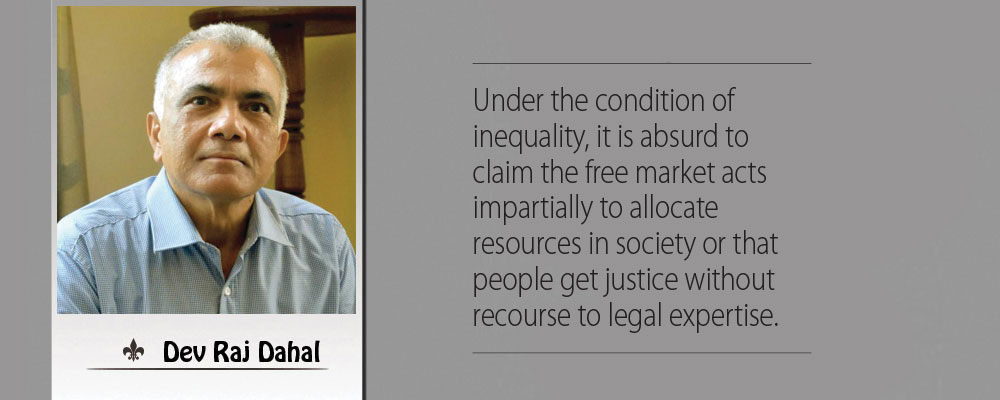
Under the condition of inequality, it is absurd to claim the free market acts impartially to allocate resources in society or that people get justice without recourse to legal expertise. When instinct for profit or hefty fees governs their behaviour, the tendency is to break the laws, affirming Nepal’s classical adage “law for the poor, immunity for the wealthy.” When those in position find slanting law convenient, the constitution remains a document of promises without teeth. In this sense, the struggle of the government to make law actionable holds a great feat in itself but its foes are crying foul. Political ethics in Nepal requires a new vision of social solidarity, as the old, ideological one is consumed by their top leaders, leaving nothing but the heartbroken crust of once-promising companionship and social cohesion.
The need for a new culture marks the revolt against the alienation of leadership from those who supported their rise to power. Rediscovering ethical issues is important to bring the people together and heal their festering wounds. The system reforms claimed by Prime Minister Balendra Shah hold utility in this sense. One great irony of business ethics is the non-recycling of the economic surpluses of society to enhance production structures, expand jobs, alleviate poverty, retain youth bulge and contribute to social peace. The economic surpluses withered as economic and political elites siphoned off profits for consumption, drained resources in luxury imports of goods and filled foreign banks. This has left its agriculture and industries stagnated while techno-feudalism is thriving.
As a result, Nepal, once a food surplus nation, became food deficient. Those at the bottom of the development pyramid are trapped in the belly of the beast, confronted from within, only to be released by migration to the foreign job market. The effort of the Balendra government to modernise agriculture and restore industries ignites a ray of hope. Democratic prospects cannot thrive if everything, including economic dynamism, is left to the private sector, which is governed by profits and hereditary profession.
If politics is run as usual, a means of acquiring power without public purpose, the Greek dictum “the weak suffers what they must,” acts against the constitutional spirit of social justice. The political culture of losing self in the prevailing habits of syndicate is likely to be broken and the reckless globalisation that for long eroded the national legal and ethical framework will be restrained to protect the legitimate functions of the state to achieve self-reliance.
The government’s stress on overcoming institutional deficiencies is vital to enable the public administration to comply with its responsibilities. Nepali constitution sets a unified framework of rights and duties that allows not only the bargaining power of various actors of society but also socially desirable outcomes that can hold the society together and engage people in productive business without undermining an edifice of ecological ethics. The poor cannot afford the cost of production of public goods owing to limited means. The dynamics of society require specialised knowledge and production diversification capable of piloting the management, technology, resources and governance based on ethical principles that prevent harming each other.
Nepali political leaders are now tirelessly working to establish their primacy of authority over the bureaucracy and bichaulias and asking them to shift their focus from career enhancement and mythical rationality of belief to the ethics of public duty and responsibility. It can help enforce rules and deliver public goods and services. It is related to their performance and sustains the reputation and integration of Nepal’s organisational life, so far left to teeter in the informal sector without a semblance of social protection. The Balendra government is thinking of introducing ethical education in the schools, which is essential to make citizens active, responsible and virtuous, capable of balancing career and social responsibility. The invocation of the Constitution deserves importance because it entrenches people with sovereignty.
Capacity building
Capacity building is essential to carry out rights and social responsibilities. This capacity is associated with their power of voice, organization and collective action to make authorities transparent and accountable as demanded by the Nepali Constitution. The utilization of ethical substances to improve moral and material conditions of people can unshackle them from impoverished life, clutches of misfortune and improve their life possibilities for freedom, justice and dignity. A responsible government knows how to care for the people’s wellbeing, become empathic, caring and responsible for its behaviour.
The new leadership of Nepal must learn how to become sensible while acting on behalf of the people and respect the trust and mandate they have bestowed on them. It is the moral obligation of the government, civil society and even business and their practical necessity, to nurture morality in society through ethical and civic education both as a duty and obligation and harness their maturity, enabling them to assume public responsibility of active citizens able to protect public property, pay tax and provide needed service to the nation and people in times of weal and woe. To conclude, ethical culture is associated with the social welfare of Nepalis, their education, health and wellbeing in a right, desirable and good way.
(Former Reader at the Department of Political Science, TU, Dahal writes on political and social issues.)