- Saturday, 6 June 2026

Every Bite Counts: Make Food Safety A Priority

Food safety and hygiene are integral aspects of food consumption and wellness. Almost every individual may have experienced a sudden health breakdown due to the consumption of unsafe food. More often than not, microbial contamination arising from poor hygiene is responsible for the storm brewing in the stomach. From mild gastrointestinal disorders like nausea, vomiting and diarrhea to severe health complications, most would require medical intervention. Physical and chemical hazards associated with food also impart grave health concerns. The implications of unsafe food in commercial food production are far beyond financial woes. From in-house batch rejection to market recall, brand image could be tarnished and consumer faith impacted.
General awareness around food safety has gained public momentum over the years; however, the need for enhanced understanding and clarity persists. To reiterate global commitment towards this crucial aspect of health, the World Health Organisation (WHO) and Food and Agriculture Organisation (FAO) jointly mark June 7th as World Food Safety Day. Organisations across the globe working on food safety and hygiene commemorate this day with activities like awareness campaigns and interactive sessions. This year’s theme, “From burden to solutions - safe food everywhere”, is a stark reminder of the implications of unsafe food and the need to seek solutions to ensure food safety.
Challenges to safe food
Nature ensures the sanctity of its food produce and hence has its own prodigy to nourish humans. Any attempt to tarnish it could deplete its bounty of nutrients and render it unsafe. A beautiful example is the goodness of colostrum or the early milk of a new mother. This nutrient-dense composition ensures the well-being of an infant. Similarly, breast milk of a lactating mother is the only food system available for a newborn on which it thrives and grows. Times, however, are changing and many new mothers are compelled to freeze their breast milk for the baby, as they leave home for work. Poignantly though, this preserved milk wouldn’t be similar to fresh milk and the likelihood of chance contamination also cannot be underestimated.
Similarly, the goodness of a ripe food is unparalleled. Challenge arises when shelf-life needs to be extended or food undergoes processing. Contamination (physical, chemical, microbial) is a common deterrent to food safety; hence, any exposure to a hostile environment dismantles the natural composition of food. A classic example is the splitting of milk caused by disruption in the cold chain temperature, which renders it unsafe.
The demand for processed and ready-to-eat food is increasing in Nepal. Online food delivery is gaining ground here. Similarly, the niche market of authentic cuisine is also becoming popular. Local-level governments are boosting communities to sell traditional foods. Delicacies served on attractive handmade leaf plates lure food connoisseurs. While these trends may appear lucrative, impending food safety concerns cannot be undermined. The likelihood of exposure to contamination is high here, as food is often cooked in open courtyards, adopting traditional practices. Moreover, preliminary food preparation is often done at other locations and transported to market sites.
The post-COVID-19 years witnessed a heightened sense of public consciousness regarding personal hygiene and sanitation. Lessons learnt from the brutality of microbial infection have percolated into human behaviour. One such subtle testimony to increasing awareness around food hygiene is the fading demand for Kachila, a delicacy made from a fine mixture of raw minced meat and spices. Kachila is native to Newars, an indigenous tribe of Nepal, and still holds relevance amongst some communities residing in the Kathmandu Valley.
To ensure food safety, validated technical protocols need to be adhered to during food processing. Food material quality, cooking adequacy, packaging material quality, handling practices, use of food safety gears and general hygiene aspects also require stringent vigilance. Guidelines about storage and delivery conditions up till the point of consumption should be duly followed. The food chain of perishable products, including milk, meat, seafood and eggs, requires close monitoring.
Shift
The growing shift towards ready-to-eat convenience foods calls for robust food safety management in place. Some proven tools commonly adopted in this regard could include ISO 22000: 2018 (Food Safety Management System as per International Organisation for Standardisation), HACCP (Hazard Analysis and Critical Control Point), and GMP (Good Manufacturing Practices).
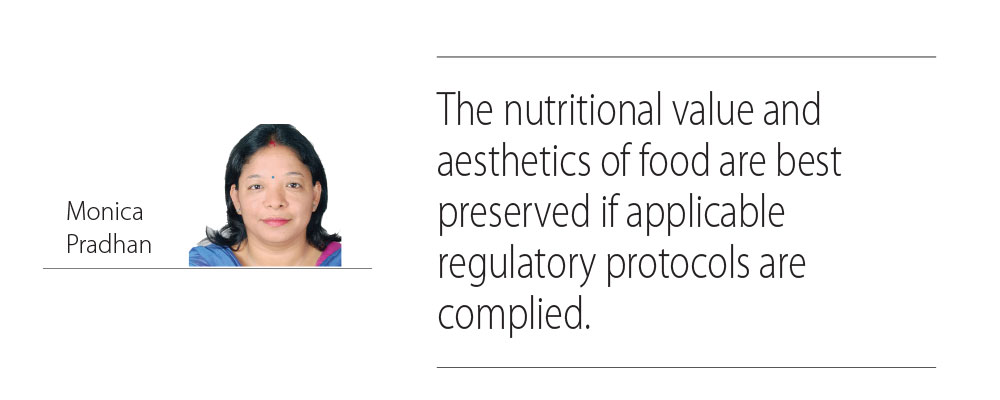
Commercialisation of food opened avenues to enhance shelf life of harvest and the processed food industry has been thriving since. The constituents of food, be it natural or processed, are a scientific amalgamation of nutrients compiled in a unique composition. Any exposure to incompatible environmental conditions leads to a progressive deterioration in food quality. The nutritional value and aesthetics of food are best preserved if applicable regulatory protocols are complied. Likewise, the emerging traditional food market also needs to be assessed to detect food safety risks concealed within those long-standing practices. Every life is precious and no individual should fall prey to malpractices. This World Food Safety Day, let's pledge to spread awareness on food safety and walk the path towards wellness and a more resilient society.
(The author is a food technologist and can be contacted at monicakpg@yahoo.com).