- Saturday, 6 June 2026

Flood empties Jogbuda's once thriving settlements

By Puskar Bhandari,Dadeldhura, June 6: Until two decades ago, the fertile plains of Jogbuda in the Inner Madhes region served as a refuge for families migrating from various districts across the country.
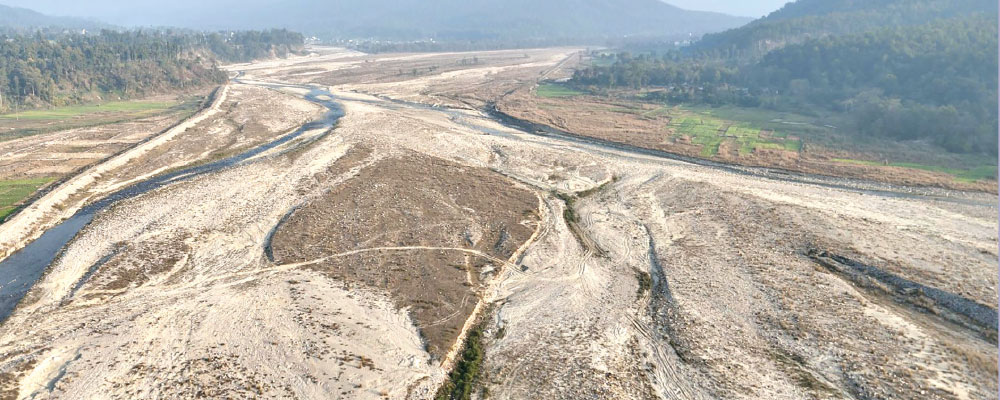
Fields carved out of dense forests, homes built through years of hard work and a growing marketplace symbolised prosperity. Today, however, many of these settlements are gradually being abandoned as erosion caused by the Rangun and Pantura rivers continues to destroy land and property.
Annual floods have not only washed away farmland but have also swept away homes. As a result, the number of people leaving Parshuram Municipality-6 and surrounding settlements has been increasing every year.
Despite government records showing that more than Rs. 2 billion has been spent on flood control projects over the past two decades, locals said they still do not feel safe.
“We pay taxes to the government, but even after losing our homes to floods, we have received neither justice nor protection,” said 70-year-old Bajir Saud of Thannjhalla. “There has been no resettlement and no durable embankment. Where are we supposed to go now?”
According to Saud, who migrated to Jogbuda from Achham around 1977/78, the area was then covered by dense forests of khair and sissoo trees. There were no roads and no market centres. Following government policies that encouraged forest clearance and timber collection, the forests gradually disappeared and settlements expanded.
“One family arrived and then another followed. Hillsides were cleared and turned into farmland,” he recalled. But after 2003, the nature of flooding changed. It no longer destroyed only fields, entire settlements began to be washed away, he added.
He said forests and shrubs previously helped slow floodwaters. Today, most of the trees along the riverbanks have been cut down, allowing the rivers to flow directly towards settlements. Millions spent on embankments that failed
After the introduction of the federal system, Parshuram Municipality initiated the construction of gabion-wire embankments from Sargauda to Simalkhet after 2017. Even before that, millions of rupees had been spent on various river-control projects.
According to Ramesh Paneru of Kuna village, nearly 20 kilometres of gabion embankments were constructed during the fiscal year 2017/18. Irrigation canals were also developed in the affected settlements.
“However, the Rangun and Pantura rivers eventually destroyed the main embankments. The structures have now collapsed, and floodwaters are once again entering farmland,” he said.
Paneru alleged that the projects were implemented through fragmented budgets rather than long-term planning. As a result, structures were built without comprehensive studies of river behaviour and were damaged during the first major floods.
Flood threats remain a permanent concern in Sargauda, Thannjhalla, Simalkhet, Kuna and Chandani. Some families have relocated to community forest areas, while others continue farming temporarily on riverbanks despite the risks.
“We used money earned from working in India to hire bulldozers and create farmland. But the river washed everything away again. There is hardly any basis left for staying in the village,” according to him.
He said most households have now sent family members to India for labour work, and many homes stand empty. Over the past few years, dozens of families have migrated to safer locations. Student numbers in local schools have declined, while large areas of productive farmland have been transformed into barren riverbeds.
Parshuram Municipality-6 is geographically one of the most vulnerable areas in the region. It is bordered by the Mahakali River to the west, the Sandani stream to the south and the Rangun-Pantura river system to the north.
Although the Chure hills lie nearby, dozens of seasonal streams become highly destructive during the monsoon season.
According to Paneru, greater damage is caused not by the seasonal streams but by the Rangun, Pantura, Mahakali and Sandani rivers. As erosion continues to increase each year, the amount of cultivable land is shrinking, forcing residents to leave their villages in search of safer and more secure futures.