- Sunday, 31 May 2026

Debate over provinces reopens with initiation for statute amendment
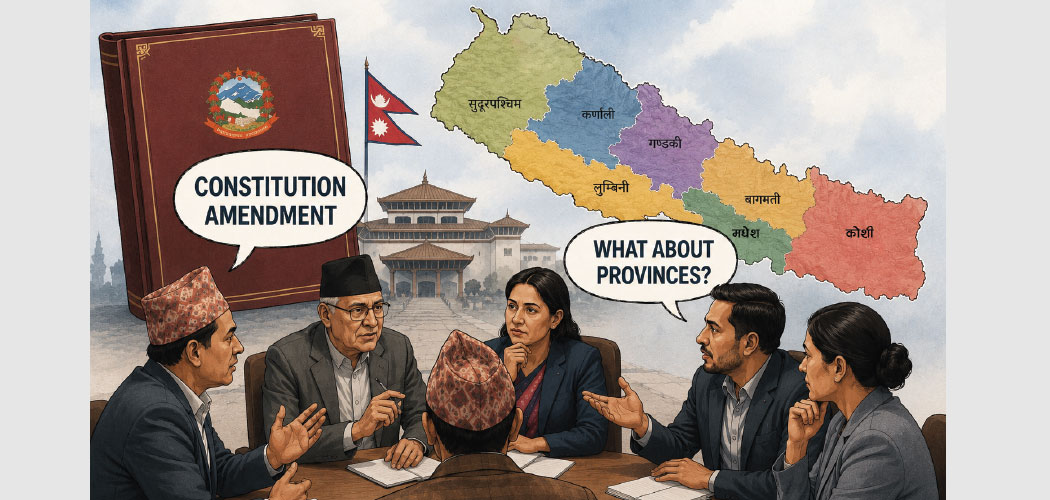
Kathmandu, May 11: At a time when public sentiment is quite against the provinces in the current three-tier federal system in Nepal, concerns are growing about the fate of the subnational governments with the government forming a task force to study and suggest reforms in the constitution.
Not only the ruling Rastriya Swatantra Party (RSP), but also the opposition parties have expressed commitment for constitution amendment in their election manifestos.
Many of those who favour the provincial structure are apprehensive of the RSP's earlier policy to scrap it. However, this has been greatly moderated with the its Senior Leader and now Prime Minister, Balendra Shah, announcing at the very first election mass meeting in Janakpur that the provinces would be strengthened.
Later, the RSP's manifesto promised to continue with the provincial structure. The party said that within three months of assuming office, a ‘discussion paper’ regarding proposals for constitutional amendments would be prepared with the aim of building a national consensus.
According to it, a reformed provincial structure will be an agenda for the amendment along with a fully proportional parliament, a provision ensuring that members of parliament cannot serve as ministers, and non-partisan local government.
Federalism expert and chair of Federalism and Localisation Centre (FLC), Dr. Khim Lal Devkota, said that common people have an impression that provinces have added additional burden to the state with too many ministries and are running sans good governance. They are not innovative and have been the carbon copy of the federal government.
Contrary to it, the provinces blame the federal government for unnecessary interference without lending hand for cooperation and collaboration. Provinces also say the federal government doesn’t support them in the formation of necessary laws and provide staff to run every day operations.
Speaking at an interaction on federalism in constitution amendment organised by FLC in Lalitpur on Sunday, Dr. Devkota said that provinces are not expensive as they only use 4.69 per cent of the total national budget and 61 per cent of their budget is allocated for development work.
RSP Lawmaker Mohan Lal Acharya, who is also the member of the task force, said that many problems were created not because of the intention of the policy provisions but their distorted implementation.
"The issues in federal governance that are not obstructed by the constitutional provisions should be immediately reformed and resolved. Then we can plan for the reforms in the critical areas," he said.
The task force is led by Political Advisor to the Prime Minister Asim Shah and includes Acharya from RSP, Bhishma Nath Adhikari from CPN (UML), Dev Prasad Gurung from Nepali Communist Party, Gyanendra Shahi from Rastriya Prajatantra Party, Manoj Bhatta from Rastriya Janamorcha, law secretary at the Prime Minister's Office Pushkar Sapkota, Secretary of Nepal Law Commission Indira Dahal and Chief of Law and Judgement Implementation Division at the PMO, Liladhar Subedi.
Speaking at the programme, Acharya said that the task force will create a discussion paper after extensive consultations with stakeholders.
"There are less chances of scrapping the provincial structure for the time being but we must scrap the district administration which has created a fourth level in the three-tier federalism," he stated.
According to him, relocating ministries like education, health and agriculture along with their departments to the provinces will help in streamlining the services and increasing efficiency.
Weak leaders weakened provinces
Nima Giri, a lawmaker from Lumbini Province, said that appointment of weak leaders to the post of chief minister has contributed to the poor performance of provinces.
"Chief secretary of the province is de facto chief minister," she said.
President of the Nepal Federation of Indigenous Nationalities Nima Lama Hyolmo showed apprehension towards radical changes in the current status and structure of provinces. However, he advocated for directly elected chief minister to ensure stable leadership in the sub-national government.
Many experts said that provinces should be shaped as development institutions to carry out social and infrastructure development. If given more resources, they can perform better, they said.
NCP leader Gurung said that federalism should be redefined in a way where the central government will do the policy making, provinces development works and local body service delivery – this can be an effective proposition to make the current federal structure effective.
Gurung and several experts indicated that the chief ministers could be elected directly to ensure political stability at the provinces.
'Tourist' staff hampered governance
Dr. Dipendra Rokaya, former planner from Karnali Province, suggested to keep nine ministries at the centre and five in the provinces to reduce the size of the government and administrative costs.
"Entire Humla is a single election constituency which means it gets less budget, less attention and less representation. Our voices are not being heard. This is the challenge," he said while adding that the current formula allocated more budget to the areas on the basis of demographics.
Most of the staff at provinces and local bodies are 'tourists' who don't care about the sustainable development and governance, he said.
Former chief secretary Dr. Som Lal Subedi suggested to take into account the governance capacity of provinces as well as federal government. "One federal infrastructure agency has more budget and power than the provincial chief minister. We only created skeleton of the federal structure but failed to give life to it," he said.
Likewise, former chief minister of Madhes Lal Babu Raut raised concerns over the intentions of the federal leaders, including prime minister, in enabling provinces in the spirit of the constitution.
"No political leader of major political parties contributed to strengthening the provinces but their efforts were to weaken the system. They were not honest in this regard. Province police and civil servant law of Madhes were good examples, we were actually obstructed by the federal government," he said.
According to him, once there was a situation – federal leaders neither wanted to kill the provinces nor activate them.
Power sharing, not decentralisation
Meanwhile, many experts also suggested the provinces to execute the existing right list.
Leader of UML Adhikari said that all service delivery units should be sent down to province or local level.
"Initially, there were doubts about the capacity of both provinces and local governments but now they have proven their ability," he said.
He suggested to review the practice of provinces in generating resources and exercising their rights and improving service delivery. Continuing with the current structure in the name of federalism will be counterproductive, he said.
Likewise, leader of Nepali Congress parliamentary party in the National Assembly Radheshyam Adhikari said that altering the rights of the subnational government will be more challenging since provincial consent should also be maintained.
"This is not decentralisation, it’s power sharing, many leaders still don't understand it. Nobody cared for power sharing," he said.





-original-thumb.jpg)