- Friday, 29 May 2026

The Small Earth Nepal to install climate tracking system in Humla

Kathmandu, Mar. 8: : Until 10 to 20 years ago, Padma Dorjee Lama, Principal of Namkha Khyung Dzong Monastery in Yalbang, Humla, used to witness up to 2 feet of snowfall during the winter season. However, he said the volume of snow has now decreased drastically to barely a foot.
According to him, snowfall patterns have changed drastically over the past two decades.
“Snow and rainfall have become increasingly unpredictable. Sometimes there is a sudden snowfall after the winter season and at other times it occurs even before the season begins. The pattern has become unbalanced,” he said.
With rising temperatures, noticeable ecological changes have begun to emerge in the region.
Animals that were previously found in lower altitudes are now being spotted in higher areas. “Species like musk deer (locally known as dumshi), foxes, deer and monkeys are now seen around here,” he said, adding that some wildlife has become less common in recent years.
Water sources have also been affected, he said. There are many small lakes in the area, but their water levels have declined significantly. “There used to be plenty of water in those lakes, but now only a small amount remains,” Lama said.
However, there is no weather monitoring station in the area so far, and local people rely largely on their own observations to assess changing weather patterns.
There is strong recognition that Himalayan communities possess detailed indigenous environmental knowledge. In the absence of scientific instruments, monks conduct rituals to pray for rain during droughts and interpret climatic patterns through traditional calendars, which guide pastoral activities and agricultural practices.
Pemma Wangchen Gurung, Vice-Chairman of Shey-Phoksundo Rural Municipality in Dolpa, said rising temperatures are having a major impact on high-mountain regions like Dolpa. “We do not have the luxury to cultivate crops whenever it rains. For good production, there should be three seasonal rainfalls or snowfalls,” he said.
Dolpa is famous in the country for the Himalayan gold, called Yarsagumba, and its production depends on snowfall. “This year we had good snowfall, so we expect a good harvest of Yarsagumba. The snowfall we received in October/November, 2025, is the best in the last 10 years,” he added.
He said that water sources are also changing in the area. “Places that had no visible water are now seeing water again, while some areas that used to have water have gone dry,” he said.
Gurung also highlighted changes in agriculture. “We never used to get good vegetables grown like in the lowlands, but now we can cultivate cauliflower, cabbage and tomatoes in greenhouses. Still, the situation is very different from the last few decades,” he said.
He also said that traditional weather predictions based on lunar calendars are becoming unreliable. “There used to be rituals according to the lunar calendar, but now we cannot predict the rainy season or the start of winter because snowfall is no longer regular. Climate patterns are shifting dramatically,” Gurung said.
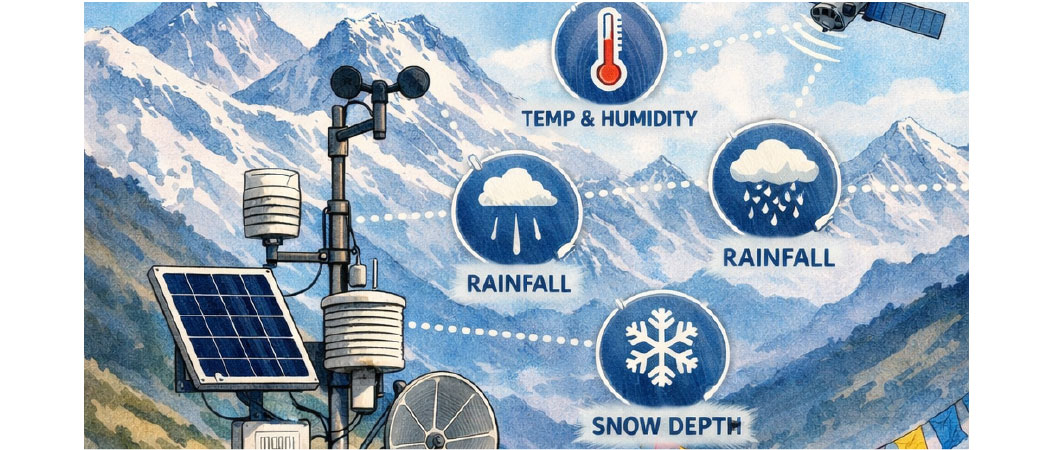
Amid the growing need to obtain reliable scientific meteorological data, The Small Earth Nepal has initiated the HiM-DATA (High-altitude Monasteries for Data Acquisition, Tracking and Awareness) initiative.
HiM-DATA is a collaborative initiative aimed at strengthening climate data collection, raising awareness, and promoting community-based climate action in high mountain regions through meaningful engagement with monastic institutions, said Dr. Dhiraj Pradhananga, UNESCO Chair in Mountain Cryosphere and Water.
The monastery in Namkha Rural Municipality-2 of Humla, which hosts around 500 residential students, has been identified as a suitable pilot site for the installation of an automatic weather station under the HiM-DATA initiative at an altitude of 3,190 metres above sea level. The site was selected because the region has limited weather station coverage, and the installation will help fill important gaps in high-altitude climate observations.
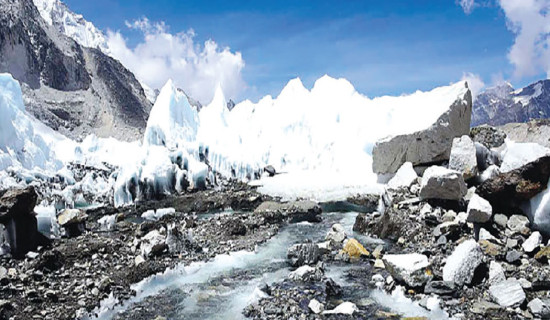
High mountainous areas are more vulnerable to the possible impact of climate change, and glaciers are melting rapidly. The weather stations in such areas are sparse, so the automatic meteorological weather station would be very beneficial for monitoring the changing weather and climatic conditions in the high mountainous areas said Dr. Pradhananga, who is also Associate Professor of Hydrometeorology, Tribhuvan University.
According to the Principal Lama, the monastery lies between two streams, and local residents depend on stream water for drinking. “We drink water directly from the streams,” he said.
Speaking about the weather station to be installed at the monastery, Lama said monks reside there throughout the year and are ready to take responsibility for maintaining the equipment. “If the device gives reliable results, we will better understand where the climate is heading. It will make it easier to know the weather patterns,” he said. “We will take responsibility for maintaining and properly utilising the equipment.”
According to Lama, they have been informed that an automatic weather station for meteorological data will be installed at the monastery premises, which has been identified as a suitable location. As per the received information, only a 5 by 5 metre area of land will be required for the installation, he said.
Lama reiterated that global warming has significantly affected the region. “Climate change has had a clear impact here, and a lot of research is necessary,” he said.
“There has already been a lot of research conducted similar to the HiM-DATA initiative. Despite the region’s vulnerability, climate monitoring remains limited, with past efforts to install automated weather stations often failing due to maintenance challenges,” Dr. Pradhananga said.
According to him, the proposed approach uses monasteries in remote, high-altitude areas, many of which are occupied year-round, as secure sites for the stations. By sensitizing monks, nuns, and lamas about climate change and raising awareness among local communities, the project aims to help bridge critical data gaps and support locally informed adaptation strategies.