- Thursday, 11 June 2026

Parties float green slogans in election manifestoes

Katmandu, Feb. 28: As political parties race for the House of Representatives election scheduled for March 5, their political agenda have expanded into a diverse collection of national priorities.
These political agendas range from promises like free internet and infrastructure development to sophisticated climate strategies aimed at addressing environmental future.
The Rastriya Swatantra Party (RSP) has positioned itself in the frontline of this shift, moving away from its 2023 focus on localised urban pollution and “dust-free cities” toward “Climate Diplomacy.”
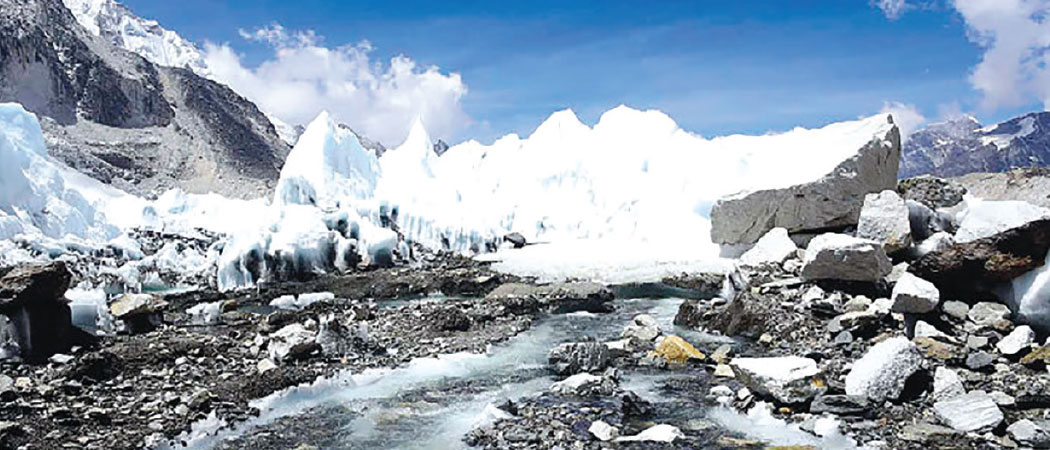
In its latest (2026) manifesto, it said the country should stop seeing itself as a victim of climate change and aim to become a global leader. Their plan, called the “Climate Diplomacy Roadmap,” focuses on seeking compensation from major polluters and securing international funding through a National Climate Finance Strategy.
By focusing on mountain conservation and technical representation at summits like COP, the RSP aims to turn country’s environmental vulnerability into a source of international leverage and economic justice.
Similarly, the Nepali Congress (NC) has responded with a plan called “Institutional and Financial Greenery.” Launched from the climate-vulnerable Madhes region, their manifesto, Pratigya Patra, focuses on the economic side of environmental protection.
The NC’s manifesto says it will seek to build a domestic green economy through “Green Bonds” and a specialised unit designed to maximise the inflow of the Green Climate Fund (GCF).
Meanwhile, the CPN-UML has maintained its focus on large-scale infrastructure and state-led economic transformation, but it has significantly "greened" its narrative compared to 2023. The CPN-UML’s 2026 manifesto focuses on linking climate action with economic growth and technology. It proposes carbon trading and the “One Community Forest, One Enterprise” scheme to turn forest conservation into income and jobs, while investing in green hydrogen for clean energy exports.
The party also plans AI-driven early warning systems for disasters, a national forest fire response centre, and “zero waste” urban strategies including utility tunnels and green belts. For resource governance, UML supports scientific river material extraction and resettling vulnerable communities in the Chure hills to protect fragile ecosystems.
The newly formed Nepali Communist Party (NCP), a merger of the Maoist Centre, Unified Socialist and others, frames its 2026 manifesto around scientific socialism and resource nationalism. It promises intensive climate adaptation programmes for Himalayan communities, a legal framework for carbon trading to monetise forests, and AI-driven early warning systems for earthquakes, floods and Tarai heat waves.
The party also pledges a national forest fire high-alert centre and aims to secure Green Climate Fund support for resilient rural infrastructure.
Talking to The Rising Nepal about the environmental and climate commitments in the manifestos and their implementation, environmentalist Bhusan Tuladhar said that while the documents contain many pledges, similar promises were made in previous elections. He noted that this time parties appear to give greater emphasis to environmental issues on paper.
However, he added that these issues have not featured strongly in election campaigns and are rarely seen being implemented on the ground. “If we look at the RSP manifesto, it lists 100 points, of which around 10 focus on forest and climate change issues,” he said.
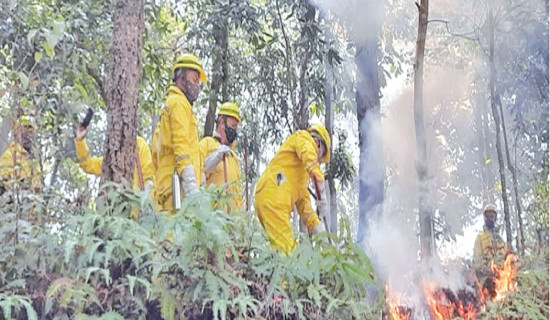
He pointed to Point 88, which addresses forest fires and promises to establish a Forest Fire High Alert Centre. According to the manifesto, the centre would use drones and satellite technology to detect and control fires. It would act as a central system for fire management, integrating satellite data with local reporting to identify heat signatures before they turn into large blazes.
The plan also includes training and equipping specialised volunteer units within community forests with modern firefighting equipment, rather than relying solely on traditional methods such as beating fires with green branches.
Tuladhar said the manifesto focuses mainly on controlling fires once they break out but does not clearly address prevention. In contrast, he noted, the Nepali Congress has proposed reducing fire risks by collecting dried leaves and forest waste in advance and encouraging local communities to form fire brigades.
“What I can say is that including environmental issues in the party’s manifesto is always a positive part but their implementation part remains weak as most of the political leaders even do not know what the points in the manifesto are."
He also said that the "Madhes" region and the "Chure" hills are identified as critical zones for adaptation. While political leaders often use these regions for "vote-bank" politics, the environmental necessity is water and soil conservation. He also suggested that this requires specific focus on open-space preservation and heat-wave (Loo) mitigation, which must be reflected in the federal budget, not just in campaign speeches.
Watershed expert Ngmindra Dahal said political manifestos are often conditional and rarely implemented after elections. “Political parties tend to forget their commitments once elections are over, and even when they form the government, their priorities shift,” he said.
He noted that many election agendas focus on popular slogans such as one tap, one household without proper study of their long-term feasibility. “These issues are reduced to short-term, self-interested promises rather than sustainable and realistic plans,” Dahal added.