- Saturday, 30 May 2026

Cross-border pollution chokes Tarai, Capital
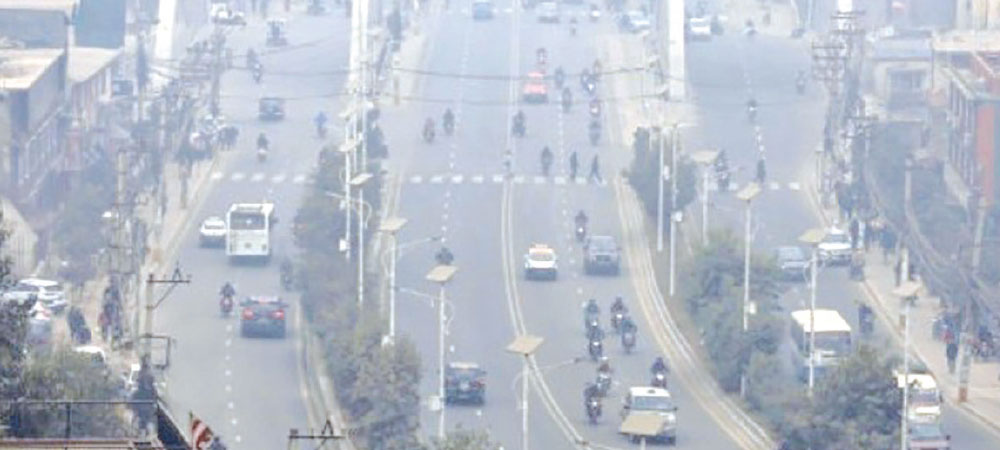

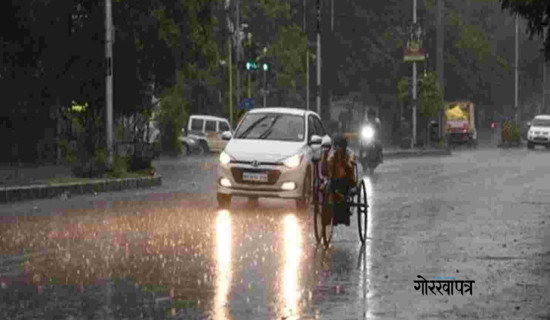
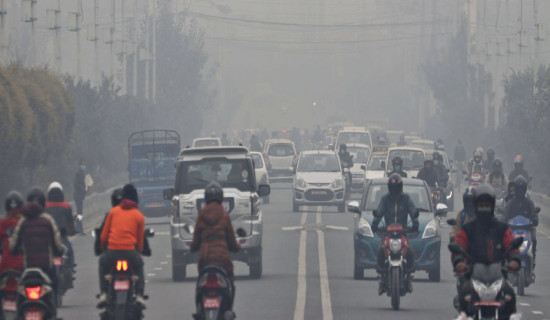
Kathmandu, Jan. 28: With no rainfall so far this winter to clear the air, people across the Tarai and mid-hill regions are enduring worsening air pollution, much of it drifting in from across the border rather than coming from local sources.
The prolonged dry conditions have allowed harmful fine particles to linger in the atmosphere, pushing pollution to unhealthy levels and increasing health risks for millions.
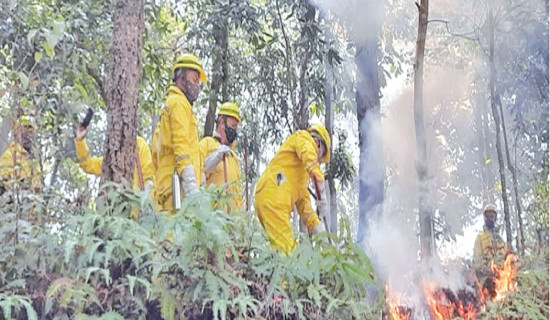
Smoke from vehicles, crop residue burning, road dust, emissions from brick kilns and forest fires are blamed for worsening pollution in the Kathmandu Valley, whose geographical setting traps most pollutant particles.
Experts argue that not only local sources but also cross-border pollution is causing pollution levels to rise. Polluted air first enters the Tarai region from India and then moves towards Kathmandu, said Hasana Shrestha, environment inspector at the Department of Environment.
Meanwhile, a survey carried out by the Central Department of Environmental Science at Tribhuvan University in collaboration with Duke University and the US State Department, said severe air pollution episodes during the winter season are largely driven by pollutants transported across the border, rather than by local sources such as agricultural burning.
Shrestha, who conducted the study as part of her PhD research, said they installed 71 low-cost air quality monitors across the country’s major physiographic regions to measure fine particulate matter, known as PM2.5, which poses serious risks to human health.
The study focused on a high-pollution episode recorded between December 28 and 30, 2022, during the dry winter season.
During this period, the PM2.5 levels exceeded the “unhealthy” threshold for several consecutive days in many parts of the country, she said.
“To understand the scale and sources of pollution, we analysed data from an average of 16 sensors in Kathmandu, five in Pokhara and 10 independent sensors across the Tarai. The study also paired four urban sites in the Tarai with nearby rural locations to compare pollution levels and assess whether urban emissions were influencing surrounding areas,” she said.
The paired sites were selected from western, central and eastern Tarai regions, including Mahendranagar, Lumbini, Bharatpur and Biratnagar. “We also ensured that urban and rural sites were within a 50-kilometre radius, at similar elevations, and positioned so that rural areas were upwind of urban centres. This allowed the team to separate local pollution from pollution transported over long distances,” she said.
The results showed a sharp rise in PM2.5 concentrations across all regions during the three-day episode. The highest increase compared to the two-month average was recorded in Kohalpur, where pollution levels rose by 81 per cent. Bharatpur in the Inner Tarai saw a 79 per cent increase, while Pokhara recorded a 57 per cent rise. Smaller but still significant increases were observed in Butwal (20 per cent) and Janakpur (26 per cent).
She said the study found that non-local sources accounted for between 61 and 82 per cent of PM2.5 pollution throughout December, meaning most of the harmful particles measured in the air were not generated locally but originated from regional or background sources.
To identify these sources, the team combined ground-based sensor data with meteorological analysis, satellite observations and atmospheric transport modelling.
“Satellite data from the Visible Infrared Imaging Radiometer Suite showed a steady build-up of aerosol pollution over the Indo-Gangetic Plain between December 26 and 31, moving towards Nepal,” she said.
Shrestha also said fire emission data from global satellite systems showed minimal biomass burning activity during the episode, ruling out agricultural residue burning as the main cause of pollution. Instead, the study suggested that non-fire sources such as industrial and urban emissions played a major role.
Speaking about the research findings and cross-border air pollution, air quality expert Dr. Bhupendra Das said several studies have already examined cross-border pollution, but this research is more comprehensive as it captures more in-depth and wide range data.
“While discussing cross-border pollution, we also need more detailed research to identify the sources and determine how much each contributes to raising pollution levels. Developing an emission inventory is essential, and continuous research is needed to better understand cross-border pollution,” he said.
He also said that once pollution enters the Kathmandu Valley, it does not disperse easily and tends to remain for longer periods.
However, pollution in Kathmandu is not caused by outside sources alone, as vehicle emissions, smoke from brick kilns and construction activities within the Valley also contribute and need to be addressed.
According to Shrestha, “The findings stressed the need for stronger regional cooperation on air pollution control. While Nepal’s Air Quality Management Action Plan 2020 focuses mainly on the Kathmandu Valley, there is no strategy for the heavily affected Tarai belt.”