- Thursday, 11 June 2026

From streets to painting, Dhankuta’s orange town comes alive
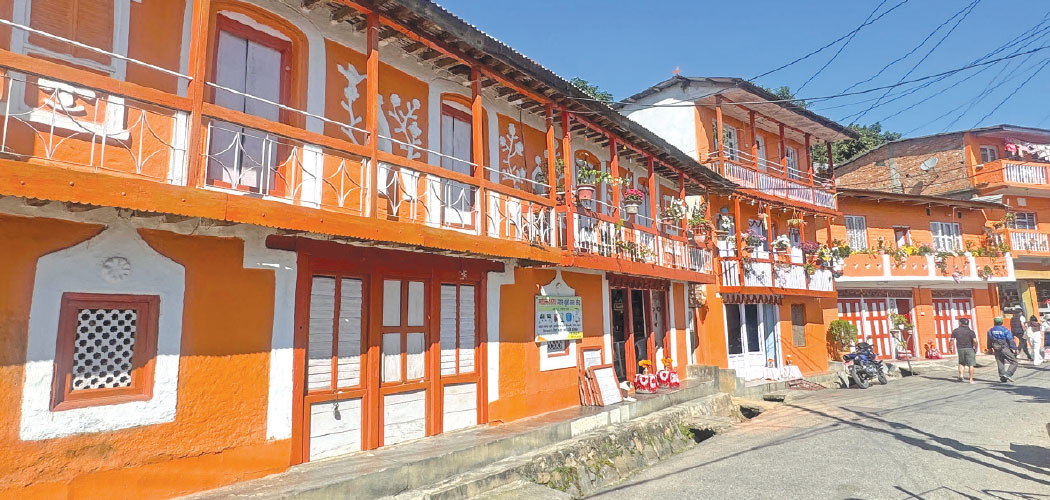

Dhankuta, Nov. 11: What comes to mind when you hear the words “Orange Town”? Perhaps a place filled with orange trees and the scent of citrus in the air. But in Dhankuta, Nepal’s Orange City tells a different story, one of colour, culture and community.
Nestled on the green hills of eastern Nepal, the twin settlements of Tallo Kopche and Mathillo Kopche have become famous not for growing oranges, but for being painted in their vibrant hues.
Every house, from old traditional homes with carved wooden windows to newer concrete structures, glows in shades of orange, giving the entire town a warm, cheerful appearance.
Many of these homes are nearly a hundred years old, preserving their traditional architecture and design. Flowers bloom on terraces, adding splashes of red, yellow and pink that blend beautifully with the orange backdrop. Together, they create a scene so picturesque that it feels like walking through a living painting.
The idea of painting the entire town orange began around 20 years ago as part of a local beautification campaign, said Sameer Shrestha of Tallo Kopche in Dhankuta Municipality-5.
“People were leaving the town, and there was not much to attract visitors anymore. Since Dhankuta is already famous for its oranges, we thought, why not give the town a unique look that reflects its identity? The orange colour not only matches with our name but also brings warmth and charm to the place,” he said.
According to Shrestha, the idea was first discussed among the town’s senior residents, who sought technical advice from local engineers before reaching a collective decision to paint the two settlements orange.
“We did not wait for outside help, everyone contributed what they could and started painting their own houses,” he said. There are around 300 houses along the main streets, with several others nestled inside the narrow lanes.
Community members, inspired by Dhankuta’s identity as a hill station and its nickname Orange City, wanted to give their town a distinct and welcoming look. With support from the municipality and local youth groups, residents came together to repaint their homes in the same bright shade, symbolising unity and pride in their heritage.
Shrestha said that the town is home to a mix of Rai, Newar, Brahmin and Chhetri communities, all united by a shared vision to promote their town’s identity and well-being.
“Everyone supports the idea, the sense of togetherness is strong here,” he said. While only a few international tourists visited in the past, the number of domestic visitors has been steadily increasing over the last five years.
“People love the bright colours and the charm of our traditional houses. Some film crews have also started coming here for shooting,” he added.
That is a great piece of local reporting! It connects the Dhankuta "Orange City" initiative to a comparable heritage preservation efforts in Kathmandu.
Here is the professional English translation:
Shashi Thapa, a Ward Member of Kathmandu Metropolitan City-5, who was visiting to observe the 'Orange City,' said that the exchange of experiences between Kopche and Hadigaun holds special significance, and he gained the opportunity to learn many things from the 'Orange City.'
He said, “Hadigaun is a Licchavi-era city where modern development is taking place while preserving the old civilisation and architecture. Similarly, Kopche can also learn from the community unity and coordination between the local governments.”
According to him, this very model will be an inspiration for Kopche as well. What began as a small initiative quickly transformed the two settlements into living canvases.
Visitors now wander through narrow alleys lined with bright orange houses, marvelling at the harmony and warmth the colour brings to the town.
For the residents of Tallo Kopche and Mathillo Kopche, the orange walls are more than just paint, they reflect community spirit, shared identity, and the vibrant heart of Dhankuta.
Walking through the narrow streets, visitors quickly realise that this is more than just a tour. The walk takes them through the community’s revival efforts, from the vibrant, heritage-painted houses to the town’s most treasured cultural landmarks.
It celebrates country’s traditions while offering a highly personal experience, allowing guests to connect with the local people and their renowned warmth and hospitality.