- Tuesday, 14 April 2026

Intergenerational poetry session held
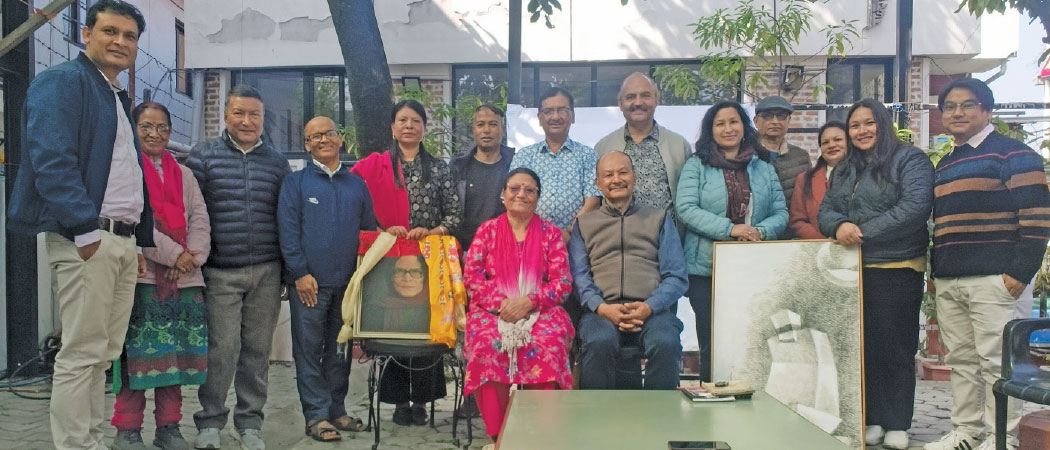

By A Staff Reporter,Kathmandu, Mar. 17: On a tranquil morning at the historic Rato Ghar in Ravibhawan, Kathmandu, the 'Bartaman Kabita Samuha' gathered for an intimate literary session titled 'Agraj sanga Bartaman Kabita' (Contemporary poetry with senior creators). The group was hosted by the distinguished literary couple, Poet Sneh Sayami and Poet Laxmi Mali.
During the programme, Bishwa Sigdel of the 'Bartaman Kabita Samuha' emphasised that dialogues between generations in programmes like this hold profound significance.
Sneh Sayami, a pivotal figure in Nepali poetry since the 1970s, opened the session by sharing his early struggles during the Panchayat era, his encounters with the legendary Bhupi Sherchan, and his close association with the iconic writer Parijat. Sayami recited several poems, including 'Shankhadharko Nuga: Khwa,' which explores the cultural evolution of Thimi, and 'Rajmarg,' a satirical take on the country's unstable political and physical infrastructure. His final poem, 'Jhola', left a deep impact, poignantly contrasting the revolutionary zeal and simple tools of his youth.
The session took an emotional turn as poet Laxmi Mali shared her life journey. From being driven to a poetry meet in Bal Krishna Sama’s car as a child to caring for her paralysed father for years, her life has been a testament to resilience. As a pioneering headmaster, she transformed a school by prioritising girls' education and fighting against child marriage. Her poetry, deeply influenced by Parijat’s social-realist philosophy, reflected these experiences. She recited 'Nachhe Galli,' a nostalgic look at her childhood neighbourhood, 'Samarpan,' dedicated to her supportive brother, and her signature poem 'Aama Timro Naam Ke Ho' (Mother, What is Your Name?), which questions the erasure of a mother’s identity in society.
The programme featured a diverse array of voices from the contemporary poetry scene. Dhir Kumar Shrestha recited 'Badal Mathi Mathi,' reflecting on the importance of staying grounded despite reaching great heights. Bhishma Upreti shared 'Kamal,' symbolising resilience in the face of adversity, along with 'Guraansko Bot' and 'Malai China,' exploring identity and nature. Bidhan Acharya brought historical depth with Thimi to Thimi.'
Prahlad Sindhuliya presented a biting political satire titled 'Janmajat Krantikari ko Biggapti,' lamenting the forgotten dreams of martyrs, and 'Simana ko Huliya.'
The plight and strength of women were central themes in the recitals of Avaya Shrestha, who read 'Akhil Strijanko Dukhanta Prem Katha,' and Rima K.C., who presented the fierce 'Sristiko Prayogshala ma,' a bold protest against rape and violence. Rita Balami offered a touching ghazal-style poem, while Anita Lama’s 'Ghar' explored the hollowness of modern urban life, where large houses lack the warmth of culture and maternal love.
Basudev Adhikari’s 'Gen Z' examined the tech-driven lives of the new generation, alongside his reflective 'Maunata ko Geet.' Rami Priya’s 'Rahar' touched upon the universal nature of human desire and struggle. Environmental and existential concerns were voiced by Chandra Bahadur Lama in 'Kharanika Sapana Ra Maatoko Gandha' and 'Hami Hariyo Birsiraheka Chhau,' which critiqued the global trend of war and displacement. Finally, Bishwa Sigdel offered a sharp critique of global power dynamics and the master-slave relationship in international politics with 'Beggar Master' and 'Joker ra Desh.'