- Sunday, 31 May 2026

Jhapa, Morang come alive for Siruwa Pawani
By Hari Prasad Koirala
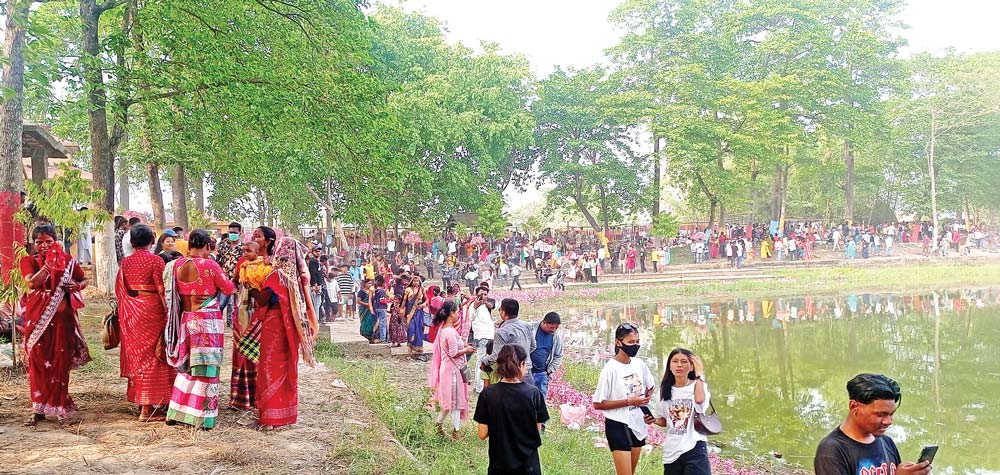
Uralabari, Apr. 14: Siruwa Pawani, the biggest festival of the Rajbanshi, Tajpuriya, and Gangai people living in the Tarai region of Jhapa and Morang, has begun. However, locals have expressed concern that the originality of the fair is being lost.
Siruwa Pawani is the biggest festival of the Rajbanshi and Tajpuriya communities. This fair is held on the first day of the Nepali New Year, after worship at Sunwarshi Maharajthan, located in Ward No. 5 of Ratuwamai Municipality in Morang.
Wherever there is a Maharajthan in the district, this fair is held daily for 15 days at the same place. The community believes in land worship, prays for good crop growth throughout the year, protection from floods and erosion, freedom from diseases, the well-being of livestock, and the absence of drought.
After harvesting rice, mustard, oilseeds, pulses, and wheat, they celebrate the beginning of the harvest season from the first day of Baisakh with various gatherings, feasts, and communal meals. In the Rajbanshi language, “Sanwarsi” means “golden rain.”
Later, as settlements of hill communities increased, the name of this crop slightly changed and became “Sunwarshi rice,” according to leaders of the local Rajbanshi community.
According to Shivdayal Rajbanshi, Secretary of the Sunwarshi Maharaj Devesthal Conservation Committee, there is a large pond in the middle of the Maharajthan that was dug by the Pandavas during the Mahabharata period.
There are human settlements and agricultural land around the pond. However, the pond has not dried up for centuries.
There is a temple on the northwestern side of the pond, spread over an area of two bighas. In ancient times, Sanwarasi Maharaj is believed to have helped the poor, the unfortunate, and the hungry.
Rajbanshi shared a legend passed down from his ancestors, saying: “The poor used to call upon the Maharaja when they did not have jewellery to wear for weddings. When the Maharaja was pleased, he would shower gold ornaments on devotees who were meditating. After use, the jewellery had to be offered back to the Maharaja’s temple.”
In recent times, not only people from the Rajbanshi, Tajpuriya, Tharu, Dhimal, Gangai, and Santhal communities, but also hill communities have adopted the tradition of eating only after offering newly harvested food.
Devotees now come not only from Morang, Jhapa, and Sunsari in eastern Nepal, but also from Bihar and West Bengal in India to Maharajthan to offer flower horses and release pigeons.
Although Sunwarshi Maharajthan has become an attractive destination for domestic tourists, gambling and liquor trading have come to dominate the fair due to the lack of new activities and local products.
Locals are also concerned about the increasing number of visitors who come for entertainment rather than for cultural and traditional worship.
Local resident Santosh Bastola said that the true essence of the fair has been overshadowed by commercial activities such as contracting, collecting fees, and charging for parking.




-original-thumb.jpg)

-original-thumb.jpg)