- Thursday, 4 June 2026

Peak forest fire season begins amid prolonged drought
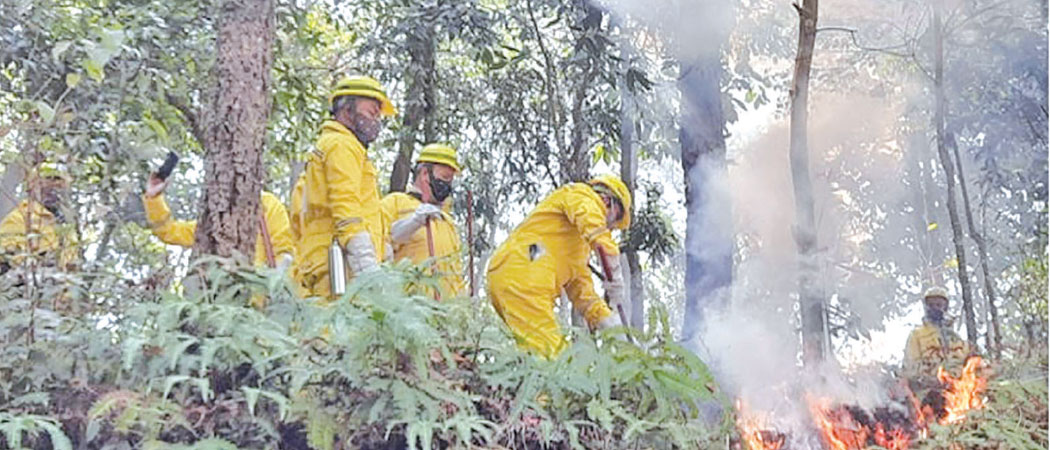
Photo Courtesy: Bhola Bhattarai

Kathmandu, Mar. 15: The peak season of forest fires has begun. Nepal, long celebrated as a global model for forest restoration, is now facing the unintended consequences of that conservation success.
Years of accumulated dry biomass, coupled with worsening drought conditions, have made many community and national forests increasingly vulnerable to fires.
The peak forest fire season generally runs from mid-March to mid-May. To reduce the risk, the government also observes Forest Fire Awareness Week every year from March 15 to March 21 (Chaitra 1 to 7).
During this period, central, provincial and local governments as well as various organisations run awareness programmes to inform people about the risks of forest fires, ways to control them and measures to protect nearby settlements when fires occur.
According to government data, an average of 77 people die each year in the country due to forest and other fire-related incidents. This year, even before the peak season began, 88 fire incidents had already been recorded, leaving one person dead and affecting 18 families.
According to the National Disaster Risk Reduction and Management Authority (NDRRMA) under the Ministry of Home Affairs, forest fire incidents have resulted in 110 deaths over the last five fiscal years. The period from mid-March 2020 to mid-July 2025 shows a worrying trend in wildfire-related fatalities, particularly in recent seasons.
The Ministry of Home Affairs, in its Nepal Disaster Report 2024, said that 593 people died in 19,593 fire-related incidents over the past six years.
The data also show a significant spike in fatalities in 2023/2024, when 61 deaths were recorded -- more than half of the five-year total. Similarly, 11 deaths were recorded in 2020/2021; 15 in 2021/2022; 13 in 2022/2023 and 10 in 2024/2025.
“These figures include deaths caused only by forest fires. The authority does not maintain separate records for other types of fire incidents,” said Shanti Mahat, Information Officer at the NDRRMA.
During the same period, 33,168 families were affected by fires and forest fires. Fire incidents partially damaged 4,739 houses and completely destroyed 19,468 houses, along with 7,321 sheds. In addition, 7,753 livestock were burnt to death.
According to the Nepal Disaster Report 2024, fire incidents have caused economic losses worth Rs 26.71 billion. On average, financial losses of more than Rs. 2 billion each year are attributed to fire incidents.
To address the growing threat, the NDRRMA has prepared the National Action Plan for Forest Fire Prevention, Preparedness and Response, 2026 (2082 BS). The plan aims to minimise forest fire risks and reduce damage to lives, property and the environment through coordinated action among government agencies and other stakeholders.
Based on past data, the authority has identified nine districts as high-risk areas for forest fires over the past 12 years. These districts are Surkhet, Bardiya, Chitwan, Dang, Banke, Kailali, Kanchanpur, Parsa and Salyan.
Several districts have also been categorised as medium-risk, including Achham, Arghakhanchi, Bara, Dadeldhura, Doti, Gorkha, Jajarkot, Kapilvastu, Makwanpur, Nawalpur, Pyuthan, Sindhuli and Udayapur.
Meanwhile, winter rainfall was again below normal across the country this year, and there is little chance of rain in the coming days, leaving conditions increasingly dry, experts said.
Bhola Bhattarai, an environmental and forest fire expert, said forest fire incidents are likely to increase again this year, potentially causing both economic and non-economic losses, as well as human casualties.
According to him, the risk of large forest fires remains high as dry biomass -- the primary fuel for fires -- continues to accumulate in forests, while the winter season has remained unusually dry.
“The biomass in forests is not being utilised as people have reduced farming in upland areas and stopped keeping livestock. Households have also largely stopped using forest products,” he said.
Bhattarai added that these resources could be used productively. Dry leaves and forest litter can be processed to produce bio-fertiliser, while briquettes made from forest biomass could replace coal in industries.
He also said that pellets, which are currently imported illegally from India, could be produced domestically and supplied to factories.
Human causes behind most fires
Bhattarai shared several incidents that illustrate how forest fires often start due to human negligence. During fieldwork, he once saw a man throw a cigarette butt into a nearby forest. In another case, he witnessed a forest fire spreading from a field where people were burning agricultural residues.
He also recalled an incident in Bara, where he saw a man deliberately set fire to a forest while taking his livestock out to graze. The man told him that burning the forest would help new grass grow for his animals.
Government data show that human activities are responsible for about 96 per cent of forest fires. Of these, 64 per cent are intentional, while 32 per cent occur due to negligence. Specific causes include grazing activities (30 per cent), discarded cigarette butts (15 per cent) and hunting (7 per cent).
According to Mahat, “With the use of LPG gas, people have stopped collecting and using forest materials. As a result, forest fuels continue to accumulate.”
The government has also started creating fire lines to prevent forest fires as mentioned in the Action Plan from spreading to nearby communities. Such fire lines were established this year in Pokhara, Koshi Tappu and Dailekh. Similarly, in the last fiscal year, fire lines were constructed in Kanchanpur, Sindhuli, and at the APF quarters in Baidibas, in coordination with the Department of Forest Offices, Mahat said.
Sabnam Pathak, Information Officer at the Department of Forests and Soil Conservation under the Ministry of Forests and Environment, said that the number of community forests in Nepal is higher than that of national forests, making them more vulnerable to fire risks.
She said that in the past, many houses were built close to community forests and fires often spread from the forests to nearby settlements. However, in recent years, the police, the army, local governments and community members have started conducting awareness programmes and creating fire lines in forests and surrounding areas when the fire starts. These efforts have helped reduce the spread of fires to nearby settlements.
Pathak said that people are responsible for the increasing fire incidents. She believed the share of human-caused fires is even higher. “Nearly 99 per cent of forest fires are caused by human activities,” she said, adding that awareness among local communities remains crucial in preventing such incidents. She added that changing rural lifestyles have also contributed to the problem.
Within the five-year period, Sindhupalchowk recorded the highest number of fire incidents with 155 cases, followed by Pyuthan with 127 incidents, and Terhathum with 102 incidents.
Climate change worsening the risk
Researchers have also linked the increasing number of forest fires to climate-induced drought conditions.
A study by Deepak Aryal and Dr. Binod Pokharel of the Central Department of Hydrology and Meteorology, TU, found that prolonged dry conditions have intensified forest fires across the country.
The study said that most fires are triggered by human activities such as unattended campfires, discarded cigarette butts and deliberate burning. However, warmer and drier weather conditions allow these fires to spread more rapidly.
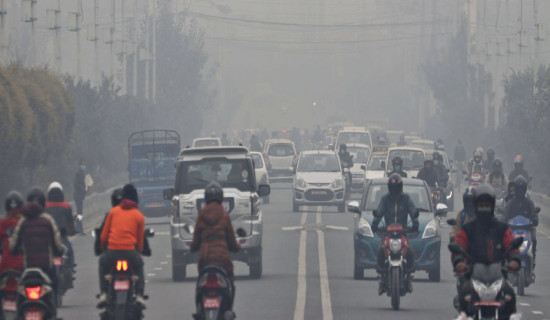
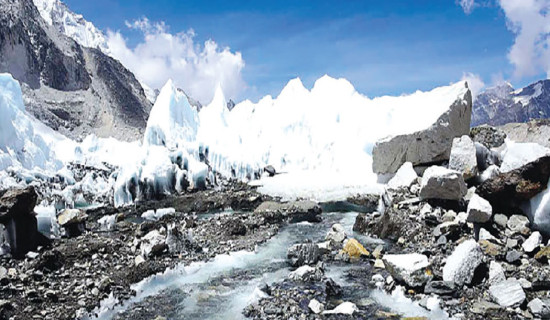
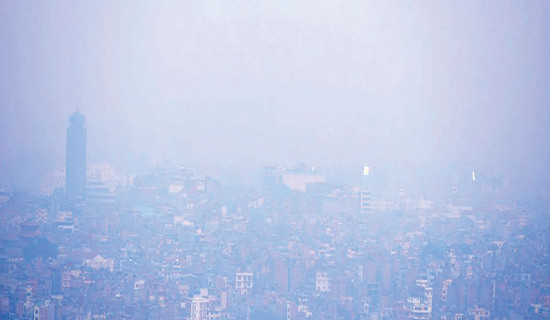
The impacts go beyond loss of forest. Forest fires contribute significantly to air pollution and release black carbon particles that settle on snow and glaciers in the Himalayas. This dark layer reduces the reflectivity of snow and ice, accelerating melting in high-mountain areas.
Recent fire seasons have been particularly severe. Forest fire incidents in 2021 and 2024 were nearly 10 times higher than the long-term average, which they have linked to prolonged post-monsoon drought conditions.
Climate projections also indicate that the situation may worsen. Climate models such as CMIP3, CMIP5 and CMIP6 suggested that winter droughts in the region are likely to intensify during the 21st century. As drought conditions persist, both the frequency and intensity of forest fires are expected to increase, the research said.
The study also highlighted the wider regional impact of forest fires, saying that smoke from large fires can travel hundreds of kilometres, affecting air quality far beyond the areas where the fires originate.
According to the Department of Hydrology and Meteorology (DHM), winter droughts have occurred frequently over the past two decades, particularly during 2006-2011, 2016-2018, and again from 2021 onwards. This trend suggests that winter droughts are no longer an occasional phenomenon but a recurring feature of the country’s changing climate, which has also contributed to the rise in forest fire incidents.
The forest fire season has just begun. As temperatures rise and rainfall has remained scarce for the past several months, the number of fires across the country could increase up to fivefold in the coming days. Experts and government officials have therefore urged the public to remain vigilant and take precautions to prevent forest fires.
-square-thumb.jpg)