- Thursday, 4 June 2026

Mobile phone overuse hampers children's creativity
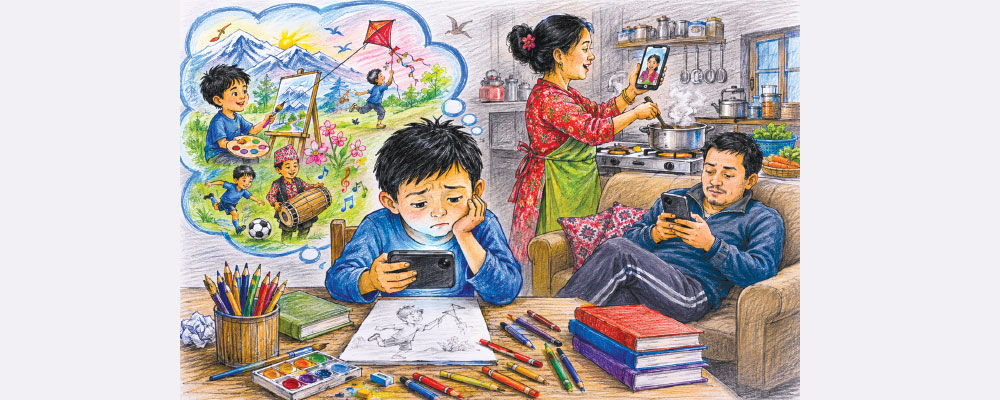

By Babu Ram Karki, Barahachhetra, June 4: The excessive use of mobile phones by today's children is diminishing their creativity. When children spend a significant amount of time on mobile phones, they miss opportunities to learn, understand, and develop knowledge.
It is said that with WiFi available in almost every home and a mobile phone in nearly every hand, children's learning achievements are declining relative to their age.
Sarita Khatiwada, Associate Professor at the Department of Nursing, Purbanchal University, said that as the habit of unnecessary mobile phone use increases, children are becoming victims of mobile addiction.
She said, “Childhood is a period of rapid growth and development. Mobile addiction can affect children's overall well-being by making them dependent on their phones. They may cry or become withdrawn when they are unable to use mobile phones even for some time.”
She added that increased screen time can have a serious impact not only on children's creativity but also on their physical and mental health.
Shiva Prasad Niraula, a teacher at Shree Prakash Secondary School, said, “Children from an early age through adolescence are becoming addicted to mobile phones.”
He said that although childhood should be a time for fun and playing with friends, excessive mobile phone use is increasing because of the convenience of having everything available on a phone.
“From young children to the elderly, people are highly attracted to mobile phones. Today's children spend much of their time using mobile devices, and their daily routines often begin with them.”
Niraula said that due to busy lifestyles, some parents give mobile phones to their children for convenience, contributing to the decline of reading habits.
Pusparaj Bista, a parent from Ramdhuni Municipality–5, said that as dependence on mobile phones increases, even very young children require mobile phones while being fed.
Children are increasingly spending their time watching videos and playing games on mobile phones. It is said that when children become overly focused on their phones, they often forget what their teachers have taught them and struggle to manage their time effectively.
Teacher Niraula said that children today spend most of their time on mobile phones, which affects their attention to studies. In the past, children would begin their homework as soon as they returned home from school. Nowadays, many children start looking for their or their parents’ mobile phones immediately after arriving home.
The excessive use of mobile phones is also reducing children's practical knowledge. Since children learn largely by observing others, they tend to imitate the behaviour of adults in their families. Niraula said that as family members spend more time on mobile phones, children have adopted the same habit.
“Earlier, parents involved their children in daily household activities. As a result, children learned practical skills and life lessons from an early age,” he said.
Although mobile phones can be useful for secondary school students to learn about the internet, communication, and technology, there is growing concern that students are increasingly copying homework directly from their phones. Since ready-made answers are readily available online, children's creative and critical thinking skills are declining because they are not developing independent thinking habits.