- Wednesday, 3 June 2026

Bureaucratic Rigmarole Stalls Reforms

Nepal has seen many political changes in its 76-year democratic journey — ranging from the people’s movement in 2007 to recent Gen Z protests — resulting in the formulation of six constitutions over the years and numerous governments. These political changes have not only broadened democratic space but have also given rise to higher political consciousness. These changes allowed for the mobility of political and social elites who engaged in politics of collective bargaining on behalf of the represented masses, while the institutionalisation of federalism from 2072 B.S. contributed to localisation of democratic space, with greater space for marginalised voices in the national polity.
The rising political consciousness on the ground and its manifestation in the local-level election not only strengthened political representation but also reinforced the conviction of the public in attainment of their democratic rights. With local government in existence, the neglected issues of daily life such as garbage disposal and sewer management no longer remained trivial because local government and its elected representatives – from ward member to mayor – could be held accountable for their management. The constitutional shift of governance accountability to lower levels has strengthened the perennial social contract that ties state and citizen.
Self-esteem of public
Meanwhile, Nepal's bureaucracy has not derailed from its sluggish pace of growth amidst all the political turmoils. It has been criticised for not acknowledging the enlargement of democratic space and heightened self-esteem of the public. The rigid characteristics of the bureaucratic mechanism are not a revelation but an overstated fact. Bureaucracy has long been recognised as an orthodox force that is supposed to preserve the status quo rather than acting as a catalyst to drive social changes. While the recent debate over governance reform mainly centres on the digitisation of services and broadening the scope of functional governance, what we actually need is a bureaucracy that does not strip people of their basic dignity while they acquire quotidian services.
For a normal service recipient, a government office often feels like a labyrinth where one must untangle a series of procedural knots to get anything done. Endless queues, poor seating arrangements, filthy toilets, procedural obscurity, and apathy from bureaucrats not only lead to a cumbersome office experience but actually humiliate service recipients. According to the World Bank Nepal Capital Expenditure Bottlenecks Analysis published in 2025, Nepal has the longest World Bank-financed project procurement timeline of 231 days in South Asia. The report reflects the gap between project planning and its implementation due to a procedural quagmire.
The report states that it took an average of two years to get tree-cutting approval in Nepal due to multiple approval procedures. The delay in project completion reveals outdated legal procedures that hamper the efficacy of public works rather than expediting them. The banality of bureaucratic rituals undermines the self-esteem of the public as they feel that they have been stripped of their agency and rendered helpless.
Nepal's bureaucracy is obsessed with procedural compliance to an extent that procedural legitimacy is conflated with actual output. There is a need for a clear distinction between procedural consent and actual service delivery on the ground to address the dismal performance on the output front. The procedural obsession can be overcome by simplifying procedural knots. Addressing the cumbersome process that citizens experience does not require a complex overhaul of government procedures but rather simple fixes such as using simple words instead of legal jargon in the formulation of laws, procedures, and regulations, and improving office norms.
Procedural obscurity has opened up avenues for bichauliyas to exploit a rigid system for their gain, further lowering the self-esteem of the public. Our public offices fail to communicate to service seekers the procedural path for acquiring public goods, which puts the burden on service recipients to justify their needs for public goods. The government has unveiled a 100-point agenda for governance reform, focusing on digitization and paperless services, with a one-stop digital platform model. The successful implementation of such strategic vision will be instrumental in curing the file fetish of public offices, where files are stacked one after another but nothing really gets done.
Change in attitude
However, merely resorting to technology as a panacea for all the ills of bureaucracy does not guarantee complete reform. Bureaucracy equally requires a change in its attitude and work culture that directly moulds organisational orientation toward service seekers. It's the intangible attributes that allow the public to develop a sense of ownership in the state when they step into public offices. We require a bureaucracy that is responsive and empathetic rather than a procedure-obsessed, patronising one.
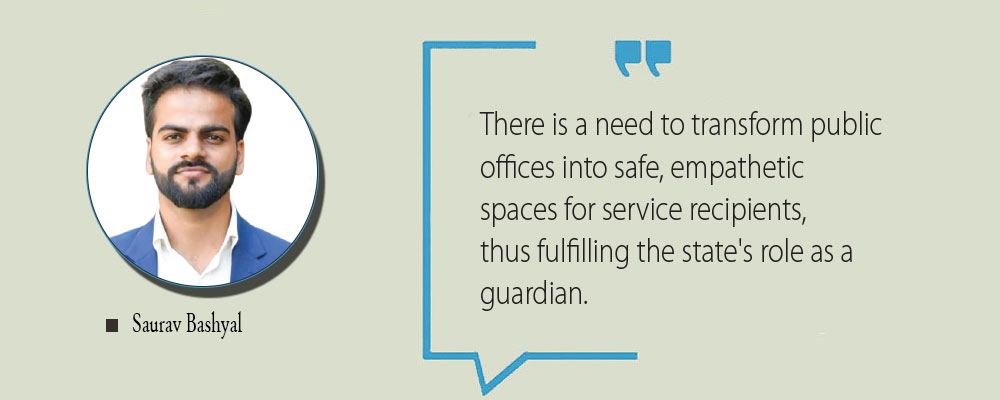
There is a need to transform public offices into safe, empathetic spaces for service recipients, thus fulfilling the state's role as a guardian by overcoming the clichéd image of public offices laden with paperwork, long queues of the public, and unapproachable hakim saabs. We need public offices that uplift the self-esteem of the public and create a conducive environment for the exchange of public aspirations and state commitments.
(Bashyal has completed his Master's in International Relations from South Asian University, New Delhi.)