- Wednesday, 3 June 2026

Revamping University Education

Nobody denies the role of education as a means of transforming society, but nobody seems to seriously consider exactly how it can be made a true means of achieving this goal in our country. The noticeable attempts made so far have not yielded the expected results. Or we might as well argue that even the goals were defective, as they could not meet the students' requirements. Maybe we are still confused about what, exactly, the goal of university education should be in general, and how universities should function. While the first issue is academic, the second is a structural matter.
It is almost universally acknowledged that the primary goal of higher education is to impart advanced knowledge to university students and to produce competent graduates who can tackle individual and social problems with confidence. The secondary goal is, of course, to develop life skills for earning a living. The concerned authorities, as well as educational stakeholders, seem to have forgotten the first goal of higher education, as they are heard in several forums focusing on skill-oriented education, which is useful for livelihood. There is nothing wrong with this goal, but focusing on this type of education while ignoring the primary goal is meaningless. No matter how useful technical education is in life, education without the aim of imparting profound knowledge and scholarship is lopsided.
Equal weight
In this sense, we are still unsure which should take priority in our context – general education or technical education, or whether we can place equal weight on each. As we all know, there are different branches of knowledge, ranging from the humanities and social sciences to the natural and applied sciences, such as medicine and engineering. For a few decades, we have been talking about the need for technical education. The entire nation seems to follow this dictum without considering the repercussions.
Needless to say, social science education, which was once hailed as the backbone of a nation, now seems to have been neglected by both individuals, the state, and society as a whole. It is not that the budget has been significantly cut, but it has not been increased over the years. It is deplorable that the relevant educational authorities do not emphasise the value of social science education. Nor do the stakeholders bother to listen to understand its worth. The beauty of social science education is that it equips a person to become a perfect citizen who can formulate appropriate national policy and implement it more effectively than anyone else.
To disparage social science education as simply a graduate programme for preparing a clerk is no more than shortsightedness, and that, too, by the top officials of the state mechanism. In this context, the new government should have opened a forum for discussion among many intellectuals, university wits, and the stakeholders before taking any steps to revamp university education. But the university executives have been indiscriminately removed from their offices without making adequate preparation for the appointments of new officials. It is very likely that the same trend might repeat with a gloomy face.
Undoubtedly, it is wise to make a decision with far-reaching consequences after considerable study and adequate discussion on the issue. The government side and the supporters of the ruling party might dismiss the issue of discussion as a futile effort because they think that the opposition groups are always negative and non-cooperative. But this is not wholly true. Despite some reservations, they can be liable to consent if the issue is adequately discussed, with valid arguments and axiomatic evidence to support them. To dismiss a genuine issue under the pretext of oppositional disgruntlement is like blaming the yard for being asymmetrical by an unskilled dancer. It is never wise to seek a playful solution to a vast problem, especially by those in decision-making roles and executive offices.
There are allegations that the two organisations are the most obstinate impediments to the effective running of the universities – professors’/employees’ associations and students’ organisations. Presently, all the appointments made by the erstwhile government have been nullified with a stroke of the pen in the ordinance. Nobody has yet lodged any petition in court against the government’s move to remove them from office, seeking their reinstatement to their respective positions. This indicates two things simultaneously: either the educationists, including the ousted officials, were in agreement about this move, as they thought it was the right decision, being considerate and responsible persons who would offer any support to the potential candidates for new appointments, or those removed from their offices were reluctant to come back to the controversial seats, which are expected to perform the impossible with limited resources and unconducive environment.
Ulterior motive
Let us hope for the best in the appointments of executive officials, entirely based on merit and being merciless in considering partisan quota-sharing, as before. Regarding these obstacles, the whole nation is divided on whether the professors’/employees’ associations and students’ organisations must be immediately eliminated from the university premises, or should be properly conducted by their respective organisations, with a view to focusing on educational matters and putting aside individual or group interests. In this case, we need to be rational about which actions are political and which are educational, like separating wheat from chaff. Partisan politics in the university are certainly detrimental, but the associations and organisations can be useful too, if properly handled and conducted without any ulterior motive.
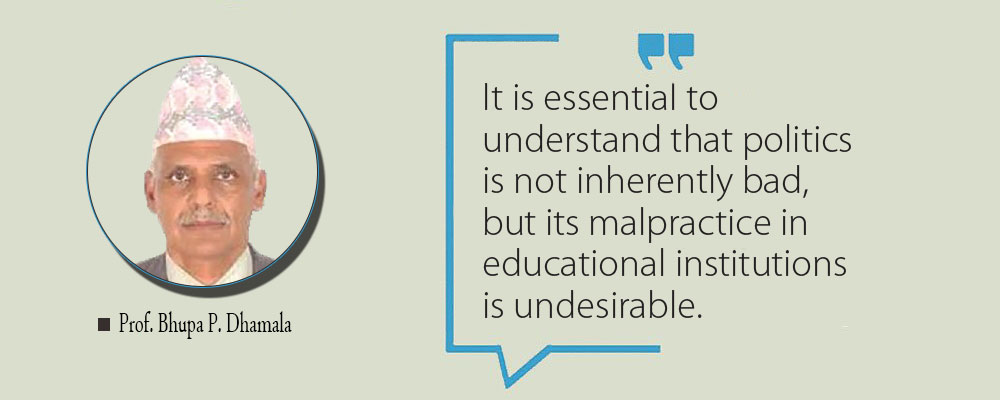
There are two possibilities to resolve this issue. One is a ban to be imposed by the law-enforcing bodies, which has been inscribed in ordinance by the state, albeit an interim order not to enact it until the final verdict is issued by the honourable court. The other possibility is to put this issue in dialogue among the stakeholders and their respective political groups to reach a consensus on exactly how to run them properly. Of the two, the second option is more useful to settle the issue. It is essential to understand that politics is not inherently bad, but its malpractice in educational institutions is undesirable. For a long time, we have cultivated the habit of eradicating what we term "harmful institutions," along with their operating systems and byproducts, without fully understanding the benefits of those institutions and systems. It is something like cutting out the root of a plant, which may yield only a few inedible fruits among many nutritious ones.
(The author is the chairman of Molung Foundation. bhupadhamala@gmail.com)