- Tuesday, 2 June 2026

Govt unveils incentives to boost agricultural productivity
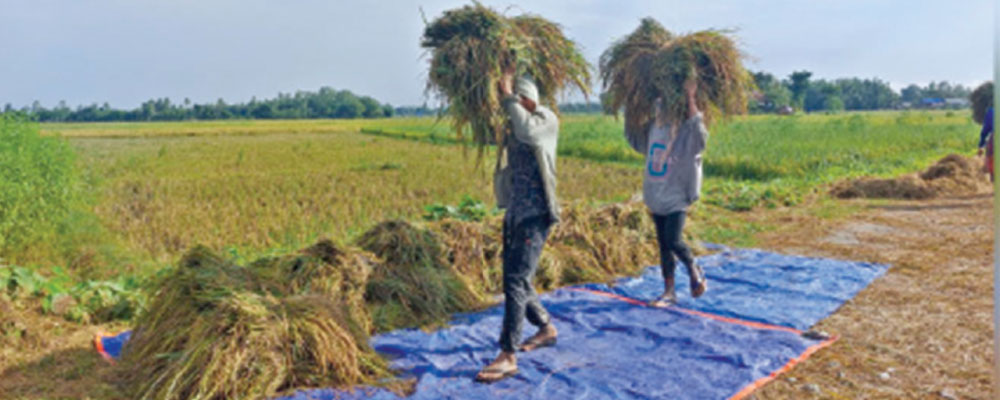

By A Staff Reporter, Kathmandu, June 2: As the country spends billions of rupees on agricultural imports to meet domestic demand, the government has prioritised reviving the agriculture sector through reforms and incentive programmes aimed at boosting productivity, commercialisation, and profitability.
Presenting the budget, the government said it would improve the entire agricultural ecosystem, including production, processing, distribution, and marketing.
The budget aims to attract commercial farmers and transform agriculture into a dignified and profitable profession by boosting productivity.
As part of a pilot initiative, farmers investing at least Rs. 20 million in agriculture and livestock production will receive incentive grants of up to 40 per cent from the government.
The subsidy will be reimbursed at an annual rate of 10 per cent over four consecutive years from the beginning of production.
Through the budget, the government also announced plans to complete the nationwide farmer identification process and begin distributing farmer identity cards in the upcoming fiscal year.
In a bid to increase agricultural land use, the government said it would establish land banks at the local level to utilise reclaimed riverbed land, unused government land, and barren farmland.
The private sector will also be encouraged to adopt an “agro-pooling” system for large-scale agricultural production.
The government also pledged to prevent the misuse of agricultural subsidies while ensuring that genuine farmers receive support for improved seeds, fertilisers, irrigation, electricity, and agricultural insurance.
Premium subsidies of up to 80 per cent will continue for agricultural and livestock insurance, while other subsidies will be gradually phased out.
In a bid to strengthen agricultural markets, the government announced concessional loans and interest subsidies for businesses purchasing agricultural products directly from farmers.
The government has also announced plans to restructure agricultural services into a “farmer-centred service system.”
Technical agricultural services, digital agriculture information, and private service providers will be mobilised to deliver year-round doorstep support to farmers through technical personnel in every local government.
Rs. 32.46 billion allocated for chemical fertiliser
Aiming to ensure the smooth supply of chemical fertilisers, the government has increased budget allocation to Rs. 32.46 billion for the upcoming fiscal year 2026/27.
The move seeks to prevent recurring shortages faced by farmers during major agricultural cultivation period like paddy.
It is 12.6 per cent higher than the budget allocation for chemical fertilisers for the current fiscal year.
The government had allocated a subsidy of Rs. 28.82 billion for the current fiscal year 2025/26.
The government has allocated Rs. 46.92 billion for agriculture and livestock development for the upcoming fiscal year, which is almost 70 per cent of the total agricultural budget.
To boost agricultural productivity, the government has allocated Rs. 2.07 billion for the National Agriculture Modernisation Programme.
The budget also prioritises agro-processing industries. Mango processing centres will be established in Siraha and Saptari districts, while a tomato processing centre will be set up in Sarlahi.
In Karnali Province, the government plans to operate fruit zones for apples, walnuts, and other produce while advancing cold storage infrastructure.
To encourage commercial farming, unused privately owned agricultural land will be converted into shares of commercial agriculture companies to support agricultural and livestock farms.
The government has earmarked Rs. 360 million in conditional grants for local governments to promote organic and green fertilizers.
In addition, a green urea fertiliser industry will be developed under a company model in collaboration between the Nepal Electricity Authority and the private sector, said the government.
The government has pledged electricity subsidies and procurement guarantee agreements to encourage private investment in green urea production.
To strengthen animal health, vaccines for livestock diseases and epidemics will be domestically produced with private sector participation.
The government allocated Rs. 240 million to control livestock diseases, including foot-and-mouth disease, and announced plans to establish an animal quarantine facility at the Hilsa border point in Humla.
Major irrigation expansion plans
In the next fiscal year, irrigation services will be expanded to an additional 15,800 hectares of farmland, increasing Nepal’s irrigated agricultural land ratio to 64 per cent.
Under the Babai Irrigation Project, irrigation facilities will be expanded to cover an additional 1,066 hectares, while restoration work on the Rajapur Irrigation Project will continue.
The head works construction of the Bheri-Babai Diversion Project will also be completed. The government has allocated Rs. 5.63 billion for these projects.
Similarly, the Sikta Irrigation Project will expand irrigation to an additional 5,000 hectares in Banke district with a budget of Rs. 2.55 billion.
The government also announced plans to restart the construction of the dam and powerhouse of the Sunkoshi-Marin Diversion Project under a new contract, targeting completion within four years. The project has received Rs. 2.98 billion in funding.
To maximise irrigation benefits from the Sunkoshi-Marin Diversion Project, the Bagmati Irrigation Project will be upgraded to expand irrigation facilities to 122,000 hectares of farmland in Bara, Rautahat, Sarlahi, Mahottari, and Dhanusha districts.
The command area of the Mahakali Irrigation Project will be expanded, while infrastructure development under the Lamki section of the Rani-Jamara-Kulariya Project will continue. These projects have received Rs. 5.13 billion.
The government also announced Rs. 1.83 billion to expand groundwater irrigation facilities to an additional 3,980 hectares of farmland in the Tarai-Madhes region, where surface irrigation remains inaccessible.