- Tuesday, 2 June 2026

Technology preserves ancestral profession of Kumhars
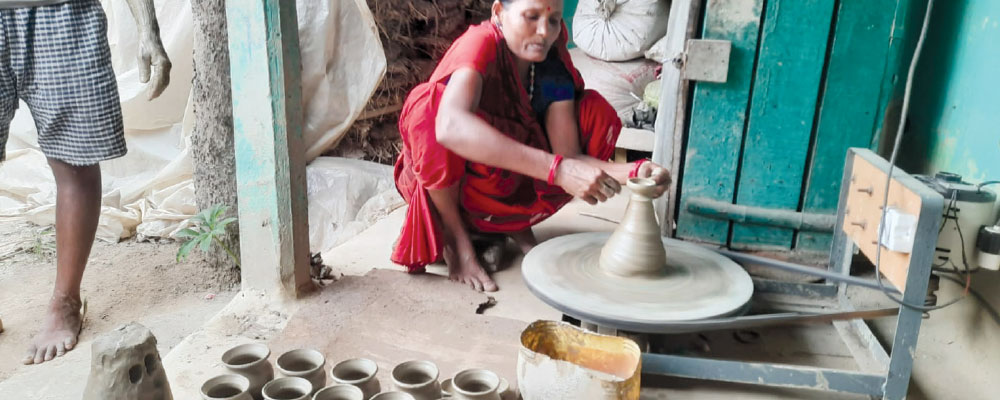

By Binaya Karna, Kalyanpur, June 2: The profession of making various types of clay vessels is closely linked to the identity of the Kumhar community living in the Tarai-Madhes region.
The Kumhar community has practised this profession for generations and earned a livelihood by making and selling clay products. However, this ancestral occupation has faced a crisis in recent years due to changing lifestyles and the increasing use of plastic and other industrial materials.
This traditional profession, which was once on the verge of extinction, is now emerging as a reliable source of livelihood with the help of modern technology. Skill development training and the use of modern equipment have enabled women from the Kumhar community to become financially self-reliant.
Twenty-year-old Aarti Pandit of Ward No. 3, Chhinnamasta Rural Municipality in Saptari, is a good example of this transformation. She is currently busy making clay tea cups using the skills she acquired through a training programme on clay cup and pot making under the Rural Women Economic Empowerment Programme.
The programme is being implemented by Didi Bahini and Sapros Nepal in partnership with the International Fund for Agricultural Development (IFAD), the World Food Programme (WFP), FAO, and UN Women. Aarti has been producing matka tea cups for the past seven months. According to her, she earns about Rs 3,000 per day from the production and sale.
“I earn around Rs 3,000 a day and am able to save about Rs 1,500 from it,” she said. She said that after receiving training in matka tea cup production and a modern electric motor-powered wheel from Sapros Nepal, her production capacity increased significantly. She now earns up to Rs 50,000 per month from the sale of clay tea cups.
Pramila Pandit, from the same locality, is also earning up to Rs 20,000 per month by making various clay utensils, religious items, and clay piggy banks.
Her husband, Rabindra Pandit, assists her in managing raw materials and marketing the products, making it easier for her to run the business.
“Earlier, we had to use a hand-operated wheel, which made pottery production time-consuming. Now, with modern motorised wheels, we can produce more in less time,” he said. “Our income has also increased.”
Naveen Chaudhary, Programme Manager of Sapros Nepal, said that the initiative was launched with the aim of economically and socially empowering women.According to him, in addition to pottery-making training, the programme also provides practical training in floriculture, vegetable cultivation, vocational literacy, capacity building, and gender awareness.
“The programme has increased the income of local women and is also helping preserve the traditional occupation of the Kumhar community, which was on the verge of extinction,” he said.
Locals believe that the combination of modern technology and traditional skills has given new life to this ancestral profession.