- Wednesday, 3 June 2026

Chisang River exploitation displaces hundreds
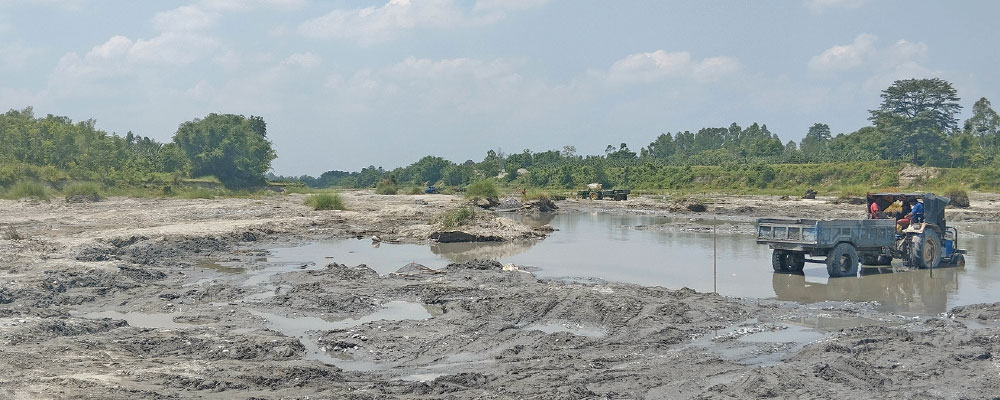
Photo: TRN Uncontrolled extraction activities along the Chisang River have increased erosion, threatening fertile farmland and settlements in Morang.

By Our Correspondent, Urlabari, June 3: The Chisang River, which flows through the northern part of Morang district, has become a blessing for a few and a curse for many.
While sand and gravel extraction, crusher industries and the construction materials business have generated income for some individuals and investors, uncontrolled exploitation of the river and increasing erosion have forced hundreds of families to lose their fertile farmland.
The plight of Dhananjaya Kafle of Kanepokhari-5 reflects the hardship faced by many families living along the riverbank. Of his 17 katthas of land, the Chisang River now flows through 10 katthas. After years of cultivating the land, he has watched much of it disappear into the river and now waits for a permanent embankment so that he can reclaim and cultivate his fields again.
His neighbour, Mohan Katwal, has already seen nearly two bighas of his land turn into a barren riverbed due to erosion. According to locals, the Chisang changes its course almost every year. Whenever the river shifts eastwards, people living in Kanepokhari fear further losses and displacement.
Katwal, who migrated from Bhojpur to the Tarai around four decades ago, said the river was once narrow but has now widened to about 120 metres due to erosion on both banks. “When I first came here, the Chisang was much smaller. Today it has expanded significantly because of continuous erosion,” he said.
Kafle and Katwal are only two examples among many affected families. Locals estimate that more than 100 families have suffered from riverbank erosion caused by the Chisang. Every monsoon season, fertile soil continues to be washed away, reducing the area of cultivable land and weakening the economic condition of farming households.
Flooding and erosion from the river forced between 15 and 20 households in Jahada Siran of Kanepokhari-5 to leave their ancestral homes. Since then, residents living near the river have faced recurring threats during every rainy season. Narayan Prasad Pokharel, who now lives in Itahari, recalled losing 10 katthas of land full of paddy crop, in a single night in 2002 when the river changed its course and swept away his farmland.
“The state collects revenue from the river and permits crusher industries to operate, but those who lose their land receive little support,” he said.
Similarly, on August 4, 2002, the Chisang shifted eastwards and washed away one and a half bighas of cultivated land belonging to the Dahal family. Dhanmaya Dahal said the family lost both its farmland and home and was eventually displaced to Biratnagar.
“After losing our shelter and source of food, we had no option but to move. The struggle eventually pushed us towards entrepreneurship,” she said.
Despite the devastation faced by riverside communities, the river has also created employment and income opportunities. Many people earn a living through sand extraction, crusher industries, transport services and the trade of construction materials. Locals, however, argue that while businesses and investors benefit, farmers living along the riverbanks are left to bear the environmental and economic costs.
Affected communities have repeatedly demanded river control measures, embankment construction, scientific management of extraction activities, and adequate compensation and relief for families affected by erosion. However, they say that their concerns have received little attention from federal, provincial and local governments.
While the Chisang River has contributed to economic activity and development in the region, it has simultaneously swept away fertile farmland and ancestral settlements belonging to hundreds of families. Locals therefore stress the need for effective long-term river management, erosion control and conservation measures before further damage occurs.