- Saturday, 2 May 2026

Bolstering Anticipatory Governance

Traditional working styles in contemporary governance often fail to meet the objectives outlined in national policies. Time has changed dramatically and the rules of the game are no longer the same, as algorithmic governance has leapfrogged the present-day bureaucratic working style. Today, people expect enhanced state resilience and trust by saving lives, conserving resources and supporting sustainable development through anticipatory governance. Government agencies, as the frontline hands of the government, must possess the visionary character of foresight to shape the policies into effective implementation to weather the storm to save the state and citizens from uneven shocks, whether natural or human-induced.
Bureaucracy, as a key driving force of a rule-based governance system, has to work under difficult circumstances and face multi-layer challenges. Even with adequate resources and favourable policy in place, dealing with unseen threats lurking behind the curtain remains an arduous task unless anticipated in advance. Such hidden threats are of different natures and shapes. Nepal's overall administrative character, both in civil or security institutions, is more reactive than anticipatory, more curative than preventive, and more risk- averse than risk- aware. These institutions, as integral parts of the state, must integrate public engagement to gather inputs, information, and 'horizon scanning', aligning with their policy formulation and delivery of actions.
Citizens as partners
Government institutions cannot achieve their goal in isolation. The traditional way of thinking as 'they know everything ', does not comply with the realities of modern-day public management. Shifting to shared vigilance from fossilized reasning is vital for anticipatory governance, which treats citizens as early-warning partners, not merely passive recipients. In reality, people working in ground level can identify threats in advance. By reason of it, under shared vigilance, the government and people should jointly watch and respond to risks and threats.
In Nepal, a wide gap exists between the citizens and the government officials involved in delivering services through different institutions. The feudal mindset of treating citizens as servants has no place in good governance and cannot be regarded as a basic feature of a modern day 'new public service' system. There is no room for playing the role of master in anticipatory governance. According to the constitution, ultimate sovereignty lies in Nepali people. Instead, if the government officials' behaviour fails to meet the expectations of citizens, it erodes public faith and, in the long run, weakens the nation.
At this point in time, public trust slips through the government's fingers. It is a broadly accepted fact that a trust deficit in state functioning shuts the door on shared vigilance. At the time of trust deficit, foreign players often play dirty games, exploiting public dissatisfactions, which ultimately destabilizes the country. To keep foreign players at bay, we all must stand united, while the government must emphasise developing a robust economy through the effective mobilization of human and natural resources.
Under exceptional circumstances, the present politically neutral government was formed with a clear mandate to hold a parliamentary election. Turning away from their initial pledge of not joining politics, the way some of the ministers joined the political parties raised public concerns. In a democracy, the government governs, not rules. Ruling reflects an obsolete mindset associated with an autocratic government. Ruling is about exercising power and governing is about empowering citizens and earning their trust. This is the reason; the government's overall functions and actions should be directed toward the well-being of its citizens.
In doing so, the government should actively involve citizens in government programmes which directly affect them. To ensure the people's effective participation, performance appraisal should be taken as a tool to make them more responsible for their given tasks. Open public meetings can serve as transparent platforms where citizens and government officials sit together to assess performance and operational ethos. If their performance falls below average, the major causes should be identified and corrected for future action.
Rigidity
If political or bureaucratic decisions tergiversate during effective implementation, the strong promise of government quickly evaporates. Short-term political mindset blocks anticipatory government, as elected politicians often prioritise immediate electoral gains over long-term national interests. Similarly, red-tape-driven orthodox bureaucracy persistently resists innovation - a strong barrier to anticipatory governance that knocks on the door of institutional vulnerability. If implementation is rigid, threats emerge from various corners, undermining effective governance. For the effectiveness of governance structure, reliable data and accurate information are essential; without them, farsighted actions degenerate into mere guesswork. At this complex juncture of AI-guided governance, poor data integration and limited analytics significantly weaken threat anticipation.
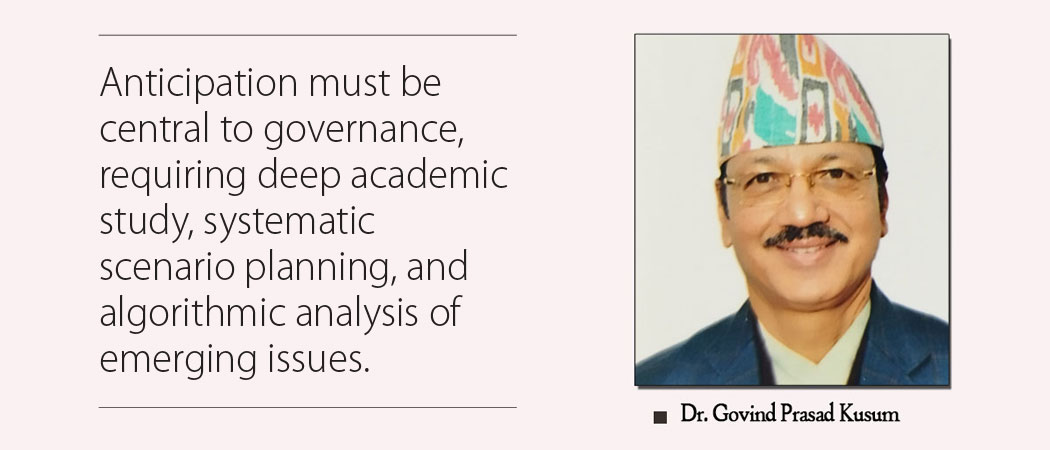
Government institutions love to work in isolation due to their tendency of not sharing information with other institutions. Information hoarding reflects a character of orthodox administrative mindset, portraying themselves as supreme institutions known as the relics of feudalism. Siloed institutions hardly achieve their objectives as a consequence of a non-cooperative working style. Anticipation must be central to governance, requiring deep academic study, systematic scenario planning, and algorithmic analysis of emerging issues, which remain largely absent in Nepal. We must understand that good governance manages the present, anticipatory governance protects the future.
(The author is former secretary of Nepal government.)

-square-thumb.jpg)