- Sunday, 31 May 2026

Political Economy Of Health Insurance

In South Asia, ensuring easy access to health care and financial protection for all continues to be a challenging task for many reasons. First and foremost, the health sector is underfunded in many countries. There is limited coverage of social protection or insurance. The catastrophic spending in health care, pandemics such as COVID-19 and other natural disasters profoundly impact on resilient health systems at large. Moreover, policymakers and planners are facing challenges in effectively regulating the private sector in delivering quality health care services.
In the federal health system, enhancing people’s access to quality essential health services is a high-priority agenda from a policy and strategic perspective. Multi-sector coordination is necessary for investing more domestic financing to improve overall performance in the health sector. The ambitious goal of achieving universal health coverage and health-related Sustainable Development Goals (SDGs) remains elusive if there are no concrete efforts to ensure effective implementation of national health policies, strategies, and guidelines at the local level.
Political leadership
High-level political leadership is necessary for the effective implementation of social health insurance for better health outcomes. While there are other social protection provisions for the elderly, people with disabilities and other chronic diseases, health insurance essentially aims to reduce financial barriers for those who are poor and economically marginalised in the communities. Despite the enormous benefits of health insurance, there are increasing concerns about its effective implementation due to inadequate funds and increasing risks of financial sustainability.
Because of financial hardship, many people still cannot afford rising health care costs. Nepal has several financial risk protection mechanisms, including free basic health services, health insurance, and other schemes designed to reduce financial hardship. However, the out-of-pocket expenditure in health care is considerably high, resulting in financial hardship in accessing health care.
People should not be pushed into poverty due to high health care costs. Insurance mechanisms, whether public or private, can significantly reduce out-of-pocket payments and hence makes local health care system more affordable and accessible. We can learn good practices from Thailand, Taiwan, South Korea, Australia and a few more where health systems are combined with universal coverage, efficient health insurance policies and equitable quality health care.
Emerging issues of continuity and sustainability of health insurance are debatable. There is a central question: Why are some hospitals facing problems in continuing the implementation of health insurance? Presumably, health insurance is costly. Moreover, there is no concrete roadmap with a clear resource mobilisation plan for sustainability. Undoubtedly, political will and leadership are crucial in advancing health financing and universal health coverage. The health insurance policies are most often shaped by political decisions. In our case, there is no systematic review of these policies in terms of assessing sustainability at large.
Therefore, the political economy of health insurance is a complex yet challenging phenomenon in the changed socio-political context. Because it constitutes political, economic and social factors while designing, planning and implementing health insurance policies, strategies and plans. The political promise to reduce out-of-pocket expenditure on health care through social health insurance is an ambitious agenda. Evidence suggests that there is still low enrollment and high drop-out rates. The health insurance is rolled out across all 77 districts, but its implementation still suffers from an inadequate and delayed reimbursement process. Yet, local governments have no concrete initiatives to mobilise financial resources for health insurance.
At its core, health insurance aims to ensure that no one is left behind in accessing health care. Quality health care is a matter of concern because health facilities in remote areas face a range of problems such as inadequate medicines, limited trained human resources and medical equipment. This scenario hinders the effective implementation of health insurance and undermines its local ownership. There is an emerging need to establish a robust monitoring and feedback system to track the progress of health insurance, identify institutional bottlenecks and provide clear information on how people can benefit from social health insurance, and the effective ways to strengthen health insurance in a sustained approach. Because the investment in social health insurance is huge.
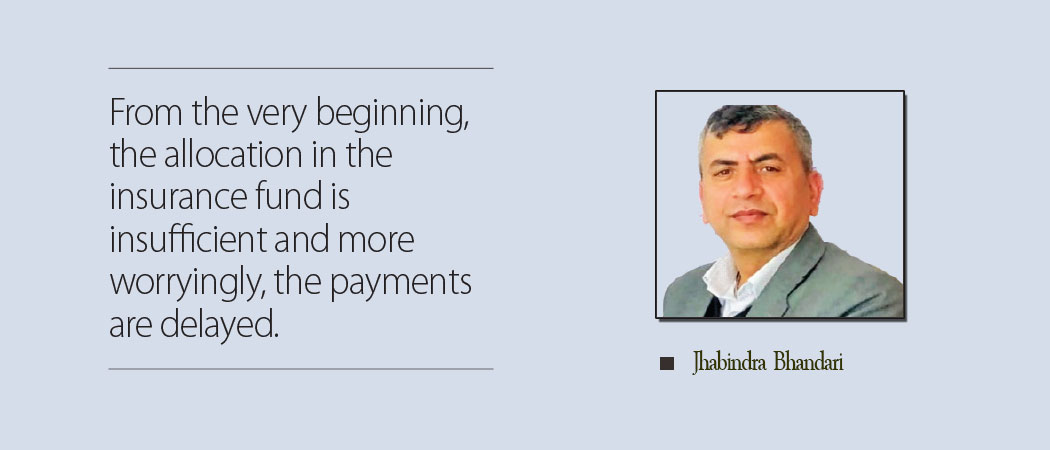
However, from the very beginning, the allocation in the insurance fund is insufficient and more worryingly, the payments are delayed. As a result, hospitals in Kathmandu are facing difficulties to continue social health insurance. The practical issues, such as inadequate funding, delayed release of funds, pending payments and subsequent administrative delays, are the critical challenges experienced so far. Therefore, institutional strengthening of health insurance must be a high priority agenda to further enhance the capacity of human resources, use of digital technologies, participatory monitoring, recording and reporting systems.
Imperative
Thus, reform in health insurance is necessary as it becomes imperative while we aim to achieve universal health coverage. Despite noted progress, much remains to be done. Stakeholders are demanding that the recent crisis and uncertainties surrounding health insurance be addressed. While people’s understanding of social health insurance is differently experienced and interpreted, it is necessary to further enhance public trust, transparency, social accountability and financial viability of health insurance.
Above all, Nepal’s social protection mechanisms need to be mainstreamed, not fragmented at all. Otherwise, there is a risk of duplication and inefficiencies in health financing. Historically, there is inadequate allocation of budget in the health sector. Considering these realities, social health insurance can be strengthened by harnessing resilient health systems, progressive premiums, efficient payment mechanisms, and enabling regulatory and policy environments for financial sustainability.
(Bhandari is a health policy analyst interested in anthropology.)