- Thursday, 30 April 2026

Songs play pivotal role in film success
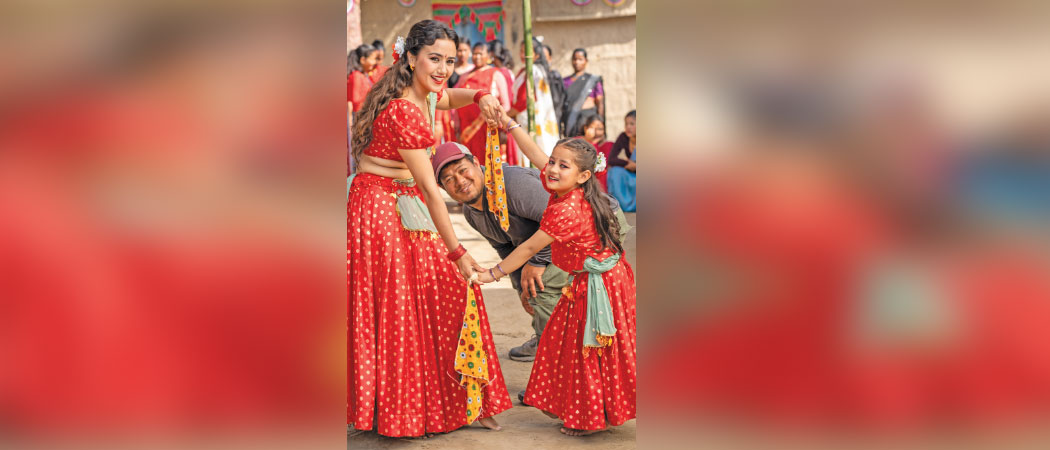

By Santosh Subedi, Kaski, Mar. 19: A song from the film ‘Lalibazar’, which is set to be released on May 1, has currently become widely popular.
The song titled ‘Mayalai Ke Diu Ma Chino’, composed in a folk form, is sung by singer and composer Khem Century and Deepika Bayambu Magar. Actress Swastima Khadka and child artist Samaira Thapa are featured in the song.
Due to the popularity of the dance, many people are recreating their steps on TikTok and Reels, leading to a surge of such videos. Many believe that the film’s success will also be driven by this song.
Likewise, the song ‘Dhagole Bateko’ from the film ‘Ram Naam Satya’, which is set to release from April 10, has also gained significant popularity.
Sung by Babul Giri and Rachana Rimal, the song has garnered over 3.5 million views on YouTube and is widely seen on TikTok and Reels as well.
In recent years, folk-style songs have become highly popular in films. Producers who once hesitated to classify folk songs as proper film songs are now actively seeking to include them.
Lately, music has been considered a key factor in the success of Nepali films. Songs and music have been found to play a highly effective role in film promotion.
Songs play a powerful role in promotion and audience engagement in the film. Films like Prem Geet, Boksi Ko Ghar, Nai Nabhannu La, Purna Bahadur Ko Sarangi, Magne Raja, and Ma Yesto Geet Gauchhu show how music can drive a film’s popularity.
Composer Basanta Sapkota said that music has always played a significant role in making films successful. “Even in the past, many excellent songs from films could be heard. Back then, songs were integrated with the storyline of the film, whereas that is not quite the case now. Nowadays, songs are included in films more for commercial purposes, which sometimes leaves audiences disappointed if the songs do not appear as expected,” he said.
Sapkota added that songs help draw audiences to cinemas.
“Rather than teasers or trailers, songs are often released first for promotional purposes. As a result, audiences who like the song tend to visit theatres in search of that very song. These days, films do not include many songs, but even with fewer songs, commercially appealing tracks are more commonly heard,” he said. According to him, the more appealing the music in a film, the more attention it garners.
Composer Arjun Pokharel said that romantic and dance-friendly songs are more preferred in films. “It also depends on the content of the film. Recently, music has become the first priority for many producers. When the music is popular, it feels as though the film has gained momentum, when it stops trending, it feels as if the momentum has declined,” he added.
He also noted that despite significant investment in some film songs, their videos may not always perform well.
“In Indian films, a large investment is made in music, which has influenced Nepal as well. In Nepal, the ratio of distribution and sales differs between films with many songs and those with fewer songs. Overall, the entire art sector has supported the film business,” said Pokharel.
According to him, in recent times, dance-friendly songs have been more popular and in demand than love songs in Nepali films. He added that film promotion is increasingly being driven by music. Pokharel believes that if songs are created in a way that suits the storyline, it benefits the entire industry.