- Sunday, 7 June 2026

Reviving Biratnagar Jute Mill requires Rs. 2 B
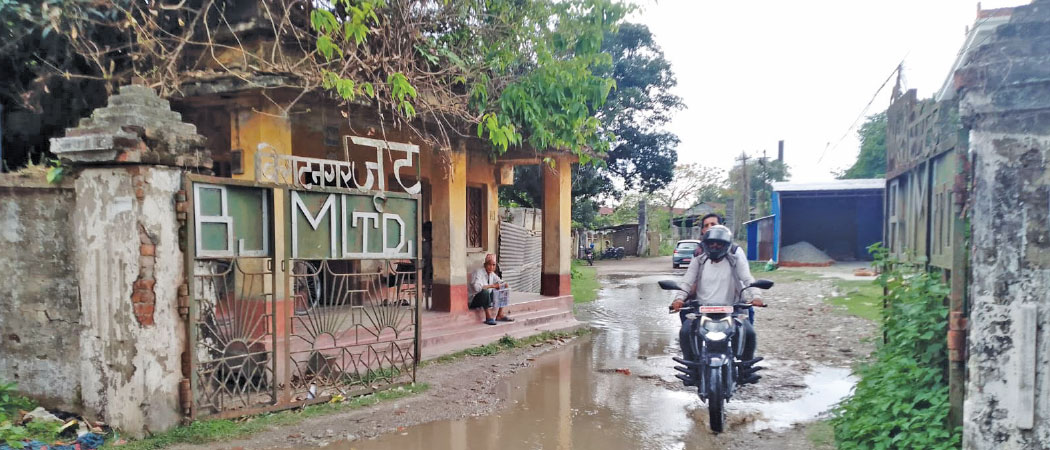

BY SASHIDHAR PARAJULI, Biratnagar, Apr.30: With the formation of a new government, renewed discussions about reopening the country’s long-shuttered and ailing industries have once again sparked hope among former workers and families dependent on the Biratnagar Jute Mill. In particular, the operation of Nepal’s first industrial establishment, the Biratnagar Jute Mill, has consistently drawn public attention and remained a key talking point in political rhetoric. However, the promises made at the political level stand in stark contrast to the mill’s current condition.
Years of neglect have left the historic industry in a severely dilapidated state. Rusted machinery, crumbling infrastructure, and mounting liabilities, including unpaid dues to former employees and electricity bills, make revival far more challenging than often portrayed. Both plants of the mill, which has remained completely closed for nearly a decade, now house machinery that is largely unusable. Idle for years, the equipment has rusted and effectively turned into scrap. Large parts of the premises resemble overgrown forest areas, with physical structures buried under dense vegetation.
According to former administrator Taranath Timsina, the current condition of the mill cannot be revived through simple repairs. “The cost of restarting operations may be slightly less than setting up a new industry, but it would still require at least Rs. 1.5 to 2 billion to make it functional and competitive in today’s market,” he said. Even if production were resumed using repaired machinery, it would not meet modern quality standards. Reviving the mill would essentially require replacing machinery and rebuilding infrastructure, an undertaking that entails significant financial risk for the state.
Beyond infrastructure, the shortage of skilled manpower poses another major challenge. Many experienced jute workers have either shifted to other professions or migrated abroad. The younger generation lacks traditional skills in jute production and shows little interest in working in such a deteriorated facility.
The mill also faces unresolved labour liabilities. A total of Rs. 30.29 million in unpaid salaries is still owed to 46 contract employees for the period between May 14, 2016 and November 18, 2020. Although the workers have won their cases through labour offices and courts, the payments remain pending.
Encroachment and security issues have further complicated matters. The mill’s 69 bigha and 10 kattha of land has been significantly encroached upon. While some former employees and their families continue to reside in old quarters, others have occupied the land over the years. In some cases, original occupants have even sold their quarters informally to new settlers. According to Timsina, around 1,200 such families are currently living in the area, creating additional obstacles to reopening the mill.
Established in 1936 during the tenure of then Prime Minister Juddha Shumsher, with the initiative of industrialists Radhakrishna Chamaria and Ramlal Golchha, the Biratnagar Jute Mill once employed up to 7,000 workers and had a daily production capacity of 40 tons of jute. It also served as the epicentre of the historic 1947 labour movement that laid the foundation for Nepal’s democratic struggle.
Today, however, the state-owned mill stands nearly defunct due to years of managerial inefficiency. Although reviving sick industries has not been explicitly included in the new government’s top priorities, hope persists among citizens. While nothing is impossible with strong political will, bringing this decayed industrial giant back to life will be anything but easy.