- Sunday, 7 June 2026

'Coconut Dropping' ritual performed
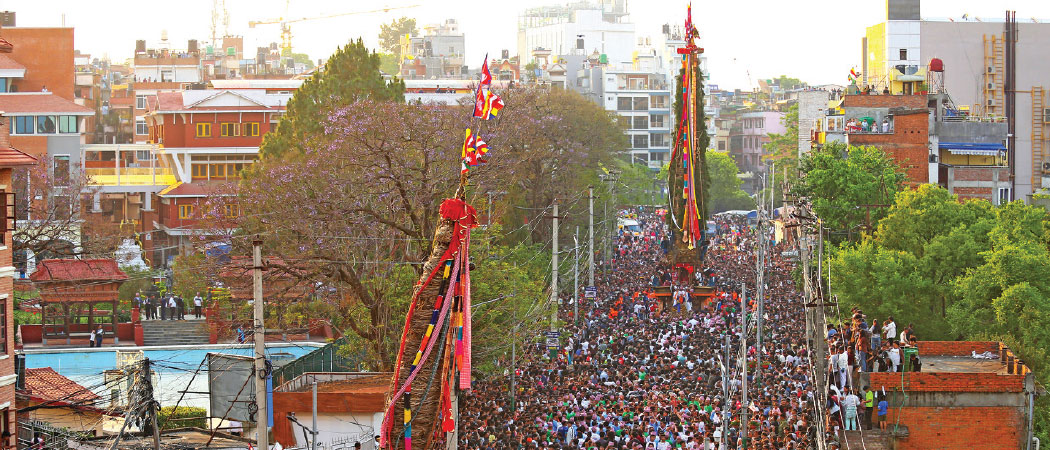
FILE PHOTO: TRN

By A Staff Reporter,Lalitpur, Apr. 30: The famous “Coconut Dropping” ritual was performed on Wednesday evening in the presence of a large number of devotees.
A large crowd gathered at Thati Tole to observe the ritual, watching and attempting to catch the coconuts falling from the chariot.
The chariot of the revered Rato Machhindranath, considered the god of rain and prosperity, has been brought to Thati Tole in Lagankhel, Lalitpur.
To mark the occasion, Lalitpur Metropolitan City (LMC) declared a local public holiday for “Coconut Dropping Day,” observed during the Rato Machhindranath Rath Jatra.
Lachhuna Sharma Kafle, chief of the Patan Guthi Sansthan, said that the coconut-dropping point is located between Lagankhel and Thati Tole.
All offices under the Metropolitan City, along with its subordinate bodies, remained closed, as a large number of residents participated in the event.
The chariot of Rato Machhindranath will be pulled by women on Thursday morning from the coconut-dropping point to Thati Tole.
As the chariot procession takes place once a year, women flocked to Lagankhel on Thursday morning to witness the event and take part in pulling the chariot.
The procession, carrying Rato Machhindranath, commenced from Pulchowk in Lalitpur on April 21.
The chariot is being pulled through Gabahal, Mangalbazar, and Sundhara en route to Lagankhel.
Upon reaching its destination, the traditional Bali Puja is performed, followed by the ceremonial dropping of a coconut next day.
The “Coconut Dropping” ritual, held in the Lagankhel area as an integral part of the Jatra, holds profound religious and cultural significance.
The Metropolitan City stated that the holiday was declared in respect of longstanding tradition and in view of the anticipated large public participation.
The historic streets of Lalitpur were transformed into a sea of devotees as the towering chariot of Rato Machhindranath, the deity of rain and harvest, embarked on its ceremonial journey.
For the people of the Kathmandu Valley, this is more than just a procession; it is a living manifestation of a centuries-old tradition that binds the community to its agrarian roots.
The atmosphere was filled with the scent of incense and the rhythmic pulse of traditional Newari music.

-square-thumb.jpg)