- Sunday, 10 May 2026

New Era Of Nepal-China Relationship
 Liu Yueming
Liu Yueming
Liu Yueming
The beginning of March 2026 has been marked as a pivotal moment for both China and Nepal. Nepal has elected a new parliament with a single-party majority for the next five years, reflecting Nepalis' aspirations for political stability. Similarly, China has concluded its national "Two Sessions", the National People's Congress (NPC) and the National Committee of the Chinese People's Political Consultative Conference (CPPCC), outlining a definitive five-year roadmap for fiscal and development strategies. This synchrony between countries linked by the same rivers and mountains may be coincidental, but it can be transformed into a strategic convergence for the benefit of both peoples.
China has articulated a revitalised vision for foreign policy, regional diplomacy, and global governance, while Nepal's newly elected single largest party has signalled to adopt a pragmatic framework for Nepali foreign policy. Both sides have prioritised national interest at the core. The alignment of these domestic priorities offers a unique argument for an elevated, more pragmatic, and win-win partnership in the next five years. The last 70 years of diplomatic relations tell us that the foundation of this new era rests on a shared commitment to stability, sovereign equality, and mutual respect.
Stabilising force
During the Two Sessions, Chinese Foreign Minister Wang Yi reaffirmed China's role as a stabilising force, stating, "We stand ready to work with all like-minded countries to pursue the noble goal of building a community with a shared future for humanity." This is the central operational logic behind the initiatives proposed by Chinese President Xi Jinping, including the Belt and Road Initiative (BRI), Global Development Initiative (GDI), Global Governance Initiative (CGI), Global Civilisation Initiative (GCI) and Global Security Initiative (GSI) for the execution of Chinese diplomacy of win-win principles.
China's diplomatic philosophy, rooted in 3,000 years of "Peace and Harmony," explicitly rules out interference in sovereign affairs. For a nation like Nepal, situated in a complex geopolitical neighbourhood, this principle of non-interference is not just a diplomatic courtesy; it is a strategic assurance from an all-weather friend. A win-win partnership should not be a mere wish list; it requires an active engagement from both sides. The emergence of a single-party majority in Nepal signals a demand for good governance and economic prosperity, anchored by a consistent foreign policy.
As Shishir Khanal, the head of the International Relations Department of Rastriya Swatantra Party (RSP), the single-majority party in Nepal's parliament, stated in a recent interview with the BBC, the party intends to maintain Nepal's existing foreign policy framework rather than upend it. This continuity is vital in China-Nepal relations, given the 70-year tradition of friendship, because it is based on the foundation of Nepal's unshaken adherence to the One-China Principle and China's continuous respect for Nepal's sovereign equality regardless of the differences in size, strengths and form of governance. This mutual restraint allows both nations to focus on their primary objective: domestic development.
China-Nepal cooperation is more imperative given the growing volatile global context. Currently, unilateralism and protectionism are disrupting the world order, and small and developing countries are forced to take sides. Both China and Nepal, as proud members of the Global South, reject the zero-sum game in the global order. The "Five Principles of Peaceful Coexistence" assure neighbours like Nepal that engagement with Beijing comes without political strings attached. In return, Nepal offers a stable, friendly northern border, allowing China to secure its southwestern frontier while Nepal leverages Chinese investment for infrastructure and energy independence. And exactly, this is the essence of the "amity, sincerity, mutual benefit, and inclusiveness" that President Xi advocates for neighbourhood diplomacy.
Strong regional partners
While maintaining the century-old legacy of our friendship, China-Nepal engagement must advance to a strategic economic interdependence. China prioritises high-quality development, while Nepal prioritises moving out of the least-developed category; these objectives are complementary. Nepal needs dependable partners to diversify its trade and transit possibilities, while China needs strong regional partners to guarantee the success of its connectivity initiatives. Thus, the ideal policy framework for operationalising this interaction is created by the convergence of Nepal's new political mandate and China's Five-Year Plan.
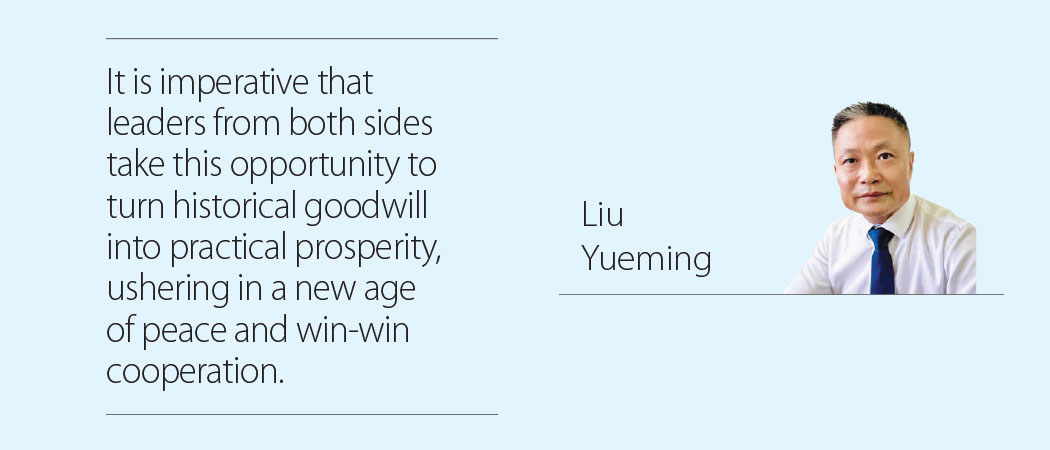
In conclusion, in today's geopolitical context, neighbours must trust and assist one another because isolation cannot find safety in the midst of global economic uncertainty. Collaboration is vital for security and stability; consequently, by combining China's economic capabilities with Nepal's strategic location and political will, both nations can protect themselves from external shocks. The last 70 years have demonstrated the strength of Sino-Nepal relations; the next five years must demonstrate their utility. It is imperative that leaders from both sides take this opportunity to turn historical goodwill into practical prosperity, ushering in a new age of peace and win-win cooperation that will serve as an example for the Global South.
(The author is the head of the Centre for Nepal Studies (CNS) at East China University of Technology (ECUT), Jiangxi, China.)