- Saturday, 30 May 2026

Ways To Alleviate Nepal’s Poverty

At present, one in five Nepalis is reeling under the absolute poverty line. Expectations of economically secured and sound standards of living, especially after the advent of democracy in 1990, remained unfulfilled for a large section of the Nepalis. This was mainly attributed to unemployment and underemployment, a modest growth rate, and low-income levels, rising inflation, eroding trust in political leadership, and inefficient and inadequate public services. Promises of faster and inclusive economic development on a sustained basis were rarely translated into action, reducing the credibility of public policy and unfolding the obstacles to productivity improvements in the private sector.
The proof of successful national leadership depends on the pragmatic economic vision that the leadership demonstrates, along with the willingness and capability to transform the vision into expected outcomes. The necessary economic agenda coupled with its time-bound action plan and programme, needs to be designed and brought into implementation. The economic agenda should be not only in qualitative or non-measurable statements like economic growth will be raised, more employment opportunities will be created, fiscal deficit will be controlled, price stability will be maintained, among others. Such statements of normative nature make the work of measurement, monitoring, and compliance regarding the economic agenda and outcome difficult and non-transparent.
Legal provisions
So far, no permanent legal arrangement exists with respect to the economic targets expressible in ratios or percentages. Legal provisions have been made only for the purpose of facilitating the implementation of government’s annual budget rather than improving the fiscal and economic management from the longer-term perspective. The periodic Plan makes the projections for growth, inflation, and main headings of the government budget including the fiscal deficit for each year of the Plan period. However, these projections are made at the constant price of the Plan’s base year. Moreover, the growth rate and inflation for the coming fiscal year is projected in the budget speech. However, the lack of a legal mandate makes state accountability to the compliance with these targets unenforceable.
Addressing the massive unemployment and recovering sluggish growth trajectory should, therefore, receive the highest priority. Facilitating this process will be the legal, institutional, managerial, regulatory, organisational, and operational refinements and reforms directed at broadening the production possibility frontier and improving the total factor productivity. Innovative production methods and new managerial techniques need to be applied on an increasing scale. There is a crucial need for steering policies to encourage and attract productive investment, fostering a conducive environment for promoting economic growth and employment, making fiscal policy effective for attaining the economic development goals, and reducing the risk and instability in the financial sector. The economic development process should be energised and expedited, and people's living standards raised sustainably through fully and favourably tapping the strengths and opportunities available in the country.
Making the fiscal management sound and sustainable remains an essential element for fostering economic growth and improving the macroeconomic scenario. Such a framework would provide a reliable basis for making public expenditure planning and management effective, besides contributing to the foreign aid harmonisation and effectiveness. In the present situation, the country demands that development activities be scaled up and sustained to meet the growing need for basic social services and facilities, besides accelerating the economic growth and ensuring its fair distribution. Low levels of development activities have remained the basic challenge of public spending. Therefore, the composition and quality of government expenditure need to be raised to accelerate economic growth, promote inclusive development, and foster poverty reduction. To bridge the resource gap, significant budgetary support from the development partners would remain pivotal.
The capability of Nepal’s public sector for meeting the development expectations of the people and the requirements of the economy needs to be raised. The task of reliably forecasting economic aggregates as a part of the planning, policymaking, and budgeting exercise remains pathetically low. The large deviations between the projected economic aggregates and their actual outcomes reflect the excessive ad-hocism and subjectivity in the projection of the economic aggregates. In such an environment of insufficient preparations and inadequacies in the field of economic management, economic growth would shrink and development outcomes become narrower, negatively affecting the goal of economic development besides undermining the process of planning, policymaking, and budgeting.
Capacity enhancement
So, capacity enhancement for scientific projections as well as the capability for regular monitoring and evaluation of the implementation process, especially among the prominent economic policymaking bodies of the nation, needs to be substantially raised so that significant developments emerging in the economy are closely monitored and assessed and appropriate corrective actions undertaken in time in a coordinated framework. For facilitating higher economic growth, increasing imports for consumption needs to be controlled while incentivising domestic production. Bringing the consumption within the prudent levels is required for releasing more resources for fixed capital formation as well as for stabilising the external balance on goods and services. The economic development agenda should receive the topmost priority of the nation in order to build a solid foundation for sustainable economic development.
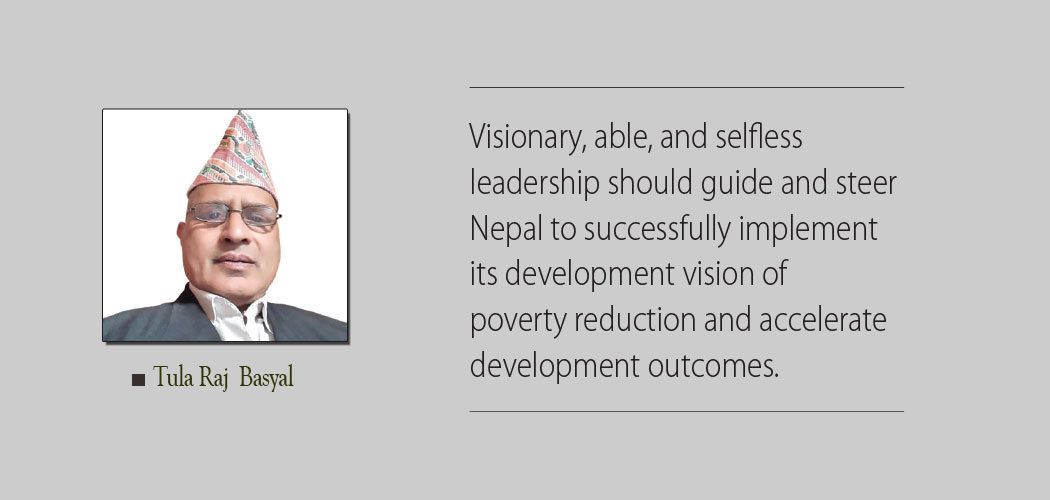
Likewise, to ensure compliance and improve state accountability for the fulfilment of the macroeconomic targets, an Act at the federal level should be formulated by incorporating the annual targets like maintaining a minimum growth at 5 per cent, keeping unemployment within 3 per cent, pegging the fiscal deficit/GDP ratio to a maximum of 5 per cent, and limiting inflation to a ceiling of 4 per cent. Otherwise, there is the risk of undermining fiscal responsibility by projecting the fiscal deficit/GDP ratio on the higher side with its associated unfavourable macroeconomic consequences. So, visionary, able, and selfless leadership should guide and steer Nepal to successfully implement its development vision of poverty reduction and accelerate development outcomes.
(Basyal is the former Executive Director, Nepal Rastra Bank, and former Senior Economic Advisor, Government of Nepal, Ministry of Finance.)