- Saturday, 30 May 2026

Private sector upbeat, opposition wary about budget

By A Staff Reporter,Kathmandu, May 30: The budget for the fiscal year 2026/27 has drawn mixed reaction from politicians, economists and business persons. The private sector is upbeat about annual fiscal outlay, citing that it has given emphasis to good governance and transparency, which is essential to give momentum to the national economy.
However, opposition parties are critical of the budget. They argue that it has neglected the marginalised and poor communities while benefiting the middle class.
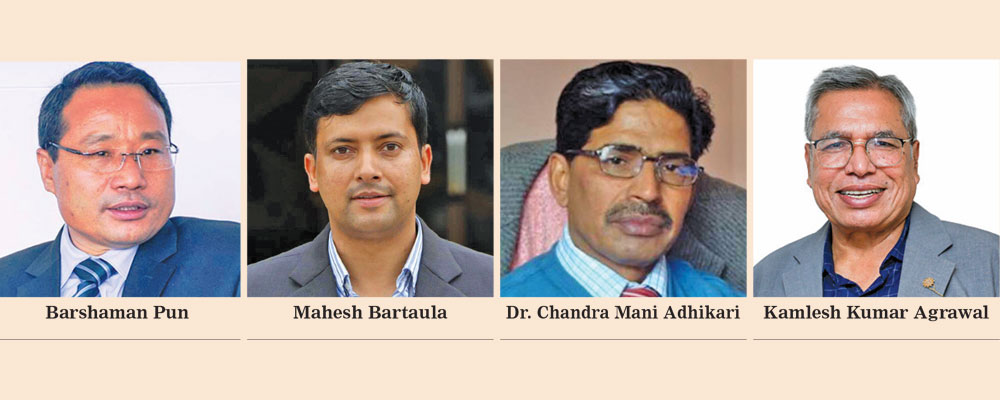
Former Finance Minister and Member of Parliament Barshaman Pun has said that the government has presented the budget for the fiscal year 2026/027, targeting the middle-class people.
He also commented that the budget has neglected the poor and marginalized people. Claiming that the budget is unnatural, Pun said that it is distributary and faces challenge to manage the financial sources.
Pun, a leader of Nepali Communist Party, however appreciated the budget for the continuation of previous programmes.
“The continuation of previous programmes, such as the one province-one production initiative, is commendable. Additionally, the salary increase for civil servants after four years is a positive aspect of the budget,” Pun said.
Similarly, young leader of CPN-UML, Mahesh Bartaula, commented that although the budget addresses all citizens, it misleads through the idea of populism.
A former whip of the UML, Bartaula stated that there is no hope or expectation regarding this budget. Bartaula also commented the budget has failed to emphasize capital mobilization, production and job creation.
“At first glance, the budget appears impressive; however, all projections are based on populist ideas. It does not guarantee any investment. There is no hope for this budget,” Bartaula said.
He also claimed that the budget is ambitious, unreal, and doesn’t address people’s expectations. Despite these problems, the salary increase of civil servants, including some other aspects, is appreciable, said Bartaula.
President of the Nepal Chamber of Commerce, Kamlesh Kumar Agrawal, has said that the budget provisions have raised hopes in the private sector, as they are expected to accelerate economic activities and boost investment.
Speaking to The Rising Nepal, Agrawal said the private sector has long been demanding reforms in tax polies to promote domestic production and strengthen investment climate.
“We, the private sector, are excited by the new tax provisions and capital expenditure spending plans in the budget as we had been demanding for the past few years to boost domestic production and private sector investment,” he said.
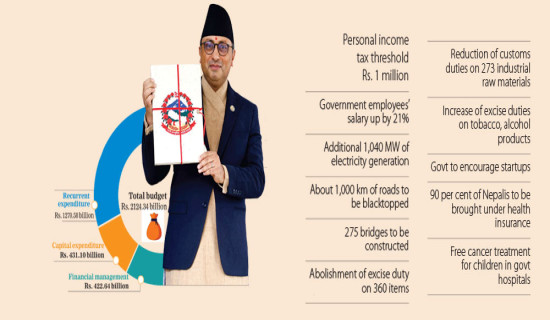
He highlighted that the doubling of the personal income tax exemption threshold to Rs. 1 million and the reduction of maximum personal income tax rate by 10 percentage points are highly encouraging measures. “This is appreciable,” he added.
Agrawal further noted that customs duties on 273 types of industrial raw materials have been reduced to ensure they remain at least one level lower than finished products, while the existing 11-tier customs structure has been streamlined into seven levels to improve efficiency and reduce production costs.
He also welcomed the government’s decision to scrap excise duties on 360 items and consolidate various scattered levies collected at customs points—including infrastructure development tax and road maintenance fees—into a single “green tax.”
However, he stressed that the government must focus on effective implementation of the budget to achieve the targeted 7 per cent growth and to strengthen private sector confidence in the economy.
Economist Dr. Chandra Mani Adhikari said that the budget has emphasised good governance, transparency, and overall economic discipline.
He noted that the budget prioritizes better management of resources by cutting unnecessary expenditures, which he described as a positive move for the economy.
However, Dr. Adhikari expressed concern over the feasibility of achieving the targeted 7 per cent growth, pointing out that capital expenditure allocation remains relatively low compared to the increase in the overall size of the budget and recurrent expenditure.
He further said that maintaining inflation within the targeted limit of 6 per cent would also be challenging due to rising recurrent expenditure and external economic pressures.