- Friday, 29 May 2026

Republic And Institutional Reform

Jestha 15 of the Nepali calendar marks the 19th Republic Day. The declaration of Nepal as a republic on 28th May 2008 was an event of historic significance, as it abolished the 240-year-old monarchy in the country. It may, however, be noted that the country remembers and honours the late King Prithvi Narayan Shah, who unified tiny principalities known as Baishi-Chaubisi and became the founder of modern Nepal. The succeeding kings, however, remained showpieces during the 104-year-old Rana rule. Nepali people suffered, sacrificed themselves and relentlessly fought to overthrow the autocratic Rana regime. The people's movement supported by King Tribhuvan in BS 2007 brought to an end the century-old family rule of the Ranas and ushered in democratic rule. Nepal celebrated the 75th National Democracy Day last February. Political instability continued for more than 8 years before the formation of a government headed by popularly elected prime minister BP Koirala in 1959. The elected government was not allowed to complete its 5-year term. It was dismissed and ousted by a Royal coup in December 1960. King Mahendra and his son King Birendra ruled the country for nearly 30 years under a partyless system known as Panchyat. Both King Mahendra and King Birendra, despite their personal and other qualities, were, however, regarded as rulers without a democratic mindset.
The restoration of multiparty democracy under constitutional monarchy in 1990 was the beginning of a new phase in the political evolution and history of Nepal. Frequent changes of government generated political instability. There was growing frustration when people's expectations remained unfulfilled. A group of disgruntled politicians launched the people's war in 1996 by calling for radical reforms, including the abolition of monarchy in the political system. It was a civil war that retarded the ongoing development programmes of the country and disrupted law and order by destroying security apparatuses, including a large number of police checkposts. The decade-long insurgency had a long list of demands, one of them being, as stated earlier, the abolition of monarchy and declaration of Nepal as a republic. During the insurgency, an estimated population of 17000 civilians, including the army and the police, had lost their lives.
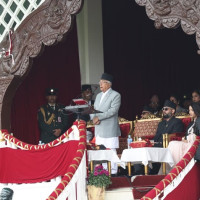
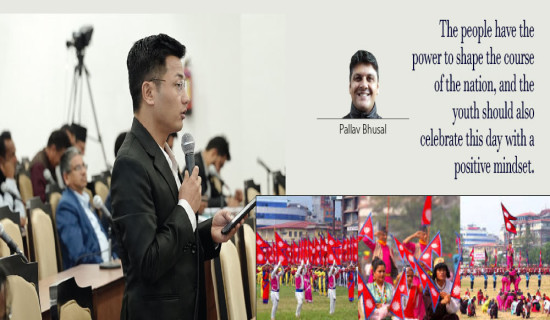
This decade-long insurgency came to an end following a comprehensive peace agreement (CPA) in 2006. Under the CPA signed between the seven-party alliance (SPA) and the Maoist insurgents, the first meeting of the Constituent Assembly on May 28, 2008 (Jestha 15, 2065 BS) abolished the monarchy and declared Nepal a federal democratic republic. Since then, Republic Day is celebrated with various functions, activities and programmes such as the army parade, processions of various organisations, cultural tableaus and programmes such as songs, dances and speeches by the president and other dignitaries.
Significance
The significance of Republic Day lies in the fact that the people's power is indomitable and sovereignty is vested in no ruler except citizens. Nepal is a country composed of and inhabited by diverse communities and multiple ethnic groups that speak different languages, embrace diverse cultures and profess more than one religious faith. The republican order strongly believes in the principle of inclusivity as it aims at catering to marginalised communities, women, Dalits, Madhesis, Janajatis and minorities. It further believes in equal participation of all sections of the population in socio-economic transformation and all-round national development. Tributes are paid on Republic Day to several activists, journalists, students and ordinary citizens who have struggled and sacrificed themselves for the cause of democracy and for creating an egalitarian society which ensures equal opportunity and justice to all.
As the country is known as a federal democratic republic, federalism is an important component of the republican order. The country, besides having a federal government at the centre, has seven provinces enjoying devolution of power and authority and regional development, as well as 753 local bodies which play a pivotal role in service delivery and management of health education and employment opportunities. Republic Day once again reminds politicians, bureaucrats, civil society, professional groups and the media about the importance of transparency, accountability and the rule of law in a democracy.
Judged in this light, all republican governments headed by two or three major parties have failed to live up to people's expectations, as their obsessive concern was power-centric and failed to focus on solving people's problems and addressing their grievances.
Political ascendancy
While the demand for constitutional review and amendment to the constitution promulgated in 2072 BS (2015 AD) was gaining momentum, escalating youth disillusionment with lack of good governance, mounting corruption and a ban on social media resulted in a movement last September known as the GenZ movement. The movement flared up as 19 young teenagers were gunned down in a matter of a few hours. It toppled KPS Oli's government, followed by an interim government headed by former CJ Sushila Karki with a mandate to conduct elections on March 5 this year. Elections were held peacefully, and all three major parties, Nepali Congress, CPN-UML and the Nepali Communist Party led by Pushpa Kamal Dahal (Prachanda), had a poor show as they won fewer seats than what they expected in parliament. The Rastriya Swatantra Party (RSP) emerged as the largest party with a near two-thirds majority. This was the fourth largest party in the previous House of Representatives.
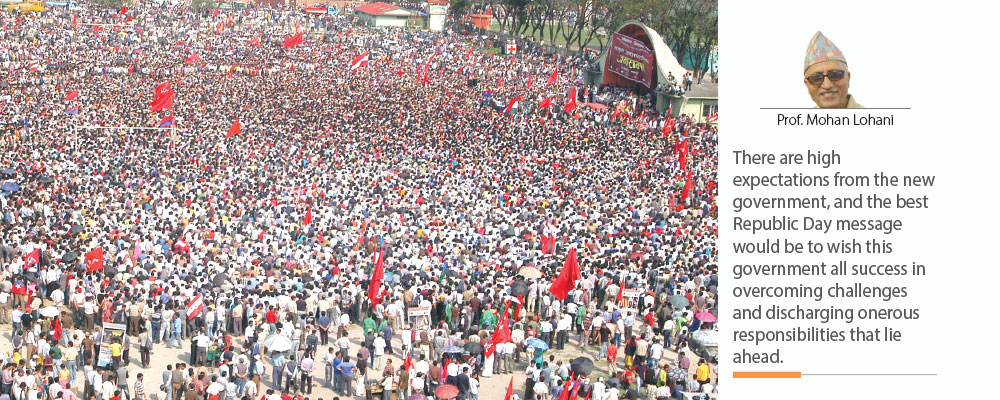
Energetic, dynamic and youthful Balendra Shah, who trounced his rival KPS Oli by more than 50 thousand votes, was sworn in as the new prime minister amidst the chanting of Vedic and Buddhist hymns on Chaitra 13 BS. It has been a little over 2 months since the Balendra Shah government assumed office. As the saying goes, 'Morning shows the day'; early indications of the government are positive. The government has lost no time in taking important decisions relating to the improvement of governance and strong measures to curb corruption and to tone up the economy. There are high expectations from the new government, and the best Republic Day message would be to wish this government all success in overcoming challenges and discharging onerous responsibilities that lie ahead.
(Prof. Lohani is a former ambassador.)