- Friday, 29 May 2026

Delayed Justice Undermines The Republic

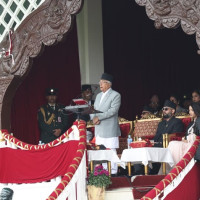
Republic Day is observed in Nepal annually on Jestha 15, as per the Nepali calendar, with great enthusiasm. Offices are embellished, speeches are made, and leaders talk about the glory of democracy, sacrifices made, and change. It was to mark the landmark decision taken in 2008 when Nepal was declared a federal democratic republic, abolishing the 240-year-old monarchy. The country has made many strides in the political and constitutional realms, but we have a long road ahead to achieve the lofty goals of the republican system as enshrined in the constitution.
Following the adoption of a republican, secular and federal set-up, hopes were high that all pending issues of mammoth scale would be sorted out without delay. But instability, lack of political will and incessant bickering among the political actors pushed the matter into the back burner. Transitional justice is one such genuine agenda that continues to linger for decades. Almost two decades since the Comprehensive Peace Agreement put an end to the decade-long Maoist conflict, thousands of victims and their families are still waiting for justice.
Lack of responsibility
The armed conflict that broke out between the government and Maoist rebels from 1996 to 2006 left over 17,000 people dead, with many missing. Many more were subjected to torture, displacement, and trauma. Following that, the process of peace was meant to fix these problems through means of justice and reconciliation. The Truth and Reconciliation Commission (TRC) and the Commission of Investigation on Enforced Disappeared (CIEDP) were formed to complete the transitional justice process in time. But victims claim that there has been a lot of talk of transitional justice for political gains rather than showing responsibility to solve it.
According to official sources, up to 3,223 complaints of disappearance cases linked with security forces or Maoists have been registered at the Disappearances Commission. The commission has selected 2,494 cases within its mandate for further investigation. Likewise, up to 63,718 complaints have been filed at the Truth Commission.
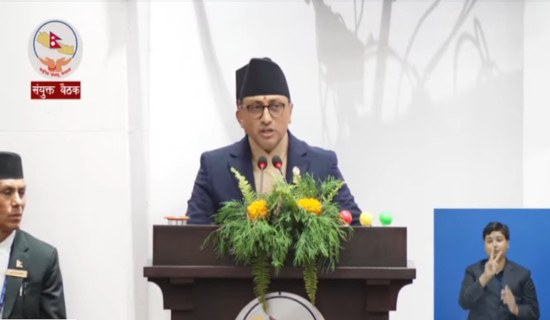
It is important to note that the issue has come into the limelight again in the wake of the formation of a new government headed by Prime Minister Balendra Shah. The government has positioned itself as one that is prepared not to resort to old practices and restore credibility and accountability. Following the promulgation of the Ordinance on the Dismissal of Public Officials, 2026, the office-bearers of Nepal’s two key transitional justice bodies, TRC and CIEDP, were formally relieved of their duties on May 2, 2026. The new administration sought to dismantle the practice of political patronage in transitional justice institutions by removing officials appointed through partisan bargaining under previous governments.
In their place, the government pledged to appoint impartial, qualified, and performance-oriented individuals capable of advancing Nepal’s long-stalled transitional justice process and delivering concrete results for conflict victims and the broader public.
The transitional justice issue is rather complicated, though. Still, the government has emphasised the significance of truth, reparations, and accountability on behalf of gross violations committed during the war years. The government should now respond in an assertive manner. The issue is lacking in the national priorities of the government, and there should be transparency in appointments, laws, and victim involvement.
The main objection to the decision is that changing the officials would not address the issue of the lack of political will behind such a decision. Whatever their ideological affiliation, different governments failed to expedite the process because they needed to keep silent about wartime crimes to protect their own interests. Thus, the problem of transitional justice is not in people but in the lack of willingness to address it.
A wide range of questions have never been answered during that period – arrests, abductions, disappearances, tortures, and killings of people by the army and rebels, as well as the problems of looting and land grabbing. However, after that time, when former adversaries started sharing their power, holding joint elections, and having some kind of unwritten agreements on protecting each other, the process of transitional justice became weaker. As all of these people bear some responsibility, nobody has been eager to implement measures for accountability.
Nevertheless, the present government has nothing to do with that issue anymore, which could be considered a good point. If the government takes its obligation to ensure justice for the conflict, it can prove to be a landmark step towards a durable peace. It became personal for thousands of families whose relatives went missing. Victims of torture and sexual violence have never received any compensation. And in many villages, the memories of the time still haunt them.
The concept of the republic stands for people’s success over their exclusion from life and authoritarianism. At the same time, the moral basis of the republic loses its strength when the justice process is delayed over and over again. Democracy cannot only be assessed by means of elections, change of leaders, or constitutional provisions. It also refers to the way a country responds to its victims of the conflict period. The emergence of the Shah’s government is also a manifestation of generational replacement among politicians. Young citizens who supported the movement for reforms expect that institutions will become more open and accountable. That creates an immense responsibility for the present government.
Rights of victims
However, whether the government achieves its objective depends both on rhetoric and action. The process needs to be independent, with the rights of victims protected, thorough investigations conducted, and the challenge of impunity faced regardless of political difficulties. Justice should not be selective or performative. So, Republic Day should not be just another annual event. It should be an occasion to reflect on the situation faced by the victims of armed conflict.
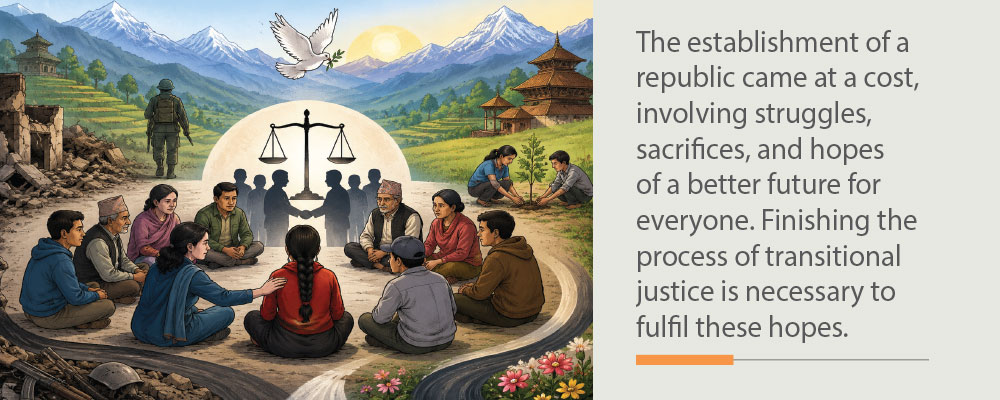
After all, the establishment of a republic came at a cost, involving struggles, sacrifices, and hopes of a better future for everyone. Finishing the process of transitional justice is necessary to fulfil these hopes. The real power of the republic should lie in the readiness to face unpleasant truths. Nepal’s democratisation process gains momentum only when victims feel justice without further delay.
(Rijal is a Sub-editor at The Rising Nepal.)