- Friday, 29 May 2026

UK risks 'lost generation' as unemployment rises

London, May 29: Young people not in work, training or education is estimated to be costing the UK £125bn a year, with 16 to 24-year-olds facing a "perfect storm" of challenges, a review has found.
The education, health and welfare systems are "no longer fit for purpose" in preparing young people for adult life, said its author former minister Alan Milburn. "We are at risk of a lost generation," he warned, with the number of 16 to 24-year-olds out of work, education or training set to rise to 1.25 million by 2031.
He told the BBC that the first rung on the career ladder was "more out of reach" for this generation of young people, adding that there was a "shortage of opportunity".The damning report comes amid growing concerns over the number of young people not being able to secure a job in the UK.
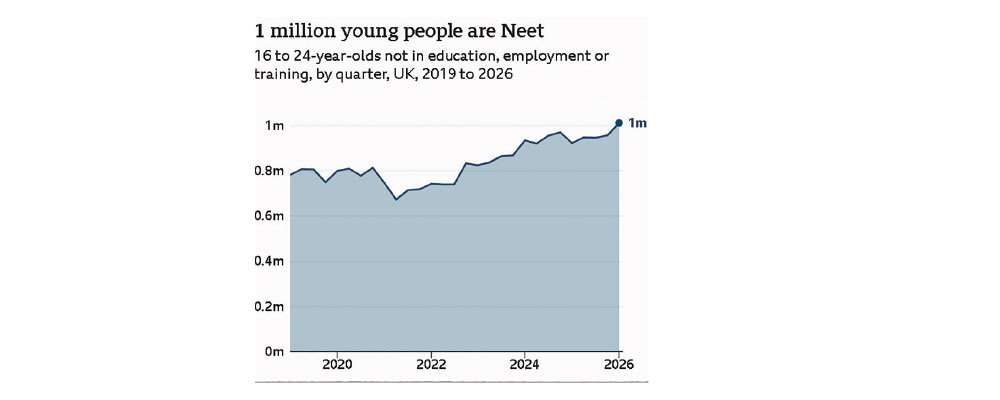
Official figures released on Thursday revealed more than one million 16 to 24-year-olds were not in education, employment or training - the highest level in more than 12 years.
Milburn said his review found that young people were putting in dozens, "sometimes hundreds" of job applications but were not hearing back from employers at times. "This is a visceral feeling in the country…it's bordering on a fear in the country among parents and grandparents that this generation is going to be a lost generation," he told the BBC.
The report estimated "the cumulative cost" to the UK of almost one million Neet young people at £125bn per year, including financial impacts of lost economic potential, as well as losses in tax revenue, increased health and benefits spending.
The amount is more than more than annual education spending in England.
Milburn was tasked with investigating why so many young people are not in employment, education or training - known by the acronym Neets.
According to the figures from the Office for National Statistics (ONS), there were 1,012,000 young people classed as Neet between January and March 2026, making up 13.5% of all young people in the UK.
Milburn warned that number could rise to 1.25 million, or one in six young people, in the next five years unless action was taken. The ONS figures revealed a spike in the number of people classed as "economically inactive" - not looking or available to work - to about 613,000, with more young women not looking or being available for work than young men.
Meanwhile, the number of young people classed as unemployed - not in work but seeking a job - was estimated to be 400,000, with more 16 to 24-year-old men than young women being jobless.
In response to the report, Work and Pensions Secretary Pat McFadden, said he was "struck by the proportion of young people not only not working but who had never experienced the sense of pride and purpose that comes with having a job".
He added the Milburn's report, which he commissioned, laid "bare the scale of the challenge and the root causes of youth unemployment we now need to confront". "We are already taking action by bringing forward the biggest youth employment reforms in a generation to create 500,000 opportunities for young people, including a Youth Jobs Grant for businesses starting next month, more apprenticeships, and subsidised employment to help young people get a foot on the ladder," McFadden said.
But shadow work and pensions secretary Helen Whately criticised the government's policies, claiming Labour had "made it harder for a young person to take their first step into work".
In his interim report released on Thursday, Milburn said there is not one factor causing the crisis, with the Covid pandemic, smartphones and the current jobs market all having an impact.
"The evidence does not support a single explanation," he said.
"It supports something harder to accept: that the institutions we built to support young people into adulthood are no longer fit for that purpose, and that the country has known this for some time." He challenged the narrative that young people do not want to work and that they were not to blame for the youth unemployment crisis.
"You hear some call them work shy, snowflakes, soft - this is a generation that is trying, putting in hundreds of applications a month," he told the BBC.
"They hear nothing back, it's the silence that kills.The old contract in society was always you put in effort and got a reward, each generation would do better than the last - this contract has been broken for this generation."
In a speech, he added that changes in mental health had also reduced the supply chain of young labour, with a sharp increase in the number of Neets reporting anxiety and ADHD as a key factor as to why they are not in work or training.
He said it was "shocking and shameful" that there was not enough support available.
Systemic problems, he claimed, were leading to a "bedroom generation" who doomscrolled and did not leave their rooms.
The report featured one young person detailing the effects of the Covid lockdown.
"We weren't really seeing people in person, so we didn't get used to the social aspect of connecting with people. Maintaining eye contact, hand gestures and all sorts. We were just sitting behind screens. There were skills that people were struggling to develop," they said.
Zaynah, 24, has suffered from physical ill health and has not had a job since leaving college. Over the past year, she has applied for more than 200 jobs but said she never heard back from any of the employers.
"Getting a job is very hard because with my issues, I haven't got that much experience, I've never worked before," she added.
"So I feel like it's restricting me and I'm not getting jobs.'' She said she was planning to start doing some volunteering so she can improve her CV.
Luke, who studied product design at university, said he applied for more than 400 positions and has only ever had one interview as a cleaner which he did not get.
''It's humiliating," the 23-year-old said. "You think 'okay I've got all the knowledge, I've got all the skills, all I'm waiting for is a job to put it in practice'.
Photo: BBC
Estimates involving young people may be more volatile than older groups because of smaller populations. (BBC)