- Friday, 29 May 2026

Path To Prosperity In Republic Era

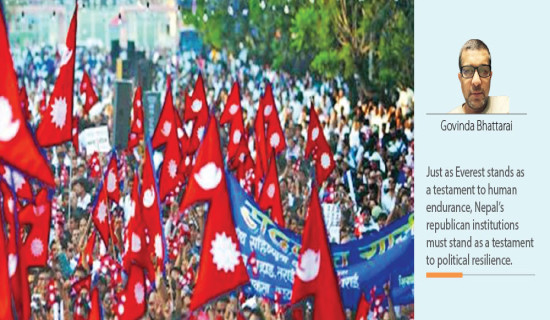
A decade-long internal armed conflict from 1996 to 2006 and a 19-day people’s uprising in April 2006 compelled Nepal to conduct elections for the Constituent Assembly following the Comprehensive Peace Accord of November 2006. The newly elected Constituent Assembly officially declared Nepal a federal democratic republic on May 28, 2008, abolishing the 240-year-old monarchy.
With that political regime change, people raise hopes for economic prosperity, social equity, and good governance. However, after nearly two decades of a republican system, Nepal has witnessed a mixed outcome with both achievements and failures. On Republican Day, it is pertinent to review Nepal’s republican journey by assessing both successes and failures and correct past mistakes going forward for economic prosperity.
Progress
Despite major shocks such as the earthquake in 2015 and the coronavirus pandemic in 2019, Nepal has shown tremendous achievements across various development fronts in the post-republic era. In 2020, the World Bank upgraded Nepal as a lower-middle-income economy from a low-income economy. The GDP per capita has more than tripled from about USD 465 in 2008 to almost USD 1,500 in 2025. As per World Bank figures, the percentage of people living in extreme poverty (less than $3.00 a day) has declined considerably from above 21.5 per cent in 2010 to roughly 2.4 per cent in 2022.
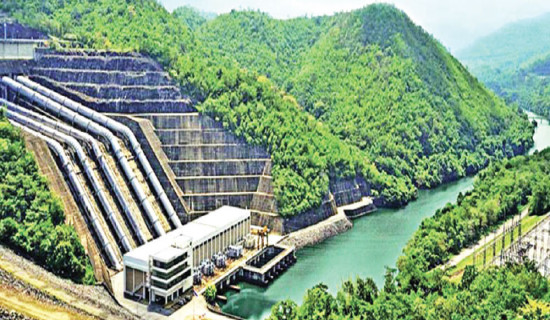
The post-republic era has registered the expansion of electricity production and digital connectivity. Infrastructure construction has advanced considerably, with the completion of two international airports, such as Gautam Buddha and Pokhara International, and thousands of kilometres of road networks have also been constructed. Most notably, hydropower generation has increased from around 650 MW in 2008 to over 4,200 MW. This development not only ended the dark era of load-shedding but also made Nepal a net exporter of electricity to India. Meanwhile, internet penetration has improved from single digits in 2008 to more than half of the population, laying the foundation for a digital economy.
In health and education, progress has been equally significant. Life expectancy increased from 66 years in 2008 to nearly 71 years in 2023. The literacy rate rose from 55 per cent to over 76 per cent. Maternal and infant mortality rates have declined, driven by improved rural healthcare access and several reproductive health programmes. Likewise, the prevalence of stunting among children under five dropped from 46 per cent in 2008 to about 26 per cent in 2024.
Pitfall
Despite these gains, Nepal’s republican period has been affected by governance deficits and weak service delivery. Since 2008, frequent government changes became norms with over a dozen governments and nine prime ministers. Frequent change in government has prioritized short-term power-sharing over long-term policy vision. This continuous political “musical chairs” has eroded the public trust and the governance capacity.
Only after the second Constituent Assembly election was Nepal able to promulgate a new constitution in 2015. The Constitution introduced a seven-province federal structure, but its implementation has remained weak. Local governments, despite their constitutional mandate, have remained deprived of adequate technical manpower and capacity.
On the economic front, Nepal’s macroeconomic stability relies heavily on remittances received from foreign employment. These remittance inflows helped to maintain rural consumption and reduce extreme poverty, but they have created an economic paradox. The continuous out-migration of youth has created a labour shortage, leaving the agricultural and manufacturing sectors in limbo. Instead of driving domestic production, remittance income fuels the consumption of imported goods. This has generated a huge trade deficit and left the economy highly vulnerable to external shocks, creating foreign employment syndrome.
Bureaucracy is frequently politicised and destabilised, leading to chronic underspending of the capital budget and weak service delivery on account of weak capacity, lack of commitment, and poor accountability. This governance deficit has become a central driver of public frustration, culminating in the youth-led anti-corruption protests of September 2025.
Path to prosperity
Nepali people are eagerly waiting for economic prosperity and are actively engaging in political change for this. Yet political transformation alone is not enough; effective strategies must be devised by correcting past mistakes. Every sector requires concrete reforms by considering changing times, technology, tastes, migration and demography. For Nepal, prosperity should mean raising per capita income to middle-range levels, reducing inequality and creating decent jobs at home with social harmony.
Nepal should harness existing potentials of clean energy, tourism, forestry, and mineral resources. Hydropower production has expanded significantly, but the lack of sufficient reservoir projects prevents year-round self-sufficiency. Tourism remains underutilised, with only about 1.2 million tourists' arrivals despite vast natural and cultural attractions. With 46 per cent forest cover, there is the possibility of establishing forest-based industries and the cultivation of high-value medicinal herbs. Tapping mineral deposits is another opportunity. Recently, information technology (IT) provides new hope, also as reflected in rising exports of IT services.
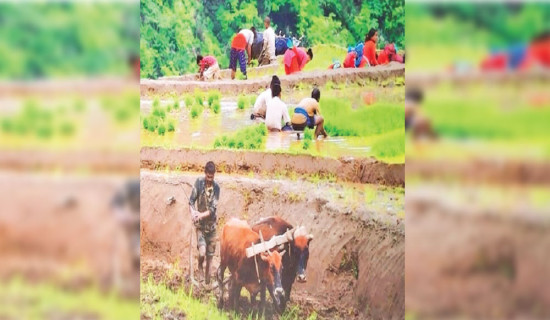
Instead of exporting raw electricity, there should be availability of cheap, uninterrupted power to local manufacturing, data centres, and electric transportation. Agriculture should be transformed from subsistence to commercialisation, for which there should be a reliable supply of fertilisers, high-yield seeds, irrigation facilities, and cold-storage facilities along with flexible land ceilings.
Foreign direct investment, which remains below 1 per cent of GDP, must be boosted by simplifying the regulatory provisions. The government should establish an effective “one-window system" for business approvals. Capital account policies should be flexible along with eliminating bureaucratic hurdles. Simultaneously, the National Project Bank must be strengthened so that high-yield capital projects can be selected for allocating funds.
The main weakness is poor implementation of policies, plans, strategies, and projects. There is weak institutional capacity and dedication, due mainly to unstable politics, inconsistent provisions, and bureaucratic inefficiency. The right people are rarely placed in the right place. Selection of most projects is influenced by the politics rather than the economic return. Laws and regulations frequently contradict each other. Lawmakers focus on trivial development activities in their constituencies instead of sound lawmaking. These shortcomings must be corrected.
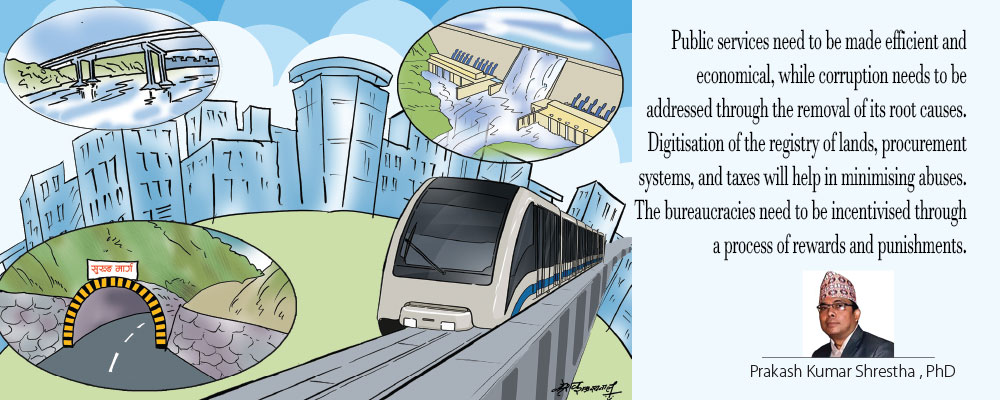
Public services need to be made efficient and economical, while corruption needs to be addressed through the removal of its root causes. Digitisation of the registry of lands, procurement systems, and taxes will help in minimising abuses. The bureaucracies need to be incentivised through a process of rewards and punishments.
With Nepal’s emergence into a federal democratic republic, an autocratic system was destroyed, and a progressive environment has been set up for economic prosperity, gender equality, and social justice. The achievements that have been made since 2008 illustrate the ability and strength of the Nepalese people. However, the economic strength of the country is very fragile, with the existing vast gap between expectations and achievement. In order to be prosperous, we need to combine political success with building productive economic forces by abolishing corruption, utilising natural resources, and generating employment opportunities.
(The author is a former vice chair of National Planning Commission.)