- Friday, 29 May 2026

People’s Power Shapes Democratic Course

The diversity, culture and resilience of Nepali people, residing from the Himalayas in the north to the plains of Madhes, fulfilled their wish for secularism and unity on 15 Jestha 2065 BS, when the first meeting of the Constituent Assembly declared Nepal a republic.
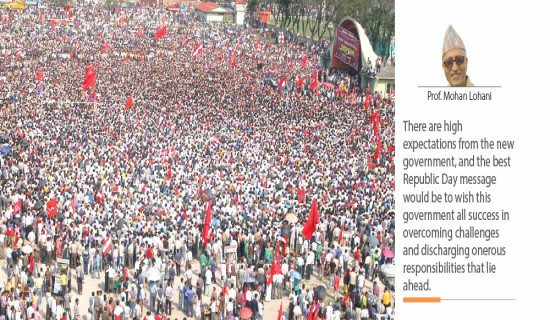
Every year, Nepali people celebrate Republic Day, also known as Ganatantra Diwas, remembering the end of 240 years of monarchical rule and the start of people’s power. The streets roared with calls for republican democracy, inclusion and sovereignty.
The Constituent Assembly shaped the way forward for people’s rule, abolishing hereditary rule and filling it with hopes, struggles and sacrifices of ordinary citizens. Nepal witnessed political instability for decades with changes in the ruling structure. The fall of the Rana regime in 1951 opened the door to democracy, but continuous instability challenged people’s democratic aspirations. The long-running thief-and-police system finally ended after the 2062/63 people’s movement.
Democratic aspirations
Khim Lal Devkota, a member of the Constituent Assembly, believes that the aspirations of democracy and a republican state can be seen in the current context of political changes in Nepal. He said that the evolving significance of Republic Day could be seen through the lens of youth involvement. Devkota argued that the recent Gen Z movement was made possible by republican freedoms but highlighted that the state must shift from merely celebrating the past to adopting a future-oriented approach.
Devkota pointed out that there are legal age barriers within the constitution preventing younger citizens from holding high-ranking political offices, stifling youth motivation. However, the country has got a young prime minister via the ballot box, hinting at change in politics. This can also be credited to the country’s democratic and republican system.
Devkota advocates structural reform that aligns national policy with the aspirations and active participation of the modern generation. A republican state, shaped after a long battle between political parties and the monarchy, along with compromise and revolution, intensified debates about inequality, representation and governance.
Constitutional expert Bipin Adhikari says the younger generation must connect republican values with responsibility, hard work and self-governance. Reflecting on the past political climate, he noted that many youths are frustrated with the existing system and often react harshly to the country’s situation. However, he argued that the culture of working hard with available opportunities is gradually declining.
According to Adhikari, today’s youth are exposed to the wider world through social media, yet they often overlook the effort, discipline and skills required to achieve success. He stressed that commitment is lacking in many sectors in which young people are currently involved.
He said the government must create opportunities by providing training, capital, education and professional development so that young people can contribute meaningfully to Nepal’s economy. At the same time, youths themselves must take initiative and dedicate themselves to work rather than remain limited to reactionary protests or social media distractions. Linking this to Republic Day, Adhikari said a republic represents self-governance, freedom, development and accountability. Without commitment to work and nation-building, he warned, republican values cannot be sustained.
Jestha 15 symbolises the strength of the people’s voice, especially that of the youth. At that time, young people believed that democratic participation and accountability were greater than inherited power. The Gen Z movement could also be seen as a build-up to previous movements because today’s youth also demand good governance, an end to corruption and greater opportunities, which have been undermined since the 2006 revolution.
Politician Mahesh Kumar Bartaula highlighted the positive achievements of the republican system and its significance for the younger generation. He said the republic ended the centralised system of governance and brought state power closer to citizens through federalism. According to him, one of the republic’s greatest achievements is replacing hereditary rule with a system in which any ordinary citizen’s son or daughter can rise to the highest position in the nation.
Bartaula noted that the republic was established through the people’s movement and institutionalised by the Constitution, creating a framework based on democracy, inclusion and citizen participation. He stressed that Republic Day should remind citizens of the sacrifices made to achieve these freedoms and encourage political forces to move forward with unity, accountability and commitment to constitutional values.
Speaking about youth, Bartaula said the republic is directly connected to citizens’ livelihoods, rights and opportunities. He highlighted the need to connect youth labour with production, employment and national development. Young people should feel ownership of the country and recognise that the state exists to protect their aspirations and future. He added that the government must address youth expectations, modern challenges and technological changes to strengthen faith in the republic and ensure long-term progress.
Special message
This Republic Day holds a special message, especially for youths. The democratic nation of Nepal was built on the sacrifices of many martyrs who gave their lives seeking a better future for the country and its people. Those sacrifices cannot be ignored, and the long-overdue process of strengthening the republic must continue.
This can only happen if responsible people in authority work under the constitution and the rule of law. Political leaders and bureaucrats have long used the constitution and the federal structure as weapons. Political instability has caused a halt in the law-making process, which is essential for building a successful republican state where ordinary people can achieve their dreams and opportunities within the nation. On this day, youths and political leaders should acknowledge that, in a republic, authoritarian rule cannot prevail. The people have the power to shape the course of the nation, and the youth should also celebrate this day with a positive mindset.
(Bhusal is a Sub-editor at The Rising Nepal.)