- Friday, 29 May 2026

Strengthening Democratic Institutions
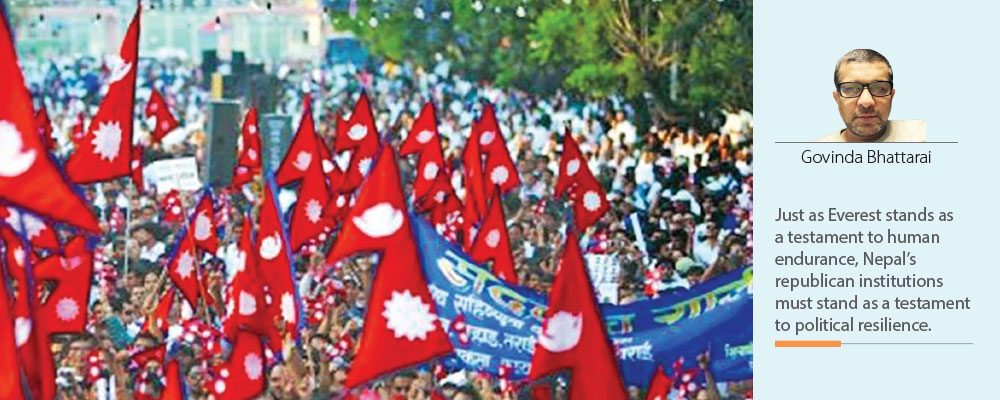

Today, May 29, Nepal is celebrating two historical milestones: the 19th Republic Day, marking the end of monarchy in 2008, and International Everest Day, marking the first ascent of the world’s tallest mountain in 1953. It may be a coincidence, as the two events fell on the same day this year (this doesn’t happen every year). Though the two celebrations may have two different themes, they share some common elements. While one speaks to the heights of political courage, the other speaks to the heights of human endurance. Together, they remind us that institutions, like mountains, must endure generational changes and last for generations to come.
The Republic Day is not just a commemoration of the abolition of monarchy; it is also a symbolic reminder that we the people are in charge of our own affairs. However, nineteen years on, the question is whether our institutions have matured enough to withstand the turbulence of leadership changes. The promise of republicanism lies in building systems that function smoothly regardless of who occupies Singha Durbar. Yet, our history since the 2062/63 People’s Movement shows that while we have made some progress, state policies have often been tied to the interests of political personalities rather than institutions. With a new administration pledging “development diplomacy” and systemic reforms, and with Gen-Z demanding accountability, Nepal is set to move towards a prosperous future.
Republicanism is not simply a majority rule. As many political observers have noted, it is interconnected with separation of power among various levels and branches of government, secularism, and participation of all, regardless of their identity. If the principles of republican governance fail, all government policies based on those principles falter. Majoritarian principles, be they in parliament or in the streets, risk undermining minority rights and institutional safeguards. Past administrations often used electoral victories as a blank check to pursue policies that catered to leaders’ personal interests rather than institutionalisation of the system. For example, the expansion of ministries and repeated recycling of ministers without knowledge of and expertise in the ministerial issues weakened institutional capacity, reduced policy coherence, and turned governance into a revolving door of personalities rather than a system of accountability. Institutionalisation requires depersonalising governance, which ensures that rules, not rulers, drive policy.
Last year’s Gen-Z movement was a watershed moment in this regard. Though it was triggered by the government’s ban on social media, it was a long-run battle against corruption, nepotism, and elite privilege. The movement, which saw the deaths of scores of youths and burning of the country’s most iconic structures, forced the members of the old regime to flee and the parliament to dissolve. That was followed by the formation of an interim government led by former Chief Justice Sushila Karki. As pledged, the interim government successfully held the parliamentary elections, resulting in the almost two-thirds majority of the Rastriya Swatantra Party.
This movement was not led or organised by any individual political party; it was rather a citizen-driven campaign, cutting across social classes, proving that the youth understand politics in their own language, demanding transparency and accountability. The Gen-Z movement cannot afford to relent and rest. Its insistence on systemic change represents a “second wave” of republicanism: it’s not just about ending a hereditary rule but embedding accountability into newly built institutions. Their activism challenges the culture of personality politics and demands that republicanism must be institutionalised.
This is not to say that Nepal failed under the previous administrations. Both national and international official records show that poverty rates have declined, infrastructure has expanded, and remittances have improved living conditions. Yet, development had often been uneven and fragile, depending on the whims of elected officials who considered themselves rulers rather than public servants. While some targets were met, the process remained centralised and elite-dominated, with policies lacking institutional calibration. Development dependent on leaders’ charisma and donor negotiations (which entailed conditions and commission for approving projects) has proved to be unsustainable. Without institutionalised delivery mechanisms, prosperity risks being hostage to political cycles. Every time a new party or a coalition of parties comes to power, they appropriate policies to their own personal and partisan benefits.
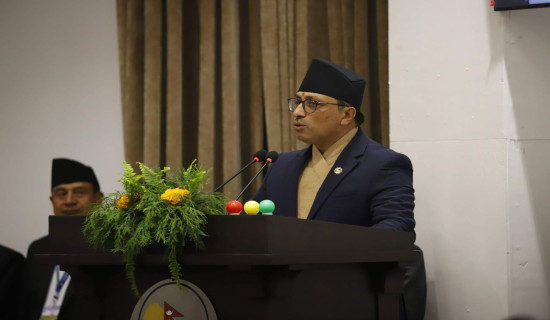
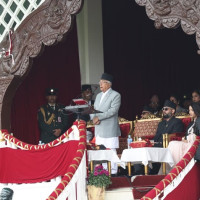
This contrasts with the new administration’s focus on what they’ve termed as “development diplomacy". The concept refers to the use of development cooperation, such as foreign aid, capacity-building, and sustainable growth initiatives, as a diplomatic tool, blending foreign policy with development goals. This requires building goodwill and strengthening alliances to advance national economic interests as a cornerstone of foreign policy. For the first time, Nepal is preparing country-specific strategy papers to align diplomacy with national interests, moving beyond generic briefs. The government’s 2026/27 Policy and Programme, presented by President Ram Chandra Paudel, emphasises good governance, zero tolerance for corruption, and systemic reforms as a tribute to the martyrs of the Gen-Z movement.
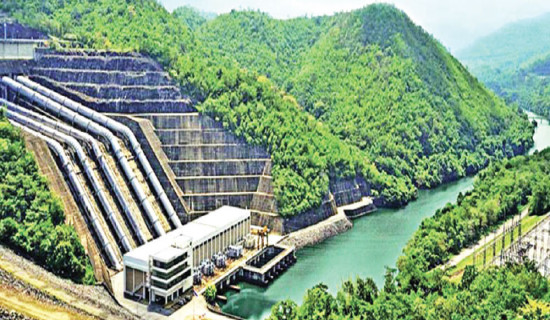
This approach contrasts sharply with previous administrations’ ad-hoc foreign policy. For instance, the previous economic diplomacy was reactive, often leader-centric, and lacked continuity. The new model seeks to institutionalise foreign engagement, ensuring that Nepal’s development priorities, such as hydropower, IT-related services, tourism, and agriculture, are consistently advanced regardless of leadership changes. If successful, development diplomacy could depersonalise foreign policy, embedding it within institutional frameworks.
Just as Everest stands as a testament to human endurance, Nepal’s republican institutions must stand as a testament to political resilience. The challenge ahead is to ensure that our republic is not a hostage to personalities but anchored in systems that endure beyond them. The integrity of these celebrations will be meaningful if we build and nurture institutions that deliver as promised.
(A PhD in political science from the State University of New York, Buffalo, the author is a faculty member at IACER. govinda@iacer.edu.np)