- Tuesday, 26 May 2026

Make Insurance System Mandatory

With the election to the House of Representatives taking place in less than three weeks, the political parties are now rolling out their roadmaps for development through their manifestos. In their commitment papers, they unveil their plans, policy and strategy for the overall progress of the nation. It is natural for them to cover important public issues, including governance, growth, infrastructure, job creation, education, health, tourism and digital development in their manifestos. However, they often fail to realise their electoral promises once they step into the corridors of power.
It is high time that parties gave greater importance to public health and education, which form the foundation of the prosperity and happiness of the people. There lie rational grounds for the political parties to prioritise the health sector. Without developing a proper health system, the country is unlikely to achieve inclusive growth. So, ensuring easy access to health for every citizen needs to be given precedence by all political parties, and that too through making health insurance mandatory.
Financial burden
Healthcare for the people is still a financial burden for many, as serious illness has forced many into debt, causing people to sell their properties to foot the hospital bills. It is stated that only 23 per cent of the population is currently receiving health insurance, making universal health coverage a far-fetched dream in the country. In order to cover all the citizens in health insurance, it should be made mandatory for everyone. This is the only way that the country would be able to minimise the risk and protect the people from catastrophic health expenditures.
However, the need to mandate health insurance should not be relegated to just an electoral slogan and should be accompanied by the commitment of political parties towards these much-needed reforms, which would further strengthen the National Health Insurance Programme (NHIP).
Reforms are needed to improve the governance of the system, which has seen instances of reimbursement delays to hospitals, technological issues, and issues related to the capacity of the system and coordination at various levels of government. Financing is another important factor to consider.
Taxing tobacco, alcohol, and various detrimental goods is an effective and rational strategy.
Such measures not only control detrimental practices, but they can also provide funding for health insurance programmes. As public health goals are related to economic policy, health is an issue of both social and economic importance. In addition to that, accessibility has to be ensured. Local governments are still not provided with health facilities that are empanelled under the NHIP.
This means that there are no health insurance cards to be used by their citizens. Expanding these health facilities, especially in rural areas where health institutions have not been established, by incorporating private health facilities can be beneficial. In addition to that, conducting feasibility studies on health institutions can be beneficial.
Moreover, an insurance benefit package revision is long overdue. The package’s current status, which is not updated to reflect changes in healthcare costs and disease patterns, undermines citizens’ confidence in the system. Such a package would be best based on evidence to ensure its effectiveness in reducing out-of-pocket costs and adapting to changing healthcare needs in the country. Most importantly, health insurance has to be depoliticised. Healthcare is a national issue and not something to be used as a political tool. All political parties have to agree on the need for Universal Health Coverage (UHC) and work towards the common national cause. The country has already suffered from political indecisiveness and delays in healthcare reform.
Health governance
This is due to a lack of ownership of the healthcare vision. Making health insurance a national priority is only meaningful if accompanied by concrete actions. The upcoming election provides a platform for political parties to show their maturity in dealing with matters that require responsibility while considering health rather than political mileage. Making health insurance mandatory, improving governance, and financing health care are some measures that would bring Nepal closer to UHC.
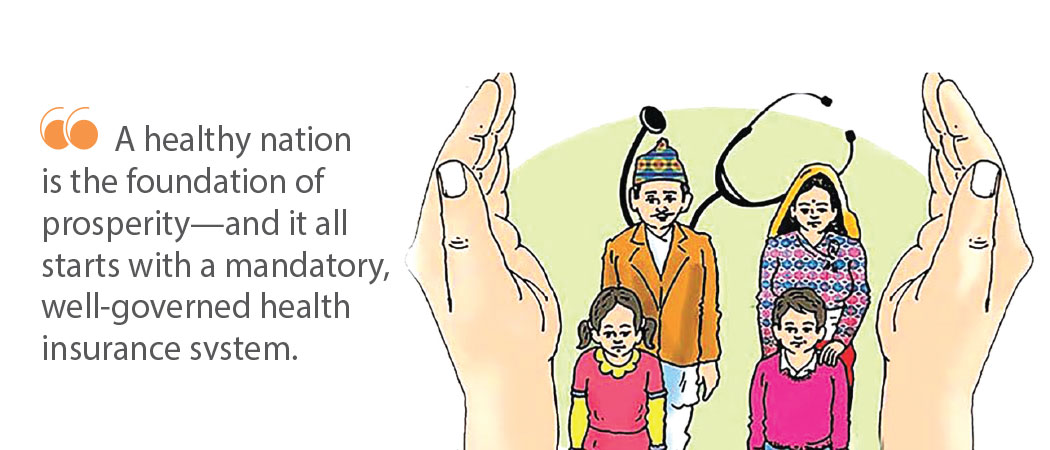
Therefore, if political parties truly prioritise the health issue in their agenda, the country has the opportunity of creating a future where every citizen receives medical attention despite their financial difficulties. A healthy nation is the foundation of prosperity—and it all starts with a mandatory, well-governed health insurance system.
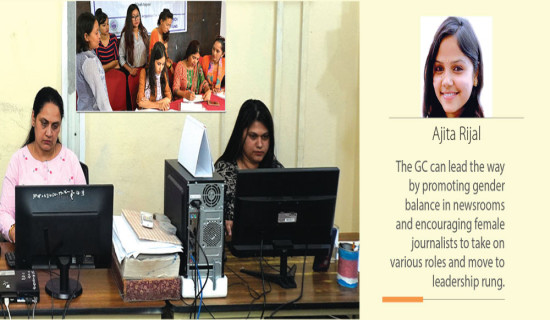
(Rijal is a journalist at The Rising Nepal.)