- Saturday, 30 May 2026

Govt unveils Rs. 2124 bn budget for FY 2026/27
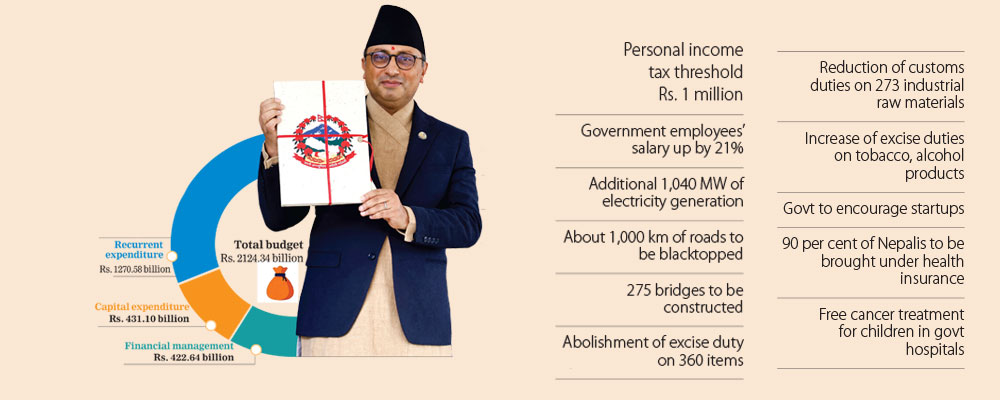

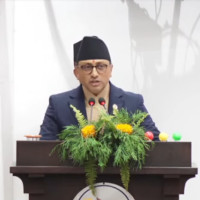
By Modnath Dhakal & Laxman Kafle,Kathmandu, May 30: With an aspiration to achieve 7 per cent economic growth, Finance Minister Dr. Swarnim Wagle has announced a budget of Rs. 2124.34 billion for the next Fiscal Year 2026/27.
He has earmarked Rs. 1270.58 billion for recurrent expenditure, Rs. 431.10 billion for capital expenditure and Rs. 422.64 billion for financial arrangements. These allocations make up 59.8 per cent, 20.3 per cent and 19.9 per cent in the total budget, respectively.
"This expenditure estimate is 25.2 per cent higher than the revised estimate of the current FY 2025/26," FM Dr. Wagle said while presenting the budget at the joint session of the Federal Parliament on Friday evening.
During the half-yearly review of the budget, then finance minister Rameshore Prasad Khanal had slashed the size of budget by 14.04 per cent to Rs. 1688.32 billion.
For this year, then finance minister Bishnu Prasad Paudel had unveiled a budget of Rs. 1964.11 billion with Rs. 1180.98 billion (60.1 per cent) allocated to recurrent, Rs. 407.89 billion (20.8 per cent) to capital and Rs. 375.24 billion (19.1 per cent) to financing management. Last year's budget size was 18.2 per cent larger than the revised estimates. Earlier, in FY 2024/25, the budget size was Rs. 1860.40 billion.
A deficit of Rs. 657 billion
Next year's budget will have a deficit of Rs. 657.29 billion.
According to Finance Minister Dr. Wagle, the government has set a revenue target of Rs. 1405.31 billion for the next year. The remaining budget will be covered with Rs. 61.74 billion from foreign grants, Rs. 247.28 billion from foreign loans and Rs. 410 billion from domestic borrowing. "As Rs. 245.89 billion in principal of domestic loans will be repaid in the upcoming fiscal year, net domestic borrowing will amount to only Rs. 164.11 billion," read the budget document.
As per the suggestions of the National Natural Resources and Fiscal Commission, Dr. Wagle has made arrangements to provide fiscal equalisation grants of Rs. 61.50 billion to the provinces and Rs. 90.20 billion to local governments for the upcoming year.
He said that complementary grants of Rs. 4.60 billion will be provided to provinces and Rs. 893 billion to local governments for implementing infrastructure projects. Likewise, special grants of Rs. 3.82 billion has been earmarked for provinces and Rs. 9.40 billion for local governments. For the implementation of federal government projects, the budget has allocated conditional grants of Rs. 39.72 billion to provinces and Rs. 206.8 billion to local governments.
Dr. Wagle estimated that a total of Rs. 175 billion will be transferred to provinces and local governments through revenue sharing. In the upcoming fiscal year, it is projected that over Rs. 600 billion will be mobilised in provinces and local governments through revenue sharing (including royalties) and fiscal transfers.
"As Finance Minister, I have taken this on not merely as a constitutional formality, but as a duty to transform the character of the state, the culture of governance, and the nature of the economy," said the Finance Minister, adding that the budget will serve as a policy document to meet expectations regarding production-oriented economy, international prestige and technology-driven change.
According to him, the need of the hour is to put an end to policy confusion, delays, institutional capture, and the exploitation of state resources, and to build a results-oriented governance system.
He said that the government is committed to launching an aggressive series of operational improvements to transform the pace and momentum of capital expenditure.
It will work in 'mission mode' to complete projects within the specified cost and on time, by improving procurement processes, ensuring flexibility in resource management (including fund reallocation), mobilising alternative finance, and guaranteeing stability in the tenure of project heads.
Dr. Wagle announced to formulate a sunset law relating to development projects within the current fiscal year and present it to the parliament. "We will make arrangements to track mobilisation advances, ensuring such funds are spent only on the relevant project. An initial pipeline of infrastructure projects that can be built under the hybrid annuity model will be ready within three months," he said.
The budget also pledged to address the difficulties faced by construction contractors as a result of price hikes in fuel, bitumen and other construction materials caused by the conflict in the Middle East.
FM Dr. Wagle has exhibited ‘cautions’ to focus the capital expenditure to a few priority sectors and large infrastructure projects that will promote growth and further development. Small projects and piecemeal allocations have been discouraged in the budget.
Salaries raised
FM Dr. Wagle increased the starting salary of government employees by 10 per cent while maintaining the existing dearness allowance. Likewise, to introduce a performance-based pay system, he has made a provision for a monthly incentive allowance equivalent to 10 per cent of the new salary scale. This will result in a net increase of approximately 21 per cent in the current remuneration, raising the minimum remuneration (including grade) to around Rs. 40,000, and beyond Rs. 100,000 at the upper level.
The new salary scale will come into effect from mid-July, beginning of the new FY 2026/27.
Stating that the salaries of civil servants have not been increased for the past four years, during which time the consumer price index-based inflation has risen by 17.3 per cent, Dr. Wagle increased the salary.
Execution challenges
Meanwhile, the budget that is augmented to about one-third of the Gross Domestic Product (GDP) of the country which is expected to reach Rs. 6,609 billion by the end of this fiscal (mid-July this year) comes with mobilisation challenges. The leaders of the opposition parties termed the budget 'ambitious' and pointed to the challenges of its implementation.
Likewise, the government has targeted to contain inflation at a maximum of 6 per cent.
Former finance minister Janardan Sharma said that the budget is positive and optimistic and welcomed the policy and legal reforms announced. In his social media post, he said that the focus on digital development and priority to Sudurpaschim, Karnali and Madhes provinces as well as education and health are highly positive steps.
However, former minister and CPN-UML Lawmaker Padma Kumari Aryal said that the budget has inherent execution challenges. Talking to media persons after the budget announcement, she said that the programmes announced through the budget lack sufficient allocation and execution assurance.
Likewise, Rastriya Prajatantra Party's lawmaker Khusbu Oli also termed the budget ambitious and said it lacked specific plans and programmes to increase the income of people.
'Growth poles and Quads'
FM Dr. Wagle announced to implement an integrated plan of policy and physical infrastructure to develop such areas as 'growth poles and quads'. This is said to be achieved by increasing investment in the comprehensive regional development of rural and peri-urban areas that have the best potential for economic growth.
Taking the 122,000-hectare command area to be irrigated by the Sunkoshi Marin Diversion as a base, and completing the remaining work on the Postal and East-West Highways, a Mid-Madhesh Quadrangle for agriculture and industry is planned.
Similarly, arrangements will be made to promote medicinal herbs, hydropower, tourism and mining-related activities in the 'Karnali Quadrangle' comprising the Mid-Hill (Pushpalal) Highway, Karnali Highway, Bheri Corridor, and the route from Rara via Jumla to Phoksundo.
The budget announced to complete Butwal-Narayangadh and Mugling-Damauli-Pokhara sections of the East-West Highway expeditiously. "We will begin the international-level transformation of Siddhartha Highway and develop the origin area of the Kaligandaki civilisation into a 'Gandaki Quadrangle' focused on pilgrimage and clean enterprises and businesses," read the budget.
It announced to develop the 'Shaligram Path' by integrating Trivenidham, Devghat, Rurukshetra (Ridi), Kagbeni, Muktinath and Damodar Kunda.
Likewise, a 'Nirvana Path' based on the Lumbini-Muktinath religious and cultural route, integrating meditation, contemplation, yoga, Buddhist and Vedic philosophy, and the Himalayan cultural experiences of Manang, Mustang and Myagdi will be promoted. The government aims to connect the Mid-Hill Highway with northern transit and trade destinations such as Olangchungola, Kimathanka, Tatopani, Rasuwagadhi, Korala and Hilsa.
It also plans for the Koshi Corridor, that will cover the area from Koshi Tappu to Kanchenjunga, focusing on biodiversity conservation and clean energy development.
In the far-west region, plans are announced for the development of a distinctive 'touristic quadrangle', encompassing Ramaroshan, Khaptad, Badimalika, Shaileshwari, Ugratara and Mallikarjun.