- Saturday, 30 May 2026

Farmers attracted to soft-shell walnut farming
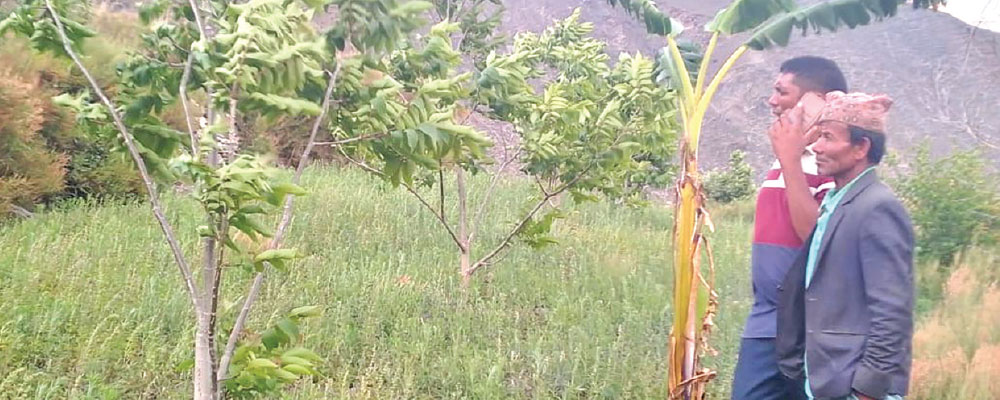

By Sher Bahadur Sharki, Bajura, May 30: Farmers in the eastern parts of Bajura district have recently shown growing interest in soft-shell walnut farming.
The increasing attraction towards walnut cultivation comes after soft-shell walnut saplings distributed for trial purposes by various governmental and non-governmental organisations showed promising growth and production potential.
Datta BK, a resident of Budhinanda Municipality Ward No. 7, said an organisation had distributed a few soft-shell walnut saplings in the village for testing purposes a few years ago. “It has been two to three years since we planted the saplings and now the trees have grown well and started bearing fruit,” he said.
“People here were not very aware that soft-shell walnuts could grow in this area. Many farmers planted a few saplings for testing, and now the trees are growing very well,” he added.
BK said farmers have started seeing walnut farming as a reliable source of income after witnessing the strong possibility of successful production in the area.
Residents of Himalayan, Jagannath, Swamikartik Khapar and Budhinanda local levels have also become increasingly interested in walnut farming in recent years. Farmers say the land in these areas is highly suitable for walnut cultivation.
Local hard-shell walnut varieties have traditionally grown well in the region, including in nearby forests. However, soft-shell walnut cultivation had not previously been tested in the district, and people knew little about it.
Walnut trees are large and strong, with an average lifespan of around 200 years. A mature walnut tree can produce between 100 and 200 kilograms of walnuts annually.
Farmers said the soft-shell variety is considered superior because its outer shell is softer and can easily be cracked open by hand or even with teeth.
According to agricultural experts, walnut farming in Nepal is suitable at altitudes ranging from 900 to 3,500 metres above sea level. Since walnut trees grow large, saplings should be planted at intervals of around seven metres, with 10 to 15 plants fitting within one ropani of land.
The trees usually begin producing fruit within five to six years. Walnuts are considered highly nutritious and are believed to help reduce the risk of cancer, improve heart health, strengthen the body, aid weight loss, and boost brain function.
With global demand for walnuts increasing rapidly, farmers in Bajura have also started taking greater interest in commercial walnut farming. At present, walnuts are sold in local markets at prices ranging from Rs. 600 to Rs. 1,500 per kilogram.
Jasiram Sahani, chief of the Agriculture Knowledge Centre, Bajura, said walnuts can be stored for a long time without spoiling and walnut trees survive for many years, making them a sustainable long-term source of income for future generations.
As a result, interest in walnut farming among local farmers has been steadily increasing, he added.