- Saturday, 30 May 2026

Green economy, forest industries in priority
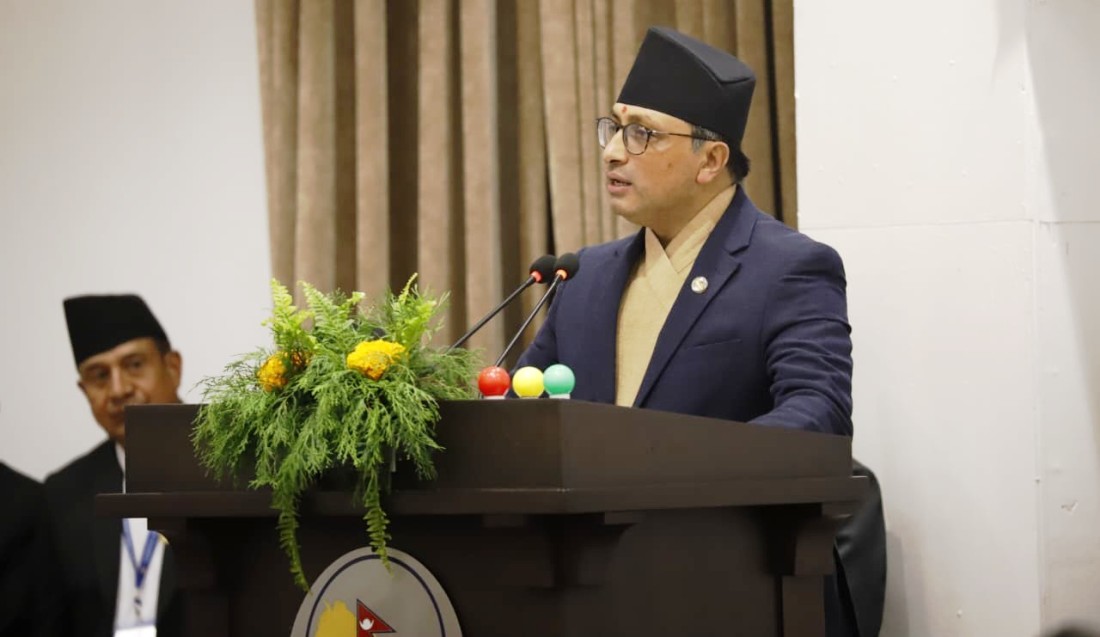

By A Staff Reporter, Kathmandu, May 30: The government has allocated Rs. 12.31 billion for the forest, environment and climate sector for the upcoming fiscal year 2026/27.
Unveiling the budget, Minister for Finance Dr. Swarnim Wagle, said that forests and natural resources will be transformed from being limited to conservation into a foundation for green industrialisation, job creation and import substitution.
The government will promote sustainable timber production, forest-based industries, processing of herbs and non-timber forest products, and green enterprises.
According to Minister Dr. Wagle, to improve the competitiveness of domestic timber industries, the sale price of raw timber collected during development and construction works will be reviewed. “The permit system related to the felling, collection, transportation and sale of forest products will be converted into a fully digital single-window system to reduce procedural hassles.”
Community forest user groups will be granted greater autonomy in production, processing, branding and enterprise operation. Inconsistencies among laws and policies related to forests, environment, industry, energy and infrastructure will also be removed. The economic valuation of forest carbon stock, ecosystem services and natural capital will be incorporated into the budget and planning system, he said.
The government has allocated Rs. 1 billion for activities such as conservation of water sources, pond construction, landslide control and embankment building to sustain the water cycle in the Chure and Tarai-Madhes region. The government will also begin fixing support prices and purchasing herbs and non-timber forest products, while a herbal processing centre will be established in Karnali, Minsiter Dr. Wagle said.
A results-based REDD+ programme will be implemented for emission reduction by prioritising local communities in the benefits received from carbon emission reductions. The private sector will also be provided access to concessional financing from international climate funds. To control forest fires, drones and satellites will be used for real-time information exchange. Human-wildlife coexistence programmes will be launched in high-risk areas. Air pollution monitoring centres and the central environmental laboratory in major cities will also be upgraded.
Tourism
Under the tourism, large-scale infrastructure development will be carried out at the historical sites of Tilaurakot, Devdaha, Kapilvastu and Ramgram. Rs. 830 million has been allocated for the Greater Lumbini Development Programme. Janakpur will be developed and branded as a wedding destination, while funds have been allocated to upgrade the Ram-Janaki Path and Ram-Janaki Parikrama Road.
Infrastructure development will be prioritised to promote hill stations in touristically important hilly regions. Reliable arrangements will be made for the safety and emergency rescue of mountaineers and trekkers. A special project will also be launched to conserve at least two dozen historical Buddhist monasteries over 200 years old in high Himalayan districts including Mustang and Manang.
The Great Himalayan Trail and other trekking routes will be developed as strategic trekking trails. The government will also develop the high-hill eco-tourism trail, known as the Danphe Route, linking Khaptad, Ramaroshan, Badimalika, Budhinanda, Rara, Swargadwari and Muktinath. Trekking routes including Api Himal, Dordi Himal, Sikles-Kahupuche-Manang and Tinjure-Pathibhara will also be developed, he said.
As a pilot project for cycle trails in the mid-hills of Gandaki Province, the Kaski Lipeni-Thumsikot-Bhachok-Lamtari route and the Byas-Chhabdi Barahi-Bandipur-Chhimkeshwari-Labdi-Devghat route will be constructed.
The museum in Kirtipur will also be expanded to preserve the culture of indigenous nationalities. Model homestays targeting dense Dalit settlements in Madhes, Karnali and Sudurpashchim will be introduced to promote traditional Dalit skills, arts and occupations, Minister Dr. Wagle said.
Mountains above 6,000 metres that have not yet been named will be given indigenous names and specially marketed for mountaineering.
Start-up and innovation
Under start-up and innovation, the government will establish the Nepal Enterprise Facility as a platform to integrate start-ups and small and medium enterprises into the national enterprise ecosystem. The platform will support enterprise-related policies, innovative financial instruments, incubation support networks and domestic enterprise campaigns in an integrated manner.
According to Minister Dr. Wagle, start-up support will be provided to 1,000 young entrepreneurs interested in agricultural and livestock-based enterprises. Funds have also been allocated for research, innovation and entrepreneurship enhancement programmes to provide young scientists with opportunities for research within the country.
Funds have also been allocated to establish an observatory centre at Everest Base Camp to promote astronomical tourism. The government has allocated Rs. 4 billion for science, technology and innovation, and Rs. 500 million for the Nepal Enterprise Facility.