- Saturday, 30 May 2026

Policy on anvil to resolve issue of landless squatters for good
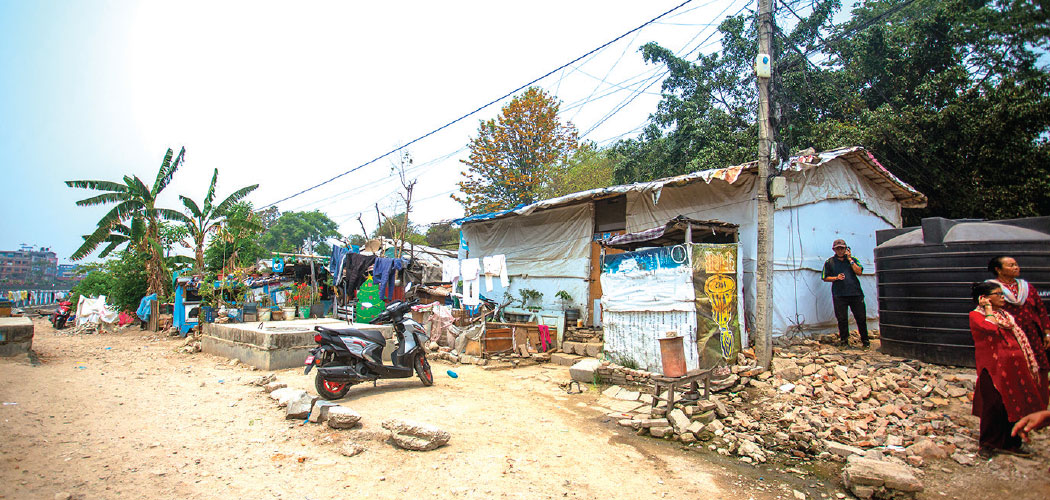

Kathmandu, May 10: The government has intensified its nationwide campaign to reclaim encroached government and public land, issuing directives to local governments across the country to prevent encroachment and remove unlawful settlements.
As part of the campaign, the Ministry of Federal Affairs and General Administration recently issued a circular to all local levels, directing them to protect public land, maintain digital records and prevent new encroachments.
The Ministry of Home Affairs has also issued directives to all District Administration Offices, stating that local governments must take the lead in identifying squatters and preparing management plans, and must provide prior notice to local communities before carrying out evacuation drives.
The first phase of the campaign to clear high-risk government and public land along the Bagmati River and its tributaries in the Kathmandu Valley has been completed.
The Ministry of Urban Development, in collaboration with several government agencies, including local bodies, has launched evacuation drives from April 25, targeting settlements located along riverbanks, road corridors and other public spaces.
Evacuation campaign in Kathmandu
During the first phase of the operation, authorities evacuated unlawful settlements in Thapathali, Gairigaun, Manohara, Kalopul, Balkhu, Banshighat, Sankhamul, Kalimati, Balaju, Swoyambhu, Gaushala, Dhobikhola, Tenzing Chowk, Krishnamandir, Kapan and Sattale areas.
According to the data provided by the Prime Minister Secretariat, a total of 2,687 huts and houses have so far been removed from settlements built along the Bagmati and its tributaries in Kathmandu, citing that they are vulnerable to annual inundation. Of the demolished structures, 890 were concrete building while remaining 1,797 were makeshift huts.
Authorities said many of the settlements were located in flood-prone and environmentally sensitive areas so clearing such areas is essential not only for legal compliance but also for public safety.
Supreme Court order to halt demolition drive
The Supreme Court (SC) has issued an interim order directing the government not to evict the squatter settlements forcibly and hold demolition of squatter settlements using bulldozers.
A joint bench of Justice Kumar Regmi and Nityananda Pandey issued an interim order on Friday, while hearing a write petition filed against the government’s move to use dozers in squatters’ settlement.
In its order, SC stated that forcibly displacing squatters and unmanaged settlers from their current residence without following proper legal procedures for rehabilitation and relocation could result in irreparable harm and a possible humanitarian crisis.
Over 2,600 families seek rehabilitation assistance
As of Thursday, 2,616 families had come into contact with government authorities seeking to be identified as landless and eligible for rehabilitation support following the eviction drives.
According to Uddhav Nepal of High Powered Committee for Integrated Development of Bagmati Civilization (HPCIDBC), a total of 11,001 individuals from the displaced families have approached authorities seeking rehabilitation assistance. Among them over 3,133 were children.
Around 1,000 individuals have been sheltered in the holding centres provided by the government, including Manav Sewa Ashram, Inchhangunarayan, Radhaswami Satsang in Kirtipur, Nepal Electricity Authority (NEA) Training Center, Kharipati, Agricultural Development Bank Limited (ADBL) Central Training Institute located in Bode, Bhaktapur, National Water Supply and Sanitation Research, Innovation and Capacity Development Centre, Nagarkot and in Nepal Red Cross Society Office, Banepa.
According to the Ministry of Urban Development, pre-screening conducted prior to the evictions found that many families living in these settlements already owned land or houses elsewhere. It also revealed that some locals were paying rent to individuals who had constructed makeshift shelters in the settlements.
Fears of displaced families
Around 15,361 people who had been living along the riverbanks of the Kathmandu Valley have been left homeless by the government’s eviction drive.
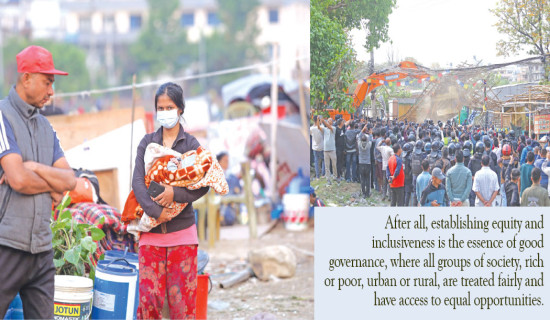
While some families have been forced to rent costly accommodation and others have moved in with relatives, over 350 families, left without options, are currently taking shelters in holding centres.
Those staying in the holding centres say they are living in uncertainty though the government has ensured food and security.
Many displaced said they have been cut off from the daily wage labour work on which they depended for survival and remain unsure about the government’s long-term rehabilitation plans. The students are concerned about how they will continue their education.
Sita (name withheld upon request), a 64-year-old woman from Thapathali settlement, who is currently staying at the Radhaswami Ashram in Kritipur, said she has to travel daily from Kritipur to Thapathali in search of work.
She said her five-member family is deeply worried about where the government will relocate them in the future. “We are facing difficulty continuing our work. As daily wage earners, it will be hard for us to survive if the government relocates us to a place where there are no employment opportunities.”
Sita, the sole breadwinner of her family, said both her husband and son are ill, while her two grandsons are still young and studying.
She also expressed fears about the safety of those staying in temporary shelters, saying many displaced families are anxious that they could again face flooding as the shelter has been set up near the Bagmati riverbank.
With concerns growing over a possible humanitarian crisis among displaced families, rights activists and campaigners have started raising their voices more strongly. They have urged the government to ensure proper rehabilitation, employment access and education for affected children.
The Amnesty International has also warned that such evictions risk making already marginalised communities, including Dalit women, children and the elderly, homeless.
However, the government authority claimed that it has been giving special attention to humanitarian aspects in this process and is providing temporary accommodation for displaced families through holding centres.
According to the Ministry of Urban Development, arrangements for temporary housing are being made in areas such as Ichangunarayan.
The ministry has stated that it is making sure that children’s education and parents’ employment are not adversely affected during the relocation process.
Urban Ministry drafting policy to manage squatters
To manage squatters living in an unorganised manner along various riverbanks and public lands in the Kathmandu Valley, the Ministry of Urban Development is preparing a new policy aimed at the long-term resolution of issues related to landless people, squatters, and unmanaged settlements.
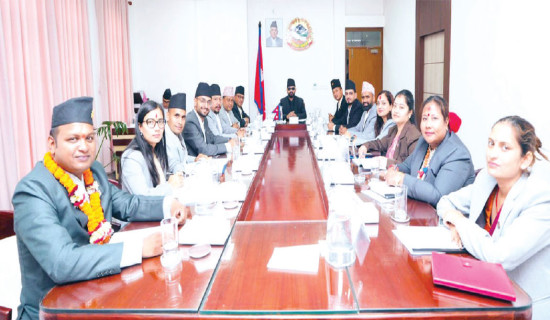
A committee formed under the Urban Development Ministry, led by the ministry’s secretary, is drafting the policy.
According to Joint Secretary Dilip Bhattarai, the committee led by Secretary Gopal Prasad Sigdel is working on the policy for a sustainable solution to the problems of landless, squatters, and unmanaged settlers, in coordination with various government agencies. The policy is being prepared for submission to the Council of Ministers for approval.
Likewise, the government has already prepared a detailed 11-point action plan to address settlements encroaching riverbanks, public spaces, and both government and private land in the Kathmandu Valley. A seven-member committee has also been formed under the Urban Development Minister to implement decisions related to resolving the squatter problem.
Protests against eviction
The ongoing demolition of squatter settlements in Kathmandu Valley has triggered protests by landless squatters and unmanaged settlers across the country. Fearing similar eviction, squatters have taken to the streets in several districts of all the provinces in recent days. The federal government’s directive to district administration offices to collect records of encroached land and settlements has further fuelled the agitation.
On Friday, members of the Joint Squatters Front Nepal staged a protest at Maitighar Mandala, Kathmadu, by clanging plates with spoon, creating loud noise to draw attention of the authority to their demands.
Likewise, landless squatters and unplanned settlers have staged protest in Dhanusha, Birgunj, Surkhet, Rupandehi, Dang, Jhapa, and Pokhara, alleging that settlements are being cleared without providing alternatives.
Problem persists despite multiple commissions and land distribution efforts
Since 1990, some 22 commissions and committees have been formed to address the issues of landlessness. A total of 1,203,519 applications have been registered with the former Land Problem Resolution Commission from across the country, according to official records.
Among them, 98,100 applications were submitted by landless Dalit squatters, while 179,104 applications were filed by other landless households seeking land ownership certificates and nearly 9,26,315 applications fall under the category of unorganised or informal settlers.
According to data from the Land Management Ministry, around 30,800 hectares of land have been distributed to approximately 150,000 families by various commissions over the past three decades.
Yet the issues persist amid frequent government changes and weak implementation of related laws. The practice of dissolving the old commission and forming a new one after every change of government is common in Nepal. It is often seen as a way to appoint party workers in new bodies.
Due to this, landless families were left in the lurch, forcing them to settle wherever space is available, even the place which lacks basic infrastructures.
Recently the government abolished the Land Problem Settlement Commission through an ordinance introduced to amend some Nepal Acts. The government has removed the provisions for such permanent commission and is instead deciding to work through committees or task forces.
Minister for Cooperatives and Poverty Alleviation Pratibha Rawal has assured that an expert committee will be formed to help resolve long-standing land-related problems. Speaking at a parliamentary committee meeting under the Agriculture, Cooperatives and Natural Resources Committee of the House of Representatives on Friday, Minister Rawal said disputes in the Land Dispute Resolution Commission have persisted due to excessive political interference.
She stressed that such issues should be handled by experts and pledged the formation of an expert committee to address them.
Govt plans digital census of squatters, linking them with sate support
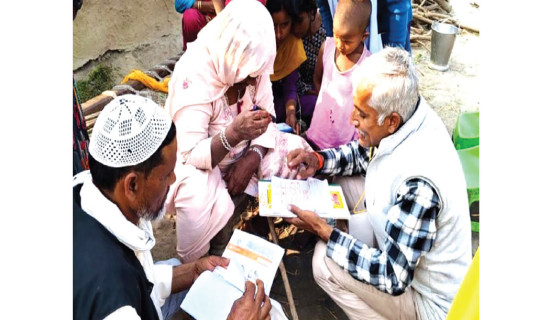
The government has announced an integrated digital data collection programme for addressing issues faced by landless squatters and unmanaged settlers.
According to the Prime Minister’s Secretariat, the initiative led by the Office of the Prime Minister and Council of Ministers will create a unified digital database of landless people in the Kathmandu Valley, with a plan to gradually expand it to other districts.
The system will not only collect personal and family details but also link beneficiaries to employment, entrepreneurship and social security programmes. It will include information on health conditions, income sources, education and skill to support targeted government assistance.
Officials said the data collection will be carried out in phases, starting with squatters inside and outside holding centres in Kathmandu.
Applications will be categorised based on available identity documents and those without identification will be assisted in obtaining National Identity Cards through a special help desk. The digital system will also include biometric data and photographs, which will be verified with other government records. Each registered family will receive a digital identity card and arrangement will be made to open bank accounts for direct transfer of government support.
With the completion of the first phase, the government has set out its next strategy. The government will only proceed with clearing other public and government lands across Kathmandu Valley and other parts of the country after identifying genuine squatters and ensuring their dignified resettlement, said Dipa Dahal, press and research adviser to Prime Minister. “The government’s main objective is to guarantee safe housing for genuine landless people and squatters while also protecting public property. The Prime Minister has a clear vision on this matter,” she added.
The Secretariat stated that the vision and action plan of Prime Minister Balendra Shah on this sensitive issue are “very clear, just, and people-centric.”
The Prime Minister also reaffirmed that the government is fully committed to ensuring safe, dignified, and permanent housing for every landless citizen, and that no one will be left homeless.
He said that safe relocation would be arranged for those living in high-risk and unsafe areas, while the problems of other landless citizens would be addressed based on recommendations from the relevant commission and collected data.



-square-thumb.jpg)


-original-thumb.jpg)