- Saturday, 6 June 2026

Former secretaries applaud time-bound reform plan
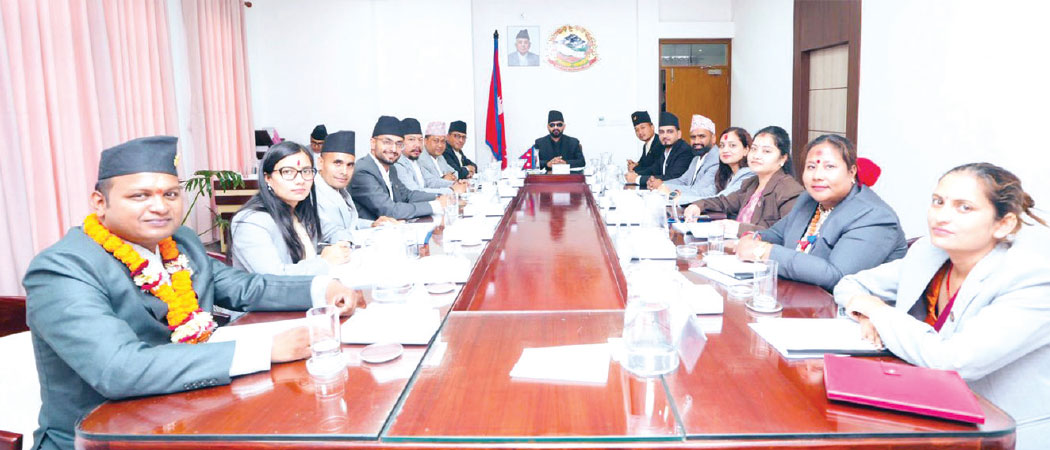

Kathmandu, April . 1: The first Cabinet meeting of the new government, led by Balendra Shah, has unveiled a 100-point governance reform plan.
The roadmap has been developed in line with the election manifesto of the Rastriya Swatantra Party and is to be implemented within government’s first 100 days in office to reform sectors like agriculture, industry, education, health, taxation, investment, above all, governance.
This has sparked a significant shift in public sentiment, with people expressing renewed hope and satisfaction with the government’s move after decades of deep frustration.
Many former government officials have also expressed their hope that the 100-point reform plan will address the longstanding problem in bureaucracy.
Talking to The Rising Nepal, Kashi Raj Dahal, former chairman of the Administrative Court, who also led the Federal Administrative Restructuring Committee, shared that political parties that participated in the elections are expected to have their implementable commitments addressed within these policies and programmes.
“Another important provision is that all offices and institutions are required to identify 10 priority tasks within seven days and begin implementation accordingly," he said.
According to him, corruption control and administrative reform are key components, while reducing the number of ministries, dissolving unnecessary committees and institutions, and introducing a one-door service delivery system constitute main priorities.
Additionally, laws related to civil service reform are to be introduced within 45 days, including provisions for performance evaluation and career progression. “A significant reform proposed is the removal of trade unions from sectors such as e public administration, schools, and universities, to ensure neutrality and professionalism,” he said.
“One of the strongest aspects of this plan is the clear timeline, some tasks are set for completion within 10, 20, or 30 days; others within 60, 90, or 100 days,” he highlighted. Stating that clear assignment of accountability and responsibility is another positive aspect, he said that the plan also directly addresses past distortions and aims to establish good governance and prosperity.
Former government secretary Purushottam Ojha shared that the roadmap is promising, with clear commitments, timelines, and accountability. However, it must move beyond paper into real implementation. Stating that it covers various sectors along with shared, cross-cutting priorities, he said, “One positive aspect is that it is time-bound, it clearly outlines what needs to be done and by when. Some tasks are set for completion within a month, others within three months. In that sense, it is well articulated.”
Khemraj Nepal, former government secretary, said from a general overview, the plan appears very good indeed and quite impressive in many respects.
However, these former bureaucrats also highlighted the challenges that may hinder its implementation. They shared this roadmap must be implemented with strong political commitment, administrative professionalism, and cooperation from all stakeholders.
Nepal said many of the targeted work plans need to be established through legislation. “When we talk about administration, even the Civil Service Act has not yet been enacted. Only after that is in place can things properly move forward,” said Nepal.
However, some progress can also be demonstrated through immediate action. For example, there was news report that chief administrative officers have now been deployed to local governments where those positions were previously vacant.
That is a very positive step, he added. The process typically begins with personnel, then resources, and then laws and regulations, after that, implementation can truly take off, he added.
According to Dahal while this serves as a roadmap and vision document, translating it into practice requires strong political will.
“Decisions must be implemented with integrity, free from pressure, influence, or any bias. There must be no protection for wrongdoing,” he added.
He further highlighted the important role of the bureaucracy in its implementation. “Currently, employee morale is low, and professionalism must be strengthened. Civil servants need clear incentives and motivation to implement policies effectively, as they are the ones responsible for execution,” he added.
Highlighting that Nepal has a history of political non-cooperation, where opposition parties often undermine the government, he said this culture must change. Political parties should support good initiatives and oppose only what is harmful.
Ojha said implementing the roadmap will require considerable effort. It is not impossible, but it cannot be achieved by the political leadership alone. The bureaucracy and administrative machinery must also actively cooperate and take responsibility.”
“Many components involve research and analysis, which require data collection, understanding, and evaluation. Naturally, this takes time, so a higher level of commitment and hard work will be necessary,” he added.
Dahal highlighted five key elements necessary for its success. They are: the Parliament must fast-track essential legislation, the government must ensure effective monitoring and daily oversight, the judiciary must remain independent and uphold constitutional and legal principles, civil society and media must act as watchdogs and citizens must remain aware, engaged, and hold the government accountable.
Nepal said there are serious budget constraints. “One of the challenges for the government is preparing the budget. This is because many unfinished commitments from the past must now be addressed. So far, much of the discussion has focused on infrastructure projects, but the situation is broader than that.”
As mentioned, therefore, the upcoming budget, which must be presented in Parliament by the end of May, will be crucial. “Once the programmes and priorities are clearly outlined in that budget, we will be in a better position to form a more informed opinion," Nepal said.



-original-thumb.jpg)