- Friday, 29 May 2026

Government Poised To Settle Landless Squatters
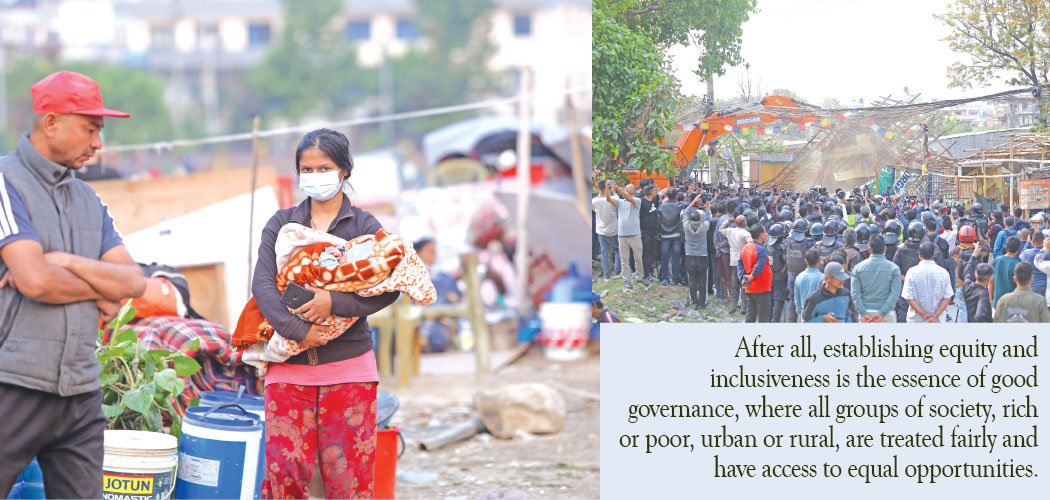

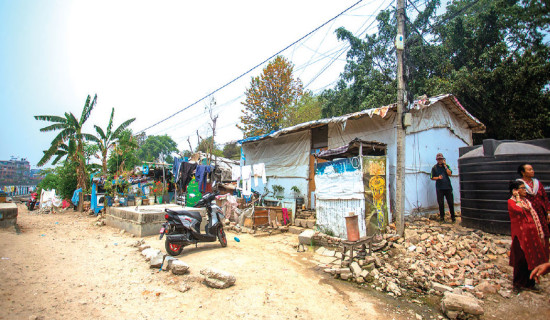
As part of its agenda to solve the problems of landless and homeless people permanently, the government has stepped up efforts to reclaim public land and remove the unlawful settlements throughout the nation. Since April 25, it has initiated a drive to evacuate and demolish the settlement along the riverbanks of the Bagmati River and its tributaries within the Kathmandu Valley, citing that they are vulnerable to annual inundation.
Authorities have already cleared settlements in Thapathali, Gairgaun, Sankhamul, Shantinagar, Gothatar, Buddhachowk, Manohara Tole, Teku Balkhu, Kalimati, Kapan, and Balaju, among other areas. The government states that measures are necessary to reduce disaster risk and restore order in urban management. As of May 4, a total of 2,202 landless squatters of the valley have approached the government, seeking rehabilitation. The campaign aligns with the government’s “100-point governance reform agenda", which includes provisions for protecting public land, maintaining digital records and strictly preventing new encroachments. The problem of landlessness has remained severe for decades as a result of the incompetence, failure and possibly even the bad intentions of the past governments.
Unlawful settlements
In recent years, unlawful settlers and landless squatters have expanded along river corridors and public spaces throughout the country, often in vulnerable areas prone to floods and environmental hazards. Those influential individuals, who are close to the political parties, have built big houses and even makeshift shelters on the public land and are found collecting rents from their tenants.
In the past, the major political parties at times treated landless people as vote banks. They repeatedly made false promises of relocating them and providing land ownership certificates. Yet, when these voters needed them most, those parties were nowhere to be seen. Since 1990, nearly a dozen commissions and committees have been formed to address the issues of landlessness. Yet the issues persist amid frequent government changes and weak implementation of related laws. Due to this, landless families were left in the lurch, forcing them to settle wherever space is available, even the place which lacks basic infrastructures.
According to data from the Land Management Ministry, around 30,800 hectares of land have been distributed to approximately 150,000 families by various commissions over the past three decades. However, tens of thousands of families across the country still remain landless. Monsoon flooding along the riverside settlements, including those of the valley, is a perennial crisis, causing loss of life, damaging property and spreading waterborne disease. Clearing such areas is essential not only for legal compliance but also for public safety.
However, the recent eviction drives of the government have also brought attention to gaps in preparedness and humanitarian arrangements. While the intention of enforcing the law has been widely acknowledged, the questions remain over the measures taken to ensure the dignified relocation of the affected families. The government has faced backlash for its eviction process, citing that the drive was initiated without a proper relocation plan. In the first place, the government should distinguish between the land mafias and genuine landless people or economically vulnerable settlers.
The renovation of apartments, which were built a decade ago by the government led by Baburam Bhattarai to resettle displaced families, only began after the evictions were initiated. Shelter has been arranged for displaced individuals who are unable to make their own accommodation arrangements, and the government has assured the provision of healthcare services and humanitarian assistance.
But there are no adequately prepared holding centres for the displaced families. The government had assured that the belongings of those families would be safely transported and stored. However, displaced dwellers have claimed that many of their possessions were left exposed and even soaked in the rain. Women, children and other vulnerable groups have been hit hardest, and the approaching monsoon is likely to worsen their plight.
Human rights groups have also criticised the eviction process as deeply distressing, citing short notices, large-scale demolitions and humanitarian concerns.
There were several disturbing videos circulating on social media and various news portals, showing helpless and vulnerable groups such as children, elderly people, persons with disabilities, pregnant women, and women in the postnatal period, who were crying with fear and urging the state authority to spare their houses. Some claimed that all their belongings were buried inside their demolished houses. Thousands of riverbank dwellers were displaced, often on very short notice, sometimes as little as 24 hours.
The government authority deployed a large number of security forces to carry out demolitions, further intensifying fear and uncertainty among already poverty-stricken communities. In many cases, vulnerable groups are left in harsh temporary conditions, with overcrowded shelters and insufficient basic services.
For the past ten days, displaced families have been staying in the holding centres set up in various parts of the valley, while some have been accommodated in lodges. Without screening the genuine landless and rehabilitating those who were evicted earlier, the authority continued to clear the other unplanned settlements. Many displaced families have expressed their concern that there was uncertainty about the alternative options following the eviction. The fear among the vulnerable groups has taken a toll on their mental health. The psychological impact on vulnerable groups, such as children and pregnant women, was even deeper. The human rights groups have also warned that such evictions risk making already marginalised communities, including Dalit women, children and the elderly, homeless.
Effective approach
A more effective approach should have been adopted in the process. The government should have undertaken systematic data collection and verification of genuine squatters. Based on this, it could have structured resettlement plans, including land allocation and temporary holding arrangements, before initiating evictions. Even a phased approach might have helped avoid the current humanitarian concerns.
It is understandable that the government, led by Prime Minister Balendra Shah, is poised to fix the mess of the past. The powerful government, composed of young and enthusiastic ministers, carries high public expectations, as citizens are eager for quick results. However, while pursuing its zeal to act swiftly and deliver quick results, the government shouldn’t refrain from its commitment to addressing the longstanding issue of landless squatters through a planned, humane and time-bound process.
The state is bound by constitutional obligation, due process and human rights standards in dealing with even those settlers occupying public land illegally. The government must give reasonable time and notice to unplanned settlers to relocate while ensuring their dignity. After all, establishing equity and inclusiveness is the essence of good governance, where all groups of society, rich or poor, urban or rural, are treated fairly and have access to equal opportunities.
(The author is a journalist at The Rising Nepal.)



-original-thumb.jpg)